@SamuraiTakedown@_stevenhl Could always do an LP position with btc/usd on an AMM dex and farm rewards/earn fees. It can take away a lot of the stress of having to be a good trader.
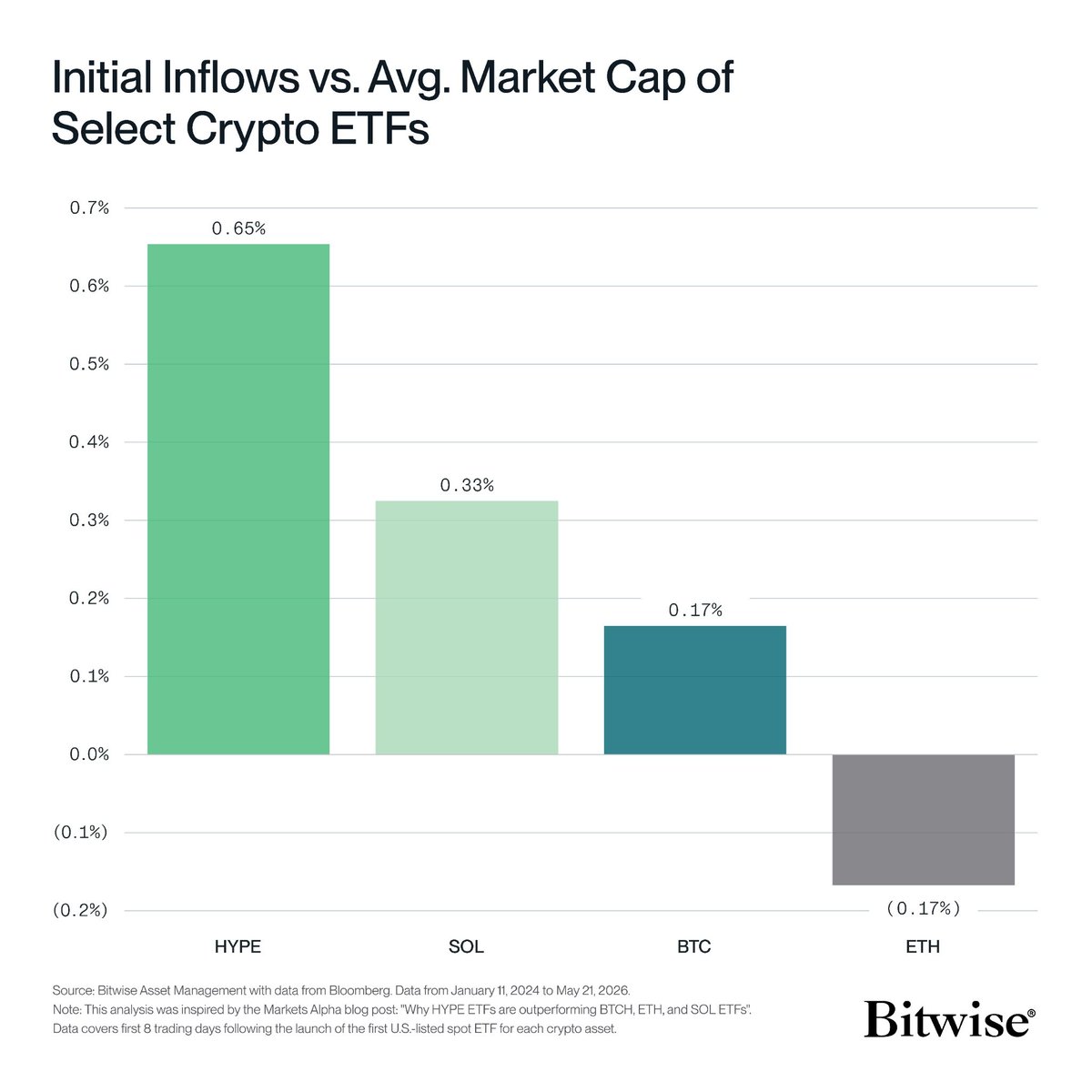
HYPE outside of BTC has largely the most attractive Institutional appeal:
> Bringing 24/7 performant settlement through HyperCore orderbooks
> Becoming a global venue for traditional asset price discovery via HIP-3
> Can be traditionally valued based on protocol revenue unlike their L1 counterparts
> Built by an 11 person team and uses 99% of protocol revenue for purchasing back HYPE from the open market unlike any other company on Earth
The Institutional demand is real and the flood gates have been opened.
"Hyperliquid should be valued as a global super-app. Its addressable universe is not the $3 trillion crypto market, but the $600 trillion market for global assets."
Give a listen to the latest Weekly CIO Memo from @Matt_Hougan:
"For much of the past decade, many of crypto’s innovative projects wore a costume: tokens that didn’t accrue value. Foundations that didn’t own anything. Builders that danced around the SEC. The Atkins-era SEC has put an end to the masquerade: Projects can now look like the decentralized business operations they actually are.
Hyperliquid is the first big project that took the permission and ran with it. The product covers every asset class. The tokens capture real value. The revenue is real and the buyback is mechanical...it’s an early, credible look at what crypto becomes when it’s allowed to grow up."
- @Matt_Hougan, "Hyperliquid Is What You Get When Crypto Is Allowed To Grow Up"
Everyone is arguing about $USDH dying. They're missing the point entirely. What happened today is the single most important business move in Hyperliquid's history.
Let me explain. Revenue, liquidity, politics, lobby, and what it means for the USDH vote debate.
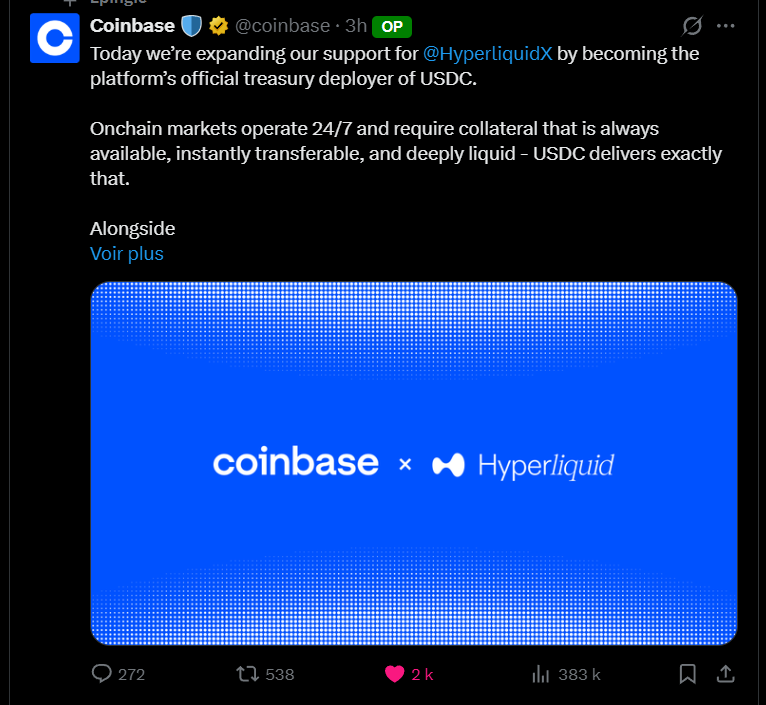
Coinbase is now the official treasury deployer of $USDC on Hyperliquid under AQAv2. Circle handles the technical side (CCTP, cross-chain infra). Both are staking hyperliquid:native. Native Markets agreed to sell the USDH brand assets to Coinbase.
$USDH is sunsetting. But the mechanics it pioneered are not. They just got applied to a $4.7B asset instead of a $100M one.
Let's break down why this is a win on every single front.
LIQUIDITY
The biggest complaint from traders and builders for months: fragmentation. $USDH had the alignment but not the liquidity. $USDC had the liquidity but not the alignment. You had to choose.
That choice is gone. One stablecoin. One orderbook per pair. No split liquidity. No confusion for HIP-3 deployers picking a quote asset. No friction for new users bridging in.
$4.7B in USDC on Hyperliquid, 2x year over year. That is the base generating yield now, not $100M.
REVENUE
Under AQAv2, the treasury deployer shares 90% of the reserve yield revenue with the protocol. Run the numbers on the current $USDC supply:
$4.7B at 3.8% interest rate, 90% shared with the Assistance Fund = $160M+ per year flowing directly into HYPE buybacks. That is $440K per day. Every day.
For context, USDH at peak supply was generating a fraction of this on $100M. The AQA model worked. It just needed to be applied at the right scale.
POLITICS AND LOBBYING
This is the angle most people are sleeping on. Coinbase is the largest publicly traded crypto company in the US. They spent over $100M on crypto lobbying and political action in the last cycle. They are the single most powerful voice for crypto regulation in Washington.
The CLARITY Act markup is happening today. Coinbase has been one of its strongest advocates. Having them financially aligned with Hyperliquid, staking HYPE, operating as treasury deployer, is not just a liquidity play. It is a regulatory shield.
Every conversation about "is Hyperliquid a US regulatory risk" just got a lot harder to make when Coinbase is literally staked into the network.
Circle staking 500K HYPE and moving toward becoming a validator. Jeremy Allaire posting "Hyperliquid." That is institutional endorsement at the highest level.
THE USDH QUESTION
"Was USDH a failure?" "Was the vote theater?" "Did Native Markets just flip an asset?"
No. USDH was a weapon. It was a credible threat that proved a protocol can demand yield sharing from stablecoin issuers. Before USDH, Hyperliquid had $5B+ in USDC generating $150-200M/year for Circle and Coinbase. The protocol saw none of it.
USDH launched. The AQA model proved that yield can be redirected onchain, transparently, back to the protocol. It only reached $100M in supply but that was never the point. The point was forcing incumbents to the table.
Basit said it best: the entire lifecycle of USDH from launch to sunset should be studied. Coinbase didn't come to Hyperliquid out of goodwill. They came because USDH proved they would lose the venue if they didn't align.
"But Paxos offered better economics during the vote." Maybe on paper. But 95-100% of a stablecoin that might have also struggled to reach $100M in supply is still less revenue than 90% of $4.7B. The vote was never about picking the best yield split on a small asset. It was about creating the leverage to capture yield on the dominant one.
WHAT THIS MEANS FOR BUILDERS
USDC becomes the canonical quote asset for HIP-4 outcome markets. No more guessing which stablecoin to build around. Hyper Foundation is issuing grants to HIP-3 and HIP-1 deployers who integrated USDH to cover migration costs. Feeless conversions from USDH to USDC during the transition.
For HIP-3 deployers running equity perps, commodity perps, outcome markets: one liquidity pool, one collateral asset, deeper books.
SECOND ORDER EFFECTS
Coinbase operating perps through Hyperliquid via builder codes? Not confirmed, but now structurally possible. Their existing perp product is weak. Hyperliquid's infrastructure is the best in crypto. The incentive alignment is there.
Tether now has a clear path to compete. AQAv2 is an open spec. Any stablecoin issuer can stake 500K HYPE and share yield to become an aligned quote asset. Competition is good.
AQAv2 becomes a blueprint for every other chain. Hyperliquid just proved that a protocol can force the largest stablecoin issuers in crypto to share revenue at the protocol level. No one has done this before.
Hyperliquid.
HIP-1 trading fees burn $HYPE
HyperEVM gas fees burn $HYPE
Spot deployment gas burns $HYPE
HIP-3 deployment gas burns $HYPE
On-chain gossip data priority now burns $HYPE.
Soon order-priority rate will burn $HYPE.
Soon HIP-4 deployments & trading will burn $HYPE.
There is not enough $HYPE.
Hyperliquid.
This is the story of Hyperliquid, the most profitable startup per employee on earth, told from a guarded office in Singapore.
Last year, its team of 11 generated $900 million in profit. It's 3 years old, has never taken a dollar of venture capital, and is beginning to change how century-old markets work.
Its founder, Jeffrey Yan (@chameleon_jeff), had never taken a physics class when he picked up a textbook at 16. Two years later, he won gold at the International Physics Olympiad. In 2019, he started trading with $10,000 from a living room in Puerto Rico—working off a television because he didn't own a monitor.
Within 3 years, he was running one of the largest anonymous crypto trading firms.
Then he shut it down. Yan was rich and free, but he had spent years inside crypto, watching it betray itself. Bitcoin's central premise was decentralization. Yet the biggest exchanges were centralized. Crypto kept reintroducing the dependence on trust it was built to eliminate. He set out to create what should have existed.
Hyperliquid is a blockchain with a trading exchange on top, and anyone can build on it. Yan's vision is to house all of finance. In 3 years, it has done over $4 trillion in volume. And in the past few months, it has begun to outgrow crypto.
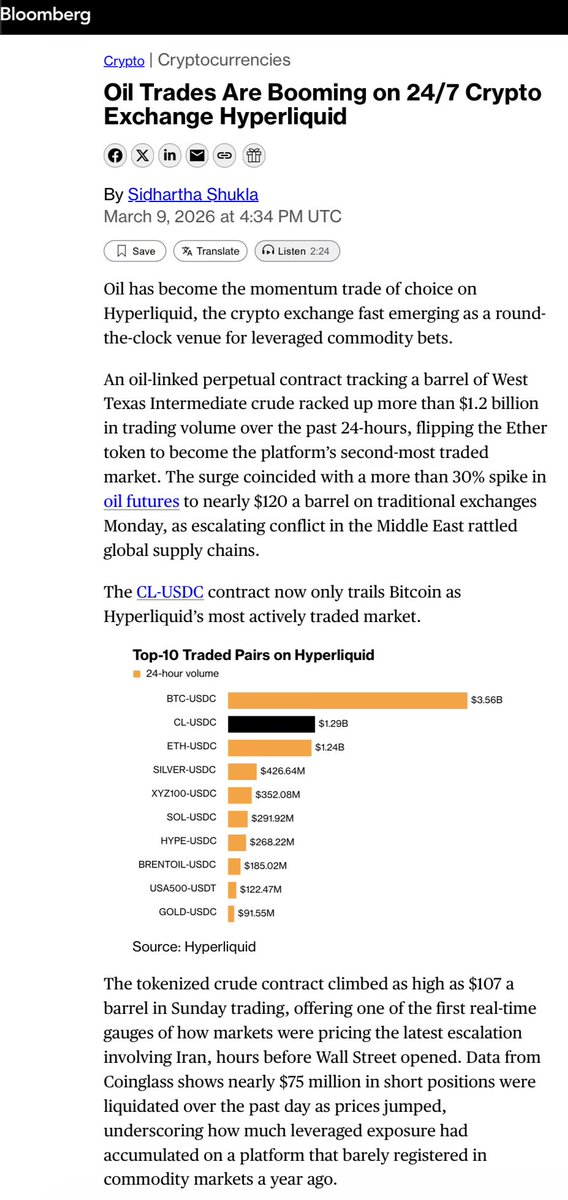
Markets for oil, silver, and the S&P 500 now trade on Hyperliquid around the clock, weekends included, and are growing roughly 40% week on week. When the US and Israel bombed Iran on a Saturday in February, Hyperliquid was the venue traders turned to.
Hyperliquid's success has cost Yan his freedom. He works out of a secret office in Singapore and cannot travel without two bodyguards. Even the team's housekeeper doesn't know what they do.
In January, @domcooke spent a week at their office. Read his profile on Yan and @HyperliquidX below.
A thread on why *insert incumbent broker / exchange will not be able to start innovating like prime steve jobs and outcompete Hyperliquid.
The Incompatability Problem:
Huge congratulations to TradeXYZ and S&P for this historic partnership. I'm honored that these teams choose to build on Hyperliquid.
Seeing official S&P500 perpetual futures launch exclusively on Hyperliquid is a validation of everyone's past years of hard work: global access to decentralized finance, perpetual futures as 24/7 price discovery, and Hyperliquid upgrading the existing financial stack to house all of finance.
The S&P500 is synonymous with "the market," a single number that captures the essence of the largest economy in the world. Looking forward to tracking the world's most important financial gauge 24/7 on the most liquid permissionless markets.
S&P Dow Jones Indices and trade[XYZ] have joined forces to launch the first official S&P 500 perpetual contract, available exclusively on Hyperliquid.
For 69 years, the S&P 500 has been a defining reference point for global finance. Until now, access to that benchmark has been shaped by market hours, intermediaries, and geography. Today, that changes.
The S&P 500 perp is now available 24/7/365, anchored by the official index data required for deep liquidity and institutional confidence at scale.
SPDJI helped define modern indexing. They are stewards of an iconic benchmark, the standard against which portfolios across the globe are measured. We are honored to bring that legacy on-chain.
Trade[XYZ] is bringing the world's most iconic assets towards a future of global, continuous markets — a future powered by Hyperliquid.
Perps eating global financial markets is the highest conviction thesis I’ve had in my 4 years since starting Syncracy.
If we’re right, the sector could produce $350B+ in value over the next 5 years, with the winning chain becoming one of the largest platforms in global finance.
As shared in our OG Hyperliquid thesis released over a year ago, we believe $HYPE is the fastest horse in this race.
While many skeptics view platforms like Hyperliquid as products of regulatory arbitrage, over time we believe they will come to be understood as a fundamental transformation of the global trading stack.
What was once a fragmented world of brokers, exchanges, clearinghouses, among other intermediaries, is giving way to integrated trading systems that are continuously margined, atomically settled, globally accessible, and permissionless to build on.
The case isn’t just theoretical as early signs of disruption are already visible in the data. In the early months of perps’ “real world asset” expansion they’re already impacting global financial markets — most recently functioning as a price discovery engine on weekends for oil during the Iran conflict.
We believe this is only the beginning and that perps will absorb an increasing share of leveraged directional trading that today lives in retail options, CFDs, and fixed-tenor futures. Even low single-digit penetration of these markets could produce dramatic outcomes for the sector.
In parallel, it remains under-appreciated how quickly DEXs like Hyperliquid have emerged as leaders in equity and commodity perps.
Should DEXs continue scaling these markets, it will accelerate their share gains from the likes of Binance and Coinbase while also positioning them to challenge legacy derivatives venues such as CME, who will struggle to compete due to regulatory and architectural incompatibilities.
Finally, as decentralized venues lead the growth of perps, we believe they will also expand into adjacent categories.
Perps are the hardest product to nail on blockchains and once a blockchain can successfully host perps it naturally starts to aggregate other crypto use cases as a byproduct.
We are already seeing early evidence of this with Hyperliquid’s expansion into spot trading and stablecoins, and soon prediction markets and options. It’s in this sense that perpetual DEXs are also Trojan horses for the financial platform of the future.
——
Enjoyed writing this one with @defi_monk who was the first sell-side analyst to cover Hyperliquid in summer 2024 and among the leading thinkers on the sector.
Hope you all enjoy what is a very detailed and data-driven piece that was a long time in the making.
Bloomberg can’t stop writing about the house of all finance!
“For an industry grappling with subdued token prices, the rise of oil trading on Hyperliquid offers a tangible demonstration of crypto infrastructure’s broader utility, independent of Bitcoin’s swings.”
It took a year for the Senate to confirm a new CFTC Chairman, but it was worth the wait.
@ChairmanSelig announced today that the CFTC is working on new regulations for perpetual derivatives and onchain markets.
You heard right. DeFi perps are coming to the USA.
Hyperliquid 🇺🇸
Hyperliquid is not a crypto company but a finance company using crypto rails to facilitate 24/7 markets.
Every day that passes by, more people start to realize the value that HL brings, which produces articles like this from Bloomberg.
https://t.co/4erq9d9l7G
Hyperliquid is quietly assembling the crypto Avengers.
• Bob Diamond (@rediamondjr ) - former CEO of Barclays → leading @HypeStrat (HYPE DAT)
• Christopher Giancarlo (@giancarloMKTS) - former Chairman of the CFTC → Legal Advisor to Hyperliquid Labs
• Jake Chervinsky (@jchervinsky) - former Chief Legal Officer at Variant → CEO of @HyperliquidPC
The Hyperliquid team is executing with regulatory foresight and a clear grasp of what it takes to build a blockchain capable of housing real financial infrastructure, with a focus on durable value creation and broader access.
It’s rare to see visionary founders who truly walk the talk. I'm proud to support builders committed to creating lasting, positive impact.
Hyperliquid.
E159: @Hyperliquidx: Housing all of Finance
@chameleon_jeff came back on the When Shift Happens Podcast to talk about the Hyperliquid journey since the TGE and what the future holds for one of the most loved and prolific protocols in the space
Hyperliquid
Timestamps
0:00 Intro
2:01 Singapore
2:27 Reminiscing on the Token Launch
5:00 Was This Scale Of Wealth Expected?
6:28 Doing The Right Thing In Crypto
9:07 The Responsibility that comes with Billions of $
11:10 @JupiterExchange@KASTxyz
11:51 Bringing Hyperliquid to the masses
15:21 Pre TGE and Post TGE: Operational difference
20:13 Choices on what to build Internally vs Externally
22:05 How to build a reliable team
24:51 Did the Team celebrate the HYPE wealth Generation event?
26:45 How to test talents for High Integrity
28:31 How much does the Hyperliquid team sleep?
30:05 Employee Vesting Fears
31:41 Dealing with FUD
32:28 How Does Jeff Personally Handle FUD
35:02 Token "Buybacks" critics
37:20 Why Hyperliquid can't have Discretionary "Buybacks"
39:04 HyperEVM, explained Simply
40:00 @paradex@zodl_app
40:41 HyperEVM: Success so Far?
44:05 HIP-3, explained Simply
47:44 What makes Hyperliquid's approach different
48:19 Why Should People Care?
51:33 Bring All Finance On Chain
52:08 Why Is The Hyperliquid Approach Better?
53:47 Key Numbers showing that Hyperliquid Is Doing it right
59:01 What Has the @unitxyz team demonstrated with spot trading on Hyperliquid in 2025
1:03:29 HIP-4: Outcome Markets
1:08:01 @Trezor@bitwise@SuiNetwork
1:08:58 What does "Housing All Of Finance" mean?
1:10:51 Why Hyperliquid is not a crypto company
1:12:23 Why Does Hyperliquid have A Stablecoin USDH (@nativemarkets)
1:14:39 What Is @Kinetiq_xyz & Why Does It Matter?
1:16:15 Why Is What @Hyperlendx Is Building Important For HyperLiquid
1:23:39 Where did Fairness cost the most?
1:24:47 What should Hyperliquid be Remembered for?
1:25:24 Why should people stay in Crypto when there's an AI brain drain?
1:28:10 Closing Thoughts