@FilBarbera Si rilegga, laicamemente parlando, in maniera attenta. Così, spero, potrà rendersi conto che quanto sostiene ha senso solo nel caso in cui il libero scambio funziona o in quello in cui non è un'ideologia.
Il paradosso italiano: piena occupazione, produttività ferma
Disoccupazione ai minimi storici. Occupati al record. Eppure la produttività italiana è ferma da trent'anni.
Come è possibile? Non è un paradosso. È aritmetica.
Partiamo dai principi primi
Produttività = valore aggiunto prodotto / ore lavorate.
È una frazione. Può calare per due vie: il numeratore scende, o il denominatore sale più del numeratore. In Italia succedono entrambe le cose, contemporaneamente.
Canale 1: il numeratore viene compresso dalla concorrenza globale
Il valore aggiunto non è una quantità fisica: è prezzo × volume, meno i costi intermedi. Se un'azienda italiana produce lo stesso identico bene di dieci anni fa, con la stessa efficienza tecnica, ma è costretta ad abbassare i prezzi per competere con Cina, Est Europa o Sud-Est asiatico, il suo valore aggiunto cala. E con lui la produttività misurata — senza che nessuno abbia lavorato peggio.
Puoi diventare tecnicamente più efficiente e statisticamente meno produttivo allo stesso tempo. Se non controlli il pricing power, non controlli la produttività.
Canale 2:Il denominatore cresce nei posti sbagliati
L'occupazione italiana cresce. Ma dove? Turismo, ristorazione, servizi alla persona, logistica di ultimo miglio. Settori a basso valore aggiunto per ora lavorata, strutturalmente: un cameriere non può servire 10x più tavoli, un rider non può consegnare 10x più pacchi.
Intanto le ore si spostano via da manifattura avanzata, chimica, farmaceutica, software — i settori dove un'ora di lavoro genera 3-5 volte più valore aggiunto.
Ogni persona che passa da un lavoro ad alto valore aggiunto a uno a basso valore aggiunto fa scendere la media nazionale. Anche se lavora di più. Anche se lavora bene. La composizione batte l'impegno.
La bassa disoccupazione non è la prova che l'economia va bene. È la prova che stiamo saturando le ore lavorate in attività che il mercato globale paga poco. Stiamo massimizzando il denominatore mentre il numeratore è sotto attacco.
Un Paese può essere pienamente occupato e collettivamente più povero, ora dopo ora.
E allora cosa muove davvero la produttività?
Tre cose, e tre soltanto:
1. Pricing power: prodotti che il mondo non può replicare facilmente: brevetti, marchi, complessità tecnologica. Chi compete solo sul costo ha già perso.
2. Capitale per addetto: macchine, software, automazione, AI. La produttività non si predica: si compra e si installa.
3. *Riallocazione: spostare persone e capitale verso i settori ad alto valore aggiunto, non proteggere quelli a basso valore aggiunto.
Nessuna di queste tre leve si attiva chiedendo alle persone di "lavorare di più". Le ore sono il denominatore. Il problema dell'Italia è il numeratore.
"Aria pulita, strade più sicure e un clima stabile sono tra le ragioni per cui medici ed esperti ambientali desiderano meno auto sulle nostre strade", questo l'attacco dell'articolo che riflette una visione largamente maggioritaria e che merita qualche nota di commento.🧵
🚨BREAKING: The workers losing their jobs to AI are not the ones who use AI.
Stanford's 2026 AI Index confirms it. Unemployment is rising faster among workers least exposed to AI than workers most exposed.
The threat was never having a job AI can do. It is having a job AI cannot reach.
For two years the entire conversation has been built on one assumption. AI takes the high-exposure jobs first. The lawyers. The analysts. The programmers. Every layoff headline reinforced the same story. Stanford just inverted it.
The Stanford Institute for Human-Centered AI tracked unemployment changes across occupations sorted by AI exposure. They expected to find workers most exposed to AI losing jobs faster than workers least exposed. They found the opposite. Workers in low-exposure occupations are losing jobs faster than workers in high-exposure ones.
The mechanism makes sense once you see it. Companies are not firing AI-exposed workers and replacing them with AI. They are using AI to make those workers more productive. Then they cut elsewhere. The cuts come from departments where AI is not yet a tool. The AI-exposed workers are not the casualties. They are the leverage that justifies cuts everywhere else.
The numbers make this concrete. Software developers aged 22 to 25 saw employment fall nearly 20% from 2022 to 2025. But experienced developers in the same field grew their headcount. The cuts within tech are concentrated in entry level. The cuts outside tech are concentrated in jobs where AI never arrived.
The pattern is consistent across every dataset Stanford pulled from. The marketing team using AI gets to keep its 12 people. The procurement team that is not using AI loses 4 of its 10. The accounting team using AI gets to keep its workflow. The facilities team that is not using AI absorbs the layoff. The savings have to come from somewhere. Stanford documented exactly where.
McKinsey's 2025 executive survey confirmed where the next round is heading. A third of organizations expect AI to shrink their workforce in the next year. The cuts they named were not in the high-exposure categories. They were in service operations and supply chain. Departments that have to absorb the cost savings the AI-exposed teams are generating elsewhere.
The detail most coverage missed: productivity gains from AI are not appearing in tasks requiring more judgment. The 14% gain in customer service and 26% gain in software development are real. In tasks requiring legal reasoning, financial judgment, or strategic decision-making, productivity gains are weak or negative. The work AI is actually doing is concentrated in narrow task categories. The work AI is supposed to do, that justifies the layoffs, is not showing measurable productivity at all.
If you spent the last two years assuming your job was safe because AI could not do it, the Stanford 2026 AI Index just confirmed your job is exactly where the cuts are landing.
Source: Stanford Institute for Human-Centered AI, 2026 AI Index Report
PDF: https://t.co/O5zXh2oXsQ
Per rispondere ad alcuni critici.
—-
Marx definì la sua dottrina "Socialismo Scientifico", ma i suoi seguaci la gestiscono come un dogma religioso. Mentre nella scienza un esperimento fallito porta all'abbandono della teoria, nel marxismo il fallimento storico (carestie, dittature, bancarotte) viene sempre attribuito a "cattive esecuzioni" o "traditori", mai alla teoria stessa.
In breve: se dopo 150 anni una "cura" uccide ogni paziente, il problema non è che i medici non l'hanno capita, ma che la medicina è tossica e incompatibile con la natura umana.
Dire che chi critica Marx "non lo ha letto" è il rifugio retorico di chi non sa rispondere nel merito.
Il fallimento del marxismo non dipende dalla mancata comprensione dei testi, ma dalla loro insostenibilità reale, dimostrata da tre pilastri del pensiero moderno:
• Il fallimento politico (Mazzini, 1847): Con vent'anni d'anticipo su Il Capitale, Mazzini profetizzò che il comunismo avrebbe trasformato i leader in "padroni di schiavi". Capì che accentrare il potere economico e politico nelle stesse mani non libera l'uomo, ma lo rende un ingranaggio statale. La storia del Novecento non è stata una "deviazione", ma la conferma letterale della sua analisi sulla tirannia burocratica.
• L’impossibilità economica (Mises/Hayek): La Scuola Austriaca ha dimostrato che il socialismo è tecnicamente impossibile. Senza proprietà privata e prezzi di mercato, non esiste il calcolo economico: il pianificatore centrale non ha segnali per sapere cosa produrre e come allocare le risorse. Questo "navigare alla cieca" genera inevitabilmente scarsità e carestie. Il mercato non è un capriccio, è un sistema di informazioni disperso che Marx non ha mai compreso.
• Il crollo teorico (Marginalismo): La teoria del valore-lavoro di Marx è morta nel 1871. Il valore non è dato dal sudore o dalle ore impiegate (visione oggettiva), ma dall'utilità che i consumatori attribuiscono a un bene (visione soggettiva). Se produci un oggetto che nessuno vuole, il suo valore è zero, indipendentemente dal lavoro accumulato. Questo errore di base rende l'intera impalcatura del plusvalore un castello di carte.
Conclusione: Marx è stato un osservatore delle sofferenze della rivoluzione industriale, ma un pessimo architetto sociale. Difenderlo oggi è rifiuto dei fatti: l'economia lo ha smentito nella teoria (Mises), la filosofia lo ha smentito nella morale (Mazzini) e la storia lo ha ridicolizzato nella pratica.
Risultato:
Se lo Stato è l'unico che possiede il pane, l'unico che scrive le leggi e l'unico che comanda la polizia, il cittadino non è più un "proletario liberato", ma un suddito totale.
@AndreaRoventini@RobertoBurioni Il che sfata un secondo mito. Se c'è una cosa che l'Italia dovrebbe imparare dagli USA è esattamente che all'aumentare della spesa pubblica in sanità non corrisponde un miglioramento in termini di salute della popolazione:
il problema è la qualità, non la quantità.
Possibile che nessuno veda l’enorme *costo opportunità* di fare un referendum costituzionale su una questione di rilevanza forse di 3 ordine, rispetto a NON impiegare risorse e capitale politico in una VERA riforma della giustizia?
Quella sì vitale per l’economia.
Repetita iuvant
"I conduttori di talk show hanno una grande, grandissima responsabilità nella degenerazione della politica. Quasi tutti commettono i quattro delitti del cattivo conduttore: invitare persone impreparate, inflazionare le trasmissioni di colleghi giornalisti, aizzare i contendenti, consentire che ci si parli sopra. E, in alcuni casi, il delitto n.5: interrompere aggressivamente chi non la pensa come il conduttore".
(Luca Ricolfi)
Mi permetto di aggiungere il delitto n.6: essere spesso impreparati.
There has never been a rules-based international order. What is new is admitting it.
The American arrest of Venezuela’s dictator Nicolás Maduro (and his wife), accompanied by the use of military force, has understandably prompted many in Europe to lament what they see as a breach of the rules-based international order.
The purpose of the following reflections is to place this assumption in perspective.
If we confine ourselves to the permanent members of the UN Security Council, only the United Kingdom and France can be said to respect - more or less consistently - what Europeans refer to as “the rules-based international order.”
Russia is waging war in Ukraine in blatant violation of international law. China’s conduct in the South China Sea has no place within the framework of international law. And neither does the American arrest of Maduro.
In other words, the majority of the permanent members of the Security Council have - diplomatically speaking - a relaxed relationship with the UN Charter and other fundamental components of the rules-based international order.
That the United States, Russia, and China adhere to the principles of the rules-based international order only until they no longer do so is nothing new.
The difference lies rather in how such violations are justified. The United States continues to legitimize its actions in a normative language of human rights, responsibility, and international order - even when the arguments are thin. Russia and China, by contrast, increasingly refer openly to spheres of influence, historical entitlement, and civilizational particularities.
Russia - and before it the Soviet Union - has a long history of invading countries within its sphere of interest that failed to fall into line. China has been a member of the WTO for 25 years without ever genuinely respecting the organization’s rules. The United States, for its part, has carried out a substantial number of military operations without a UN mandate since the Second World War.
The question, therefore, is not when these three countries abandoned respect for the international order. The question is rather whether they ever truly embraced it in anything other than a rhetorical sense.
Upon closer reflection, one is compelled to conclude that “the rules-based international order” is, to a large extent, a normative phantom—one to which small and medium-sized European states have shown a particular fondness for rhetorical devotion. Much like their principal cooperative institution: the EU.
This is not to say that norms are without significance. Rules do matter—but they operate asymmetrically. They discipline the weak far more effectively than they constrain the strong.
In principle, I see nothing wrong with toasts to principles that are difficult to live up to on a daily basis.
The point of a toast is to install an ideal: a conception most people recognize and respect. If successful, this has two advantages.
First, it provides a norm to which one can appeal when it is violated. Even if one does not tell the full truth at all times, the norm of truthfulness is a good thing. It offers a starting point for legitimate criticism when a specific person, in a specific situation, is not being truthful. And that is useful.
Second, norms can, in fortunate cases, induce shame in those who violate them—and public shaming when they are caught in flagrante. No society can function without such mechanisms of control and self-control.
Seen in this light, there is of course nothing wrong with European countries - and the EU as a whole - professing their commitment to the rules-based international order.
The problem arises when Europeans genuinely and in all seriousness believe that the world is in fact governed by rules, and that violations are consistently called out and sanctioned.
Why? Fundamentally because this has little to do with reality. Because it is an illusion—and permanent illusions are dangerous.
What ultimately governs the course of world affairs is power. Toasts to the rules-based international order cannot and should not obscure that fact.
Great powers comply with rules as long as it is in their interest to do so. The moment that interest disappears, so does compliance. Small and medium-sized states can only hope that the great powers will continue to play by the rules. For if they do not—what then? Nothing. In practice, the rules become void, and the law of the strong prevails.
For this reason, the real problem with the American arrest of Maduro is not that international law has once again been set aside. Historically speaking, that is nothing new.
What is new is that Europeans still pretend to be surprised.
That great powers recognize the “rules-based international order” only when it suits them is therefore not new. What is new is merely that they are increasingly no longer bothering to conceal it.
Sex also existed before the liberalization of pornography. What was new was not that people suddenly began doing things they had never done before. What was new was that they no longer felt ashamed of it - and allowed it to become common knowledge that this is how the world actually works.
In this sense, the new international reality more closely resembles the liberalization of pornography than the emergence of wholly new and epoch-making activities in bedrooms around the world.
In a world where strong powers act openly on the basis of interest and power, weaker actors must either build real power, align themselves with power - or accept their irrelevance. Appeals to unenforced rules change nothing. Protests without sanctioning capacity change nothing. Moral outrage without material means changes nothing.
For Europe, this means that the question is no longer whether the rules-based international order has been violated. That question is irrelevant. The only relevant question is which instruments of power Europe possesses - military, economic, and strategic - and whether there is political will to use them.
If not, Europe will continue to speak the language of norms in a world that has moved on to the language of power. Elegant - but without effect.
Quanti non comprendono che ns coinvolgimento in Ucraina mira a tutela del sistema delle democrazie europee, oltre che alla difesa del diritto internazionale, e credono di essere intelligenti nel dire: gnegne,adesso allora armiamo il Venezuela, sono, tecnicamente, degli imbecilli.
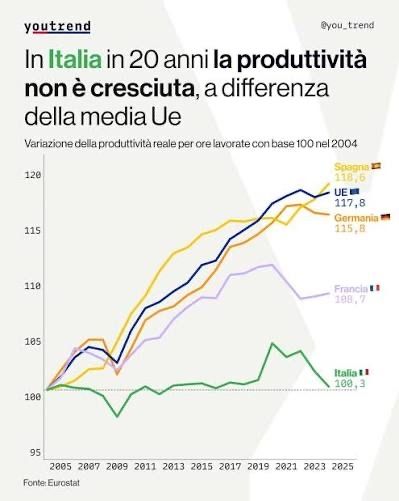
Nell’Unione europea la produttività reale per ore lavorate è aumentata del 18% tra 2004 e 2024, ma quella italiana è rimasta ferma. In realtà è scesa sotto quella del 2004 nei primi anni, poi è rimasta sostanzialmente stabile per otto anni e poi era cresciuta tra 2019 e 2020, ma negli ultimi due anni ha avuto un brusco calo.
La Francia ha registrato nel complesso un aumento del 9%, la Germania del 16% e la Spagna del 19%. La produttività spagnola è cresciuta molto tra 2008 e 2017, poi dopo un periodo di stagnazione ha avuto una forte accelerazione negli ultimi quattro anni, permettendole di superare la Germania.
@MathGuyTFL −∞ approaching from the left and +∞ approaching from the right. So I would say the answer is c if, abusing notation, with "∞" we mean infinity without a defined sign. In a standard context the limit doesn't exist.