Regional account: Sugar Land-Fort Bend Co-Houston-Texas. Native Houstonian. Grew up in shadow of Greenway Plaza, lived in Webster & now Sugar Land. Main: @aeroG
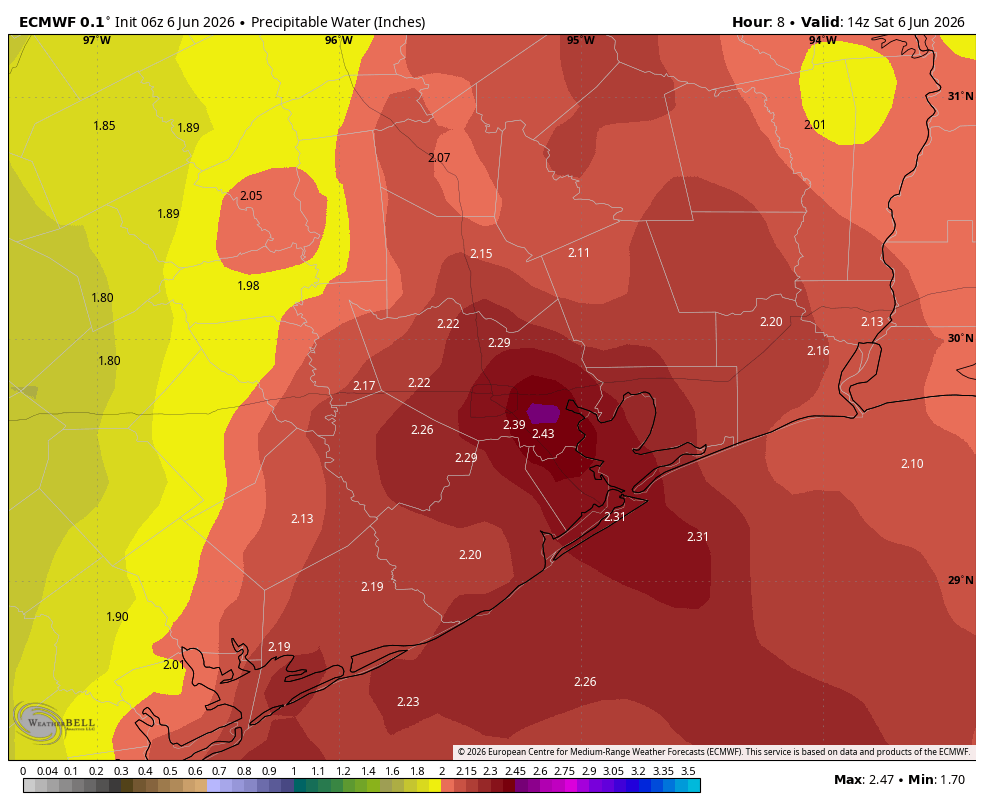
Due to wet soils and the potential for slow moving storms, we are instituting a Stage 1 flood alert for the Houston region through Saturday evening. Please be weather aware and mindful of the potential for high water on roads: https://t.co/8IyRjrx7xa
I’m verrrrry used to people meeting me in Houston sort of like, soooooo I hear it’s terrible here, but we’re only going to stay 2 years for John’s career.
https://t.co/R7Oh1typ7w
It's interesting how much you know, sometimes without even realizing it, when you grow up in a family business. My dad was a small-time Houston real estate investor, rental property and land was just something we heard about every day. We couldn't have an outing anywhere on a Saturday without stopping by to check on something.
Now, walking or driving around Texas, I can't help seeing all sorts of things, and noticing growth, wherever it is (lots of places nowadays).
We are well past the point where the last tankers of pre-war exports have reached their destination. So, everyone's just been burning through stocks, and at some point, in either June or early July, we're going to basically reach minimum operating inventory levels for half the world, if not more.
Prices go through the roof because there isn't enough throughput. It's not that people have cut refinery runs for the most part. It's the simple fact that we're running out of feedstock. And when that happens, you get this lovely thing called demand destruction, where prices rise to a point that some parts of the economy, some people in some parts of the world can't afford the crude-derived products at all.
When that happens, their demand is destroyed until prices fall back into line. The last time the world experienced this scale of disruption wasn't the oil crises in the 70s or 80s. It was World War II when everything got sunk. So, historically unprecedented is the term. And keep in mind that with deglobalization, some large-scale version of this would happen regardless.
#iranwar #crudeoil #geopolitics
The Zvezda service module transfer tunnel, known as PrK, has suffered from cracks and leaks for some time, and has been mitigated by Roscosmos as much as possible to date. The cracks have always been a concern that NASA watches very closely. NASA and Roscosmos have been working to determine the root cause of the cracks, and Roscosmos manages the issue through operational mitigation measures and periodic partial-repair efforts. Following new leaks, Roscosmos has elected to proceed with a more extensive repair operation on Friday, June 5. Out of an abundance of caution, NASA has directed all four of the agency's SpaceX Crew-12 members and NASA astronaut Chris Williams to assume an elevated safety posture in the Dragon spacecraft while the repair is underway. We continue to work with our Russian counterparts, along with the rest of the international community that supports the space station, to arrive at a more permanent resolution.
Showers and storms will continue to pester much of the Houston area today and tomorrow, but we will gradually see declining coverage by Sunday and Monday. @mattlanza has details on that and a subtle change next week that will make it more summerlike: https://t.co/EgtPJBz6sN
It may not look like your city, but Houston’s inner loop is a properly dense urban core.
The interesting part is that unlike any “real city” in the US, all of the new density has been built in the last 20 years and is actually affordable.
In the 1950s and 60's, screwworm was devastating in Texas, costing billions ( adjusted for inflation) annually. In 1935, 180K livestock were lost to the fly. 50% of deer fawns died, and the fly decimated deer populations. We have to get on top of this urgently.
So, I've worked in the beef industry. I have a fairly detailed knowledge of beef markets, the supply chain, parasites and parasiticides, etc. Suffice it to say, this is a nightmare scenario, but one we've known was coming since at least 2022.
New World Screwworm was eradicated from North and Central America in the mid-90's. The US gov't (APHIS) funded a program of screwworm drops, where they bred sterile males so that extant populations couldn't reproduce and move northwards. But in 2022 NWS jumped the Darien gap and started moving northwards once again. It's most likely that they came undetected on livestock brought alongside migrants fleeing political instability in South and Central America. Elon Musk/DOGE, of course, cut several monitoring programs that would have detected this exact scenario. The screwworm drops are still funded, but the monitoring programs are what have been cut - a stupid move if there ever was one.
A serious Central/South America policy would have worked hand-in-hand with CA/SA governments to help contain this, but we've never had a serious policy towards South America, not during the Biden years, and especially not under Trump. The USDA broke ground on a sterile screwworm facility in Texas... last month. I worry it's too little, too late.
Screwworm is so dangerous because, unlike other fly larvae, they lay eggs and feed on living flesh. So something like a small scratch (or even bug bite) can quickly becomes infested, and the larvae will burrow into the flesh, growing the wound and attracting more screwworm. They don't only parasitize cattle, but will also feed on wildlife, domestic pets, even humans. Since they have detected screwworms in domesticated cattle right now, it's likely that there is a wild reservoir as well. We can quarantine herds and pets, but we can't quarantine deer and armadillos. They will move, and so will the NWS.
Under normal circumstances, cattle are moved around - a lot. Calves will be sent to stockers through their adolescence, then shipped to feedlots for finishing. A lot of calving operations (like 70%) are small, and small-time producers don't always catch parasite infestations. Cattle moved in-state don't require a certificate of veterinary inspection, so it's easy for an infested animal to be moved without being noticed. Animals crossing state lines do need a CVI, but Texas has such an enormous cattle population (something like 13 million head) that as goes Texas, so goes the nation.
Fortunately, we have a lot of drugs that treat NWS. The FDA has issued several emergency use authorizations in the last year or so. But every input raises the price of beef, and treatment only makes a difference if producers catch an infestation early. If an infestation spreads unnoticed on a large feedlot, it can hit hard, both in terms of cattle that have to be killed, and treatments that then have to be deployed. Producers will spend days at a time running cattle through the chute, inspecting them and applying parasiticides. It costs a lot of money, which is then passed on to the consumer.
What does that mean for you? Beef is a commodity, and just because there's no NWS up here in Illinois doesn't mean that prices won't skyrocket - and they will skyrocket. US herd size is already at record lows, and this will result in culls. Consumer prices also run 18-24 months behind, which means that shocks to the supply chain now are still going to be felt by consumers in 2028.
It's hard to say if our government will be able to muster an effective response - though I don't trust our current administration, which can't even throw a 250th anniversary party, to be able to deal with an ecological issue of this magnitude. It doesn't help that our current USDA secretary is a lawyer and think-tank creature. I don't much trust the state government of Texas either. The industry has also taken the workforce of large animal veterinarians for granted - a monopoly/market power issue that I just can't get in to here.
For me, it comes back to our federal government having an incoherent policy on Central and South America. We knew what was coming, we know what's going to happen, but we cut the program meant to prevent this scenario. Instead of taking those countries seriously as partners, the government has been stupid and domineering.
Here's the kicker: this is what the industry voted for. They might scream, they might get bailed out, but all that means is that you, the consumer, are going to be paying more for beef, plus whatever bailout gets shoveled their way. Until the industry accepts that they are part of a larger system; that they cannot eternally privatize the gains and publicize the losses of beef production; that they need to consider sustainability and stewardship in the management of their operations, this is only going to keep happening. Eventually, they may find that there is very little goodwill for them among the public, and people will decide that a Brazilian ribeye tastes just as good as one from Texas.
Shoot for the stars, land on the Moon, start your career today! We're hiring passionate individuals to help us launch, land and orbit in space. Check out what positions are available here: https://t.co/545w6hFHwj
Axiom’s Jonathan Cirtain said last week that the majority of new capital raised goes to space station development versus spacesuits.
"We've invested a lot in the spacesuit already. We still have some engineering work to do, so we do spend a little bit of money on the spacesuit."
"A couple million is the monthly-ish add to R&D on the suit. The bulk of the equity is going to the space station."