Someone hid a self-replicating worm inside 37 npm packages.
Written in Rust.
Hidden behind an eBPF kernel rootkit.
Talking to its operator over Tor.
It steals 86 environment variables.
AWS keys. GCP keys. Vault secrets. Kubernetes tokens.
Your Anthropic API key. Your OpenAI key.
Your Exodus wallet seed phrase.
Then it uses your own npm credentials to republish itself into your packages.
So your code infects the next developer.
Who infects the next one.
The commits were backdated up to 13 years.
The commit author name was “claude.”
The malware named itself after the AI to hide in plain sight.
The attacker also left their own wallet recovery phrase in the debug data.
Nobody is having a good day.
Check your preinstall hooks.
"Bitcoin isn't backed by anything."
Let me stop you right there.
Bitcoin is backed by energy. Real energy. Kilowatts. Heat. Physics.
The kind of backing you can't print, fake, or vote into existence at an emergency Fed meeting.
Every block mined is a thermodynamic proof of work. Not a promise. Not a policy. Proof.
The issuance schedule has never been amended by a committee. Not once. Not ever. Because there is no committee.
There's just math. Cold, indifferent, and immune to political theater.
The network is secured by more raw computing power than anything humanity has ever built. Hundreds of exahashes per second standing guard. Every single day.
Now let's talk about what is backed by nothing.
The dollar.
It's is backed by confidence. Specifically, confidence in the institution that printed $6 trillion in two years while telling you 3% inflation was healthy and you should be grateful for the soft landing.
In the same people who can't pass an audit.
Who fund wars with a credit card.
Who promise solvency while sitting on $39 trillion in debt and accelerating.
"Backed by nothing" isn't an attack on Bitcoin.
It's a confession about the dollar.
Follow if you're serious about building wealth they can't print away.
For 19 years, GPS satellites have secretly broadcast a “numbers station” in their public signals. We decoded 12M messages: a 2011 flash where 31 of 32 satellites flipped in hours, “ghost” substrings repeating years apart, and a “TEXT” prefix spreading now. https://t.co/xz3svmqiDa
A LINUX KERNEL DEVELOPER PROVED THE THING YOU PUSH CODE TO IS SECRETLY A DATABASE THAT CAN VERSION ALMOST ANYTHING AND THAT MOST DEVS HAVE ONLY EVER TOUCHED A TENTH OF IT
42 minutes from Josh Triplett -- a longtime Linux kernel and Debian developer -- showing that Git is a general-purpose, tamper-evident versioning engine that just happens to be famous for code.
-> The moment it clicks, Git stops being "Where my code lives" and becomes what it really is underneath: a content-addressable store that can version almost anything -- your configs, your notes, your servers' state, entire datasets.
People run whole wikis on it. They version their entire machine's configuration with it. They ship websites by pushing to it. They track data too big to email. None of it is a hack -- it's the same handful of objects you already use for code, pointed somewhere new.
Treating Git as a code-only tool was never the ceiling -> it's a versioning engine for anything, and the people who see that automate what the rest of the team still does by hand. And as AI agents start spitting out not just code but configs, docs and data, the one system that can version and audit all of it at once is already sitting on your machine.
You learned five commands to survive. This is the talk that shows you were standing on top of a database the whole time.
It changes what you think the tool is even for.
Bookmark & Watch it today ↓
Andrej Karpathy just explained the future of software engineering without directly saying it.
The best AI engineers are no longer “prompting.”
They’re building systems around the agents.
Karpathy’s biggest insight wasn’t:
“Claude can code.”
It was:
LLMs become dramatically better when you force them into disciplined workflows.
That’s why "CLAUDE.md" files are suddenly everywhere.
Not because they’re prompts.
Because they behave like an operating system for the agent.
Karpathy called out the exact problems with AI coding:
- models assume instead of asking
- they overengineer simple tasks
- they hide confusion
- they rewrite unrelated code
- they optimize for completion, not correctness
So developers started encoding rules directly into the workflow:
→ Think before coding
→ Simplicity first
→ Surgical edits only
→ Goal-driven execution
And the results are wild.
People are now running multiple Claude Code agents in parallel like engineering teams:
• one agent researching
• one debugging
• one writing tests
• one optimizing code
• one validating outputs
Not “AI assistance.”
Actual orchestration.
And this part from Karpathy changes everything:
“Don’t tell the model what to do. Give it success criteria and let it loop.”
That is the shift.
From:
“write this function”
To:
“here’s the goal, constraints, tests, and verification system — now iterate until correct.”
The craziest part?
This already feels like a phase shift in engineering.
A lot of developers quietly went from:
80% manual coding → to 80% agent-driven coding in just months.
Not because AI became perfect.
Because the leverage became impossible to ignore.
We’re entering an era where the highest leverage engineers won’t necessarily be the best coders.
They’ll be the people who build the best systems around AI agents.
I showed the below chart in the post to highlight the counter trend nature of BTCUSD channel.
If it is taking 3 weeks to drop to a level and then 3 months to climb back up to retrace only 50% of the move, that is a counter trend move. $BTCUSD
Latest channel broke down.
and I discussed it in the special #cryptocurrency report as it was taking place.
https://t.co/wak7vcrjGK
the harness debate is over. anthropic just made claude code write its own.
dynamic workflows mean claude code builds a custom harness for every task on the fly.
it decides how to decompose the work, which sub-agents to spin up, how to verify the output, and how to stitch it all together.
this matters because the biggest failure mode with coding agents was always the single context window.
the longer the session, the worse the output. details drift. constraints get lost. the agent declares victory halfway through.
workflows solve this structurally. each sub-task gets a fresh context window.
only the condensed result passes back. the orchestration layer holds the plan while individual agents stay focused and sharp.
and this goes way beyond coding.
> triage 200 support tickets.
> stress-test a business plan from investor, customer, and competitor perspectives simultaneously.
> verify every factual claim in a document with a dedicated sub-agent per claim.
> rank 80 resumes with adversarial double-checking on the top 10.
claude just became a general-purpose orchestration layer that builds its own execution plan for whatever you throw at it.
Claude Code creator:
"Now I don’t prompt Claude anymore - I have loops that are running. My job is to write loops."
In this 30-min speech, Boris revealed his actual Claude setup for daily coding.
Claude Code + loops + dynamic workflow
Worth more than a $500 vibe-coding course
Boris Cherny who built Claude Code named one move that beats all 10. Almost nobody does it.
Boris Cherny onboards new Anthropic hires this way.
Day one: install Claude Code, point it at the codebase, ask questions.
Don’t edit. Don’t touch skills, hooks, or subagents.
Ask.
“Why does this function have 15 arguments?”
Claude reads the git history. Finds who added each one, the commit, the linked issue. Writes you the whole story.
Nobody taught it that. There’s nothing about git in the system prompt. The model just knows.
That habit took Anthropic onboarding from 3 weeks to 3 days.
Everyone grabs the advanced toys first. The people who built it start with a question.
Anthropic just dropped a 31-page prompting guide.
Here's everything you actually need (in 10 rules):
1. You write "review this contract" and pray.
Fix: Name every output. "Review this contract. Flag risks per clause. Rate severity 1-5. Return as a table."
2: You say "summarize this" on a 40-page report.
Fix: 4.8 sizes the answer to the input. Cap it: "5 bullets. Each under 15 words. Start each with an action verb."
3: You write "don't use jargon. don't be salesy."
Fix: Negative instructions don't stick.
Flip them: "Write in plain English a 16-year-old could read aloud."
4: You type "can you help me with the email?"
Fix: Each verb ships something. For example: "Go to Gmail. Find [contact]. Write the send-ready reply. Under 90 words. Tone: confident, casual."
5: You wait for Claude to web search on its own.
Fix: Claude opus 4.8 calls fewer tools than 4.6.
Force it: "Use web search aggressively. Verify every claim with at least 2 sources."
6: You miss the warm tone from old Claude.
Fix: Claude opus 4.8 is direct. Almost zero emojis. Paste 2-3 sentences in the voice you want.
Tell Claude to match the rhythm.
7: You ask for "a landing page" & get bare minimum.
Fix: Drop this one line on every creative task
→ "Go beyond the basics."
It's from Anthropic's own doc.
8: You forget Claude 4.8 doesn't reason by default.
Fix: They call it "Thinking." Effort: High
Add this at the end: "Think before answering (maximum reasoning)." Free upgrade. Every time.
9: You rewrite the same prompt 14 times a week.
Fix: A skill is a command with instructions pre-built.
Write the same prompt twice? Make it a skill.
10: You assume Claude knows what you meant.
Fix: Old Claude 4.6 guessed.
New Claude 4.8 does exactly what you typed.
Spell it out. Output. Order. Length. Tone. Format.
If you don't say it, you don't get it.
To go even further & download my .md files directly:
Step 1. Go to https://t.co/psB7XxAv8w.
Step 2. Subscribe for free. Don't pay anything.
Step 3. Open my welcome email (most skip this).
Step 4. Hit the automatic reply button inside.
Step 5. Download my .md files from my Notion.
Bonus. Enjoy my best copy-paste prompts, too.
Anthropic's applied AI engineer:
"Most people type one vague sentence and blame Claude. We rebuilt the same prompt five times until it stopped hallucinating."
This 24-minute video shows the whole process live. By the end Claude reads Swedish handwriting, analyzes hand-drawn sketches, and delivers fault verdicts in XML.
Now that Opus 4.8 is here, this is the baseline.
Watch the video, then read the full breakdown below.
the official move with opus 4.8 is "hand off the long task and walk away."
that same line answers a question almost nobody measures: when is xhigh actually worth it.
with opus 4.8, you can hand off long-running coding work to claude code and walk away.
long autonomous work is the one place the extra effort budget earns its cost.
i measured the whole ladder. one task at all four levels, five more to confirm.
high to xhigh on a normal task: 4x the cost, two quality points out of a hundred. quality-per-dollar falls from 95 to 24. four of five tasks went flat after high.
the only one that paid back the jump was a cross-file migration, 78 to 87. exactly the long-horizon work the video is about.
so the two fit together. walk away from the long jobs at xhigh.
leave the rest on high, because past high you pay migration prices for a rename.
most people inverted it, pinned xhigh to everything, and call the bill diligence.
full breakdown in the article: every number, the curve, which level fits which task.
Anthropic team member just revealed the 3 layers that turn Claude into a self-running agent team.
36 minutes. free. by Claude Agents engineer.
here's what he covers:
• verification - Claude checks its own work
• multi-сlaude - many agents in parallel background
• loops - keyboard out of the hot
• path routines - prompts that run themselves
most people babysit one agent at a time - while the people who get this delegate entire workflows to running loops
Watch master class, then read the article below ↓
Anthropic engineer:
"You're not supposed to prompt Claude. You're supposed to build a system that prompts itself."
this is one of the best workflows I've seen in a long time
in this video she breaks down exactly how most people are using Claude:
- the 14% you lose to CLAUDE.md before typing a word
- the plugins that 95% of users have never installed
- the workflows that run without you typing a single prompt
- why typing one prompt and closing the tab is leaving 90% on the table
if you've been using Claude for months and still start every session from scratch, you have at least 28 untouched features. probably 30
instead of another show tonight, watch this
make sure to bookmark it before it gets lost in your feed
full guide in the article below
WAIT. This is actually insane.
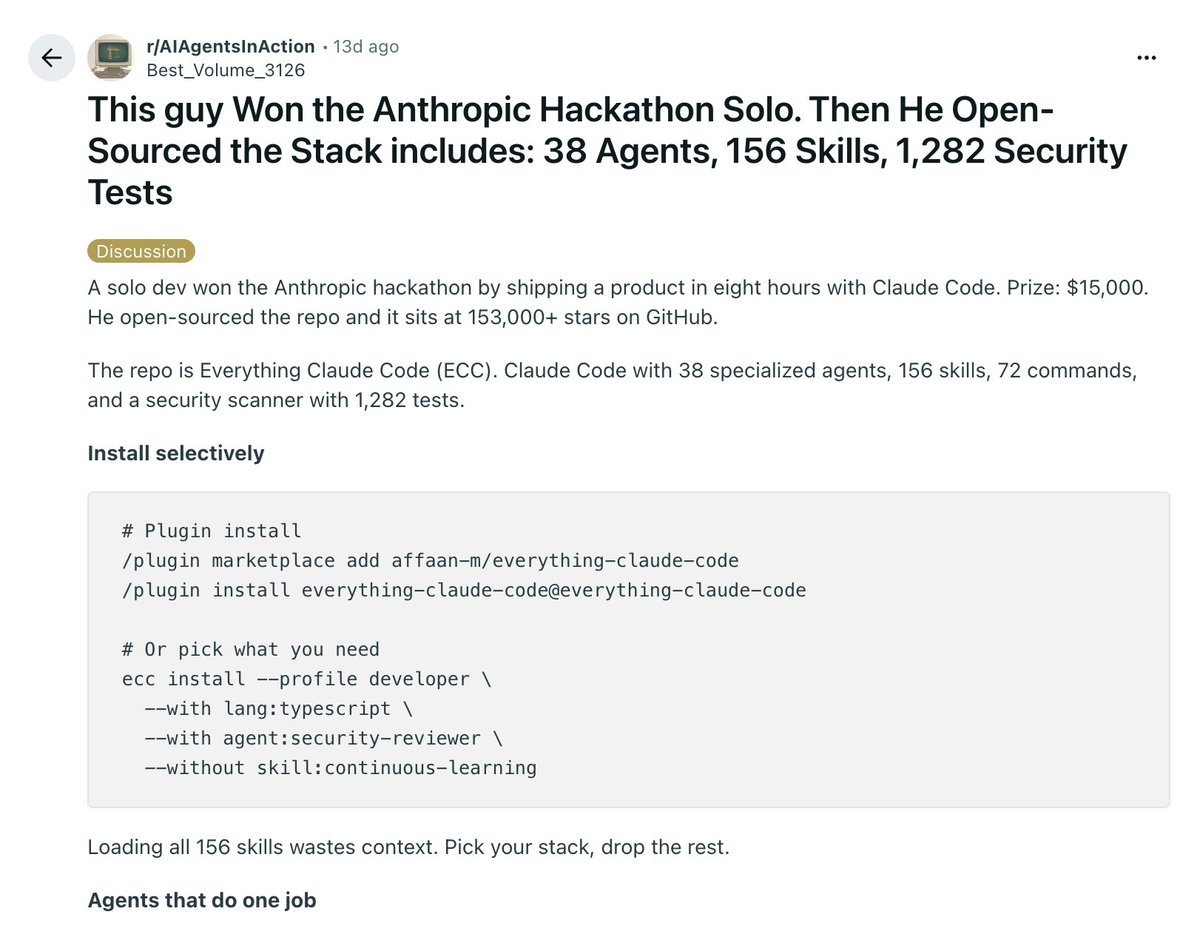
A solo dev just won the Anthropic hackathon, shipped a working product in 8 hours with Claude Code, and walked away with $15,000.
Then he open-sourced the entire stack.
153,000 stars on GitHub. Here's full setup:
→ 38 specialized agents (planner, security reviewer, debugger, code reviewer)
→ 156 skills loaded on demand (/plan, /tdd, /security-scan, /quality-gate)
→ 72 custom slash commands
→ AgentShield: 1,282 security tests across CLAUDE .md, MCP configs, hooks, skills
→ 3 Opus 4.6 agents running red-team pipelines (Attacker, Defender, Auditor)
→ Continuous learning layer that builds confidence across sessions
→ Coverage across 12 language ecosystems
This is what Claude Code looks like when someone treats it like infrastructure instead of a chatbot.
ANDREJ KARPATHY COULD HAVE CHARGED $2,000 FOR THIS COURSE.
He put it on YouTube.
The full training stack. Tokenization. Neural network internals. Hallucinations. Tool use. Reinforcement learning. RLHF. DeepSeek. AlphaGo.
3 hours of the most comprehensive LLM education that exists anywhere at any price.
Not how to use the tools.
How the entire system was built from the ground up and why it behaves the way it does.
The engineers who understand this build things the ones who only use the tools cannot even conceive of.
The gap between those two groups is not 3 hours.
It is everything those 3 hours quietly unlock for the rest of your career.











![rubenhassid's tweet photo. Anthropic just dropped a 31-page prompting guide.
Here's everything you actually need (in 10 rules):
1. You write "review this contract" and pray.
Fix: Name every output. "Review this contract. Flag risks per clause. Rate severity 1-5. Return as a table."
2: You say "summarize this" on a 40-page report.
Fix: 4.8 sizes the answer to the input. Cap it: "5 bullets. Each under 15 words. Start each with an action verb."
3: You write "don't use jargon. don't be salesy."
Fix: Negative instructions don't stick.
Flip them: "Write in plain English a 16-year-old could read aloud."
4: You type "can you help me with the email?"
Fix: Each verb ships something. For example: "Go to Gmail. Find [contact]. Write the send-ready reply. Under 90 words. Tone: confident, casual."
5: You wait for Claude to web search on its own.
Fix: Claude opus 4.8 calls fewer tools than 4.6.
Force it: "Use web search aggressively. Verify every claim with at least 2 sources."
6: You miss the warm tone from old Claude.
Fix: Claude opus 4.8 is direct. Almost zero emojis. Paste 2-3 sentences in the voice you want.
Tell Claude to match the rhythm.
7: You ask for "a landing page" & get bare minimum.
Fix: Drop this one line on every creative task
→ "Go beyond the basics."
It's from Anthropic's own doc.
8: You forget Claude 4.8 doesn't reason by default.
Fix: They call it "Thinking." Effort: High
Add this at the end: "Think before answering (maximum reasoning)." Free upgrade. Every time.
9: You rewrite the same prompt 14 times a week.
Fix: A skill is a command with instructions pre-built.
Write the same prompt twice? Make it a skill.
10: You assume Claude knows what you meant.
Fix: Old Claude 4.6 guessed.
New Claude 4.8 does exactly what you typed.
Spell it out. Output. Order. Length. Tone. Format.
If you don't say it, you don't get it.
To go even further & download my .md files directly:
Step 1. Go to https://t.co/psB7XxAv8w.
Step 2. Subscribe for free. Don't pay anything.
Step 3. Open my welcome email (most skip this).
Step 4. Hit the automatic reply button inside.
Step 5. Download my .md files from my Notion.
Bonus. Enjoy my best copy-paste prompts, too.](https://pbs.twimg.com/media/HJoSjWJa0AA7KX8.jpg)