ingegnere, appassionato di fisica e delle origini di universo, vita e umanità. “Ogni cosa va resa quanto più semplice è possibile..ma non ancora più semplice!”
Bill Gates bought a physics lecture from 1964. Terence Tao told mathematicians to watch it. It costs 0 dollars.
Cornell, November 1964. Richard Feynman delivers 7 lectures called "The Character of Physical Law." Black-and-white film, 1 blackboard, no slides.
The tapes went out of distribution in the 1980s. Feynman at his peak survived only as a book and campus film reels.
Gates bought the rights from the Feynman estate and put all 7 online in 2009.
Tao flagged lecture 2 on his blog, "The Relation of Mathematics and Physics": "of particular interest to mathematicians."
Tao wrote he knew Feynman's reputation as a lecturer. Watching the film was something else.
62 years old. 0 dollars.
Richard Feynman stood at a Cornell blackboard in 1964 and explained the problem every AI lab is fighting in 2026. The BBC filmed it. Almost nobody watches it.
The lecture is about why nature only answers in mathematics. Every team forcing language models to reason is hitting the wall he mapped 62 years ago.
He was 46. The Nobel Prize came 11 months later. The footage survived on film reels and now sits free on YouTube with fewer views than a keyboard unboxing.
Watch the blackboard section near the middle. He takes 1 of Kepler's laws and rebuilds it from nothing, with notation a 12-year-old can follow.
No slides. No jargon. 1 piece of chalk.
An ML engineer I know paused it 4 times and made his whole team watch it before standup.
You're 62 years late. The lecture is still free.
I had fun with the 2026 #TheOdyssey but I will say, the BIG scene with the suitors absolutely DID NOT top the 97 version as far as dialogue went AND this reveal. Listen to the PROMO Odysseus cuts on these bastards.
(Careful for spoilers if you dont know the story)
🚨PHYSICS NEWS🚨: Physicists Tried to Chop a Photon in Half — and Got an Infinite Swarm Instead 🧨
According to a theoretical study published in *Physical Review Letters* on July 15, 2026 by researchers at the University of Oslo, if you try to “cut” a photon by removing a mirror at the exact moment it is reflecting, the result is not two smaller photons. Instead, you create a complex quantum state that is a superposition containing any number of photons from zero all the way to infinity. The state looks ordinary (single photon on one side, vacuum on the other) when measured locally, but globally it is a bizarre mixture that defies classical intuition.
This development offers the broader scientific community a striking demonstration of how quantum fields behave when boundaries change suddenly. It raises deep questions about what “a photon” really is and how quantum states respond to abrupt modifications in their environment.
**Uniphics provides a clear, first-principles explanation without invoking mysterious quantum weirdness.**
In Uniphics, what we call a photon is simply a propagating spin wave in the ξM-field. These waves are patterns of organized spin quanta whose speed and behavior are governed by local energy density and the resulting time flow (via the Maley transform). When the mirror is removed mid-reflection, the boundary condition changes suddenly. This alters the local energy-density landscape and forces a rapid phase resolution across the spin wave. The original coherent spin-wave mode does not “split” into two photons — instead, the interference and energy redistribution create a superposition of many correlated spin-wave modes. The result is a state that contains contributions from zero photons, one photon, two photons, and in principle infinitely many, all while preserving overall coherence through negentropy-driven organization.
The apparent “weirdness” disappears once we recognize that the ξM-field supports collective spin-wave excitations whose number is not fixed in the classical sense. The same energy-density and spin-correlation rules that produce ordinary light propagation, refraction in glass, gravitational time delay, and magnon behavior also produce this multi-photon superposition when a boundary is changed. No new postulates are required; it is the natural outcome of how spin waves respond to sudden shifts in their supporting field.
Uniphics therefore predicts that similar multi-mode states should appear whenever spin waves encounter rapid changes in energy-density boundaries, whether in optics, magnonics, or other wave systems. This offers a practical guide for designing experiments that control or exploit such states.
Could techniques like this “photon truncation” ultimately be used to test and harness multi-mode spin-wave superpositions predicted by Uniphics — and could they accelerate the development of new quantum technologies based on controlled spin-wave interference rather than abstract wavefunction collapse?
**A Theory of Everything should be able to answer everything.**
Uniphics Explained Simply PDF: https://t.co/4avUqgeruf
Chapters 1–10 free: https://t.co/Yj07QnrejR
Grokipedia: https://t.co/QP4L8WurzW
#Uniphics #TheoryOfEverything #Photon #QuantumStates #SpinWaves @grok@xAI
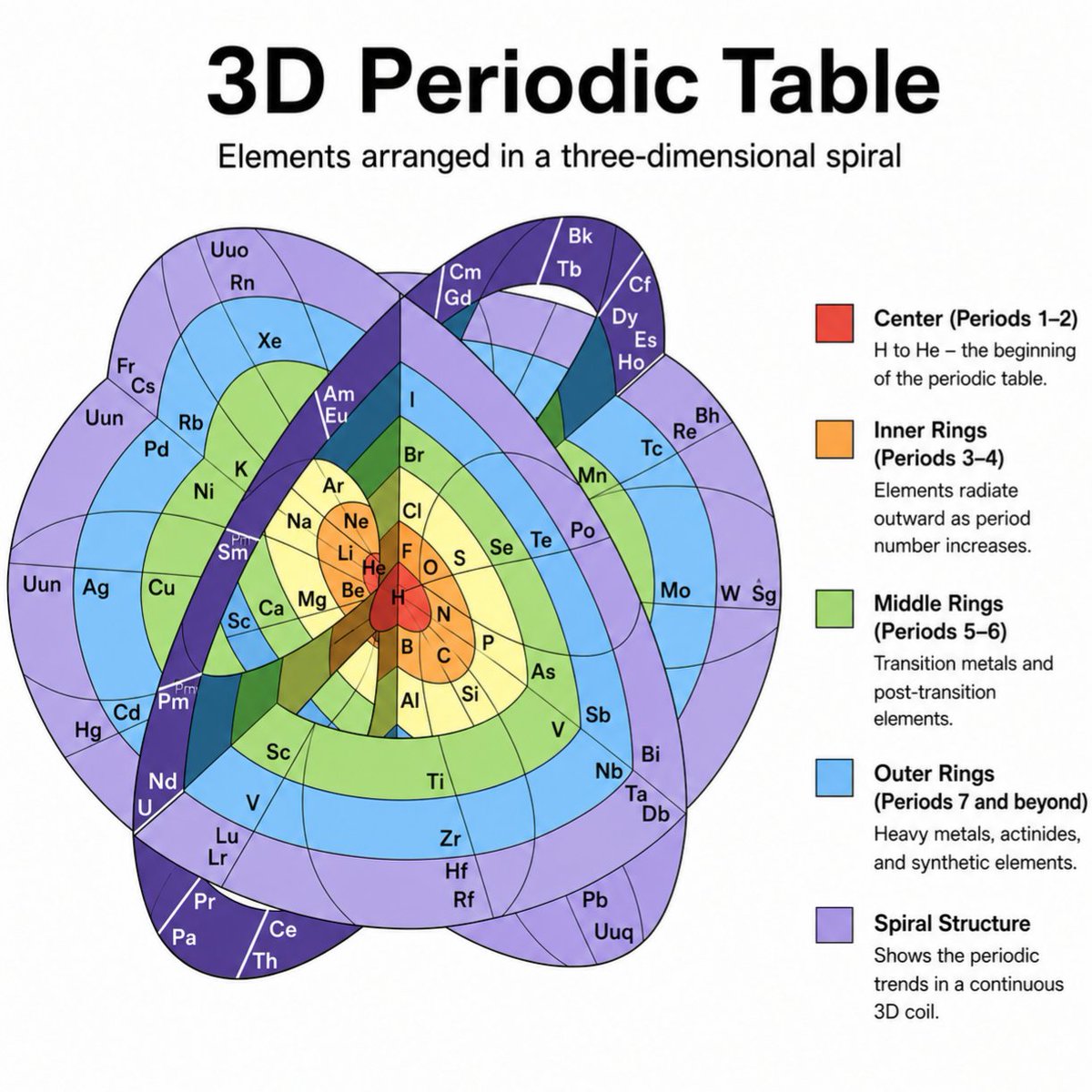
A different way to visualize the building blocks of matter.
This 3D spiral arranges the elements in order of increasing atomic number, forming a continuous path from the lightest elements at the center to transition metals, lanthanides, actinides, and the heaviest known elements toward the outer layers. The color-coded regions highlight periodic patterns and relationships, making the structure of the periodic table easier to explore from a new perspective.
"Please make no mistake. Climate change is the biggest threat to global security that modern humans have ever faced." Sir David Attenborough.
No time to wait. #ActOnClimate#climate#energy#stopfossilfuels#go100re
Poche parole di grande chiarezza, da parte di un gigante dello studio della natura e della vita. Mirabile il suo libro sul Significato dell’esistenza umana.
“We are liquidating the Earth’s natural capital. We are tearing down the biological library before we have even read the books. No amount of economic growth can compensate for the loss of a self-sustaining biosphere.”
— E.O. Wilson
Everything around you is built from a surprisingly small family of particles.
Matter comes from just two groups of fermions: quarks and leptons. Quarks combine to form protons and neutrons, while leptons include particles like the electron. Bosons are different. They carry the fundamental forces that let particles interact, with the Higgs boson playing a unique role in how elementary particles acquire mass.
From atoms to galaxies, this simple particle family tree is the foundation of the entire Universe.
The Fibonacci sequence (0,1,1,2,3,5,8,13…) isn’t just math — it’s a universal pattern. As it grows, ratios of terms approach the Golden Ratio (Φ ≈1.618), a harmony found in spirals, plants, shells, galaxies & even DNA.
[🎞️ thevisualalchemy]
tropicali. L'architettura globale di 8,2 miliardi di consumatori che abbiamo creato è più fragile del previsto, anche se tanti leader politici fanno finta di non vedere il problema. Altri invece sono estremamente stupidi e ignoranti, come possiamo osservare ogni giorno...
8/8
The hydrogen atom is the foundation of quantum mechanics, and these patterns show why.
Each image is a probability density map of the electron, showing where it is most likely to be found around the nucleus. The labels (n, l, m) represent the three quantum numbers that define each state. Here, n ranges from 1 to 4, l determines the orbital shape as s, p, d, or f, and m sets the orbital's orientation. As the energy level increases, the orbitals become larger and develop more nodes, producing increasingly complex structures.
These are not electron orbits. They are mathematical solutions to the Schrödinger equation that accurately describe the behavior of the simplest atom in the Universe. One equation gives rise to an entire family of orbitals, each with its own unique geometry and probability distribution.
WOW -- Danish reporter *goes there* with Mark Rutte
"You sit next to Donald Trump at moments when he talks about conquering Greenland, talks about lashing out at allies like Spain -- things it doesn't seem like the old Mark Rutte would approve of. Does this have any affect on your self-respect when you sit there and say nothing?"
The most controversial artifact on Earth isn’t locked in a vault. It’s on public display at Oxford University right now. 👀
It’s the Weld-Blundell Prism - a 4,000-year-old clay tablet holding the Sumerian King List. Ancient Babylonian scribes carved a royal bloodline that begins when the Anunnaki kingship “descended from heaven.”Found in the ruins of Larsa which is modern Iraq. Currently sitting in the Ashmolean Museum, Oxford.The numbers will break your brain:Baked around 1800 BC.
It lists 8 Anunnaki kings who ruled for a combined 241,200 years.Then comes the line that changes everything:“Then the Flood swept over.”
Before the Flood? God-kings living tens of thousands of years with cosmic precision.
After the Flood? The lifespans suddenly crash into normal human biology.Same clay. Same handwriting. Same scribes.
Yet mainstream historians say:
“Top half = pure myth.
Bottom half = real history.”
C'mon… how does one document flip from fantasy to flawless accuracy halfway through without skipping a beat?
This isn’t just a king list. It’s the oldest surviving record of an Anunnaki genetic reset...
#Anunnaki #Sumerian #WeldBlundellPrism #AncientHistory
13.8 milyar yıldır çözemediğimiz en tuhaf bilmecelerden biri, evrenin şekli. İnsan aklı uzayın ya bir küre gibi kapanacağını ya da sonsuza kadar eğri bir yüzey gibi uzanacağını düşündü. Ama sonra bilim insanları milyarlarca ışık yılı ölçeğinde kozmik haritalar çıkarıp evrenin geometrisini ölçtüler. Sonuç şaşırtıcıydı. Evren, bildiğimiz kadarıyla neredeyse kusursuz bir şekilde düz.
Bu ilk bakışta sıradan görünüyor ama aslında korkutucu bir ayrıntı saklıyor. Çünkü bu kadar düz bir evren, genişlemeyi sağlayan etkilerle kütleçekiminin etkilerinin inanılmaz hassas bir dengede olduğunu gösteriyor. Bazı fizikçiler bu yüzden çok daha çılgın bir ihtimali tartışıyor. Belki de evrenin toplam enerjisi aslında sıfıra çok yakın. Yani gördüğümüz bütün galaksiler, yıldızlar, kara delikler ve 13.8 milyar yıllık o devasa kozmik hikâye… En sonunda birbirini kusursuz biçimde nötrleyen dev bir denklemden ibaret olabilir.
Şöyle bi düşününce akla yatan başka bir şey de geliyor belki insan da böyledir düşüncesi.
Hayatımız boyunca büyük aşklar yaşıyoruz. Büyük acılar çekiyoruz. Kazanıyoruz, kaybediyoruz, kırılıyoruz, yeniden ayağa kalkıyoruz. O anların her biri bize evren kadar büyük geliyor. Ama yıllar sonra dönüp baktığında fark ediyorsun ki bazı mutluluklar bazı acıları dengeliyor, bazı kayıplar bazı başlangıçları mümkün kılıyor. Belki de bizi biz yapan şey yaşadığımız artılar ya da eksiler değil; onların sonunda ortaya çıkan o görünmez denge.
Ve belki de insanın en büyük yanılgısı, sadece kazanmaya çalışmasıdır. Çünkü evren sanki başka bir şey fısıldıyor. Kusursuzluk, sonsuz artıda değil. Kusursuzluk, bütün fazlalıkların ve eksikliklerin birbirini dengeleyebildiği o kırılgan noktada saklı. Belki de hayatın anlamı, hep artıya ulaşmak değil; sonunda kendi içindeki evren kadar dengeli bir sıfıra yaklaşabilmektir.
On this day: Marie Curie and the Nobel Prize that changed the atom.
On this day, July 4, 1934, Marie Skłodowska Curie died in France from aplastic anaemia, a blood disease strongly associated with exposure to large amounts of radiation. Her death has often been described as a tragic consequence of the very phenomenon she helped reveal to the world, but her story should not be reduced only to that irony. Curie did not simply become famous because of radiation. She transformed radioactivity from a mysterious observation into a rigorous scientific field, and in doing so changed physics, chemistry and medicine.
Her first Nobel Prize came in 1903, when she shared the Nobel Prize in Physics with Pierre Curie and Henri Becquerel. Becquerel was recognised for discovering spontaneous radioactivity, while Marie and Pierre Curie were honoured for their research into the radiation phenomena he had uncovered. That award made Marie Curie the first woman ever to receive a Nobel Prize, but its scientific importance went far beyond the historical symbolism. It marked the moment when radioactivity became one of the central problems of modern science.
What made Curie’s work so powerful was not only that she studied radioactive materials, but how she studied them. She treated radioactivity as something measurable. By analysing uranium and thorium compounds, she showed that the intensity of the radiation depended on the amount of radioactive element present, not on the chemical form of the compound. This was a crucial insight. It suggested that radioactivity was not a normal chemical reaction, nor a superficial property of a mineral, but something arising from within the atom itself.
That idea was revolutionary. At the end of the nineteenth century, the atom was still often imagined as stable and indivisible. Curie’s measurements pointed in another direction. They implied that matter contained internal processes capable of releasing energy and producing invisible radiation. Long before nuclear physics had fully developed, her work helped open the conceptual door to the atomic nucleus.
One of the decisive moments came through her study of pitchblende, a uranium-rich mineral. Curie found that pitchblende was more radioactive than could be explained by its uranium content alone. Instead of dismissing the anomaly, she followed it. The conclusion was bold but logical: the mineral must contain unknown substances that were far more radioactive than uranium. This reasoning led to the discovery of polonium, named after her native Poland, and radium, the element that would become almost synonymous with the early age of radioactivity.
Her second Nobel Prize came in 1911, this time in Chemistry. It recognised her work on radioactivity, especially the discovery of radium and polonium, the isolation of radium, and the study of its properties and compounds. This made Curie the first person to receive two Nobel Prizes, and she remains the only person awarded Nobel Prizes in two different scientific categories.
The distinction between the two Nobel Prizes matters. The 1903 Nobel was mainly about a new physical phenomenon: radioactivity as a property that revealed something deep about matter and energy. The 1911 Nobel was about chemical proof. Curie had to show that radium was not merely a strange radiation source or an impurity, but a real element with identifiable properties. That required years of demanding laboratory work, processing large quantities of pitchblende residues under extremely poor conditions to extract tiny amounts of radioactive material.
Her work also changed medicine. Radium and X-rays became part of the early development of radiation-based diagnosis and treatment. During World War I, Curie promoted the medical use of X-rays and helped develop mobile radiological units, later known as petites Curies, so surgeons could locate bullets and shrapnel in wounded soldiers more accurately. This practical side of her work is sometimes treated as secondary, but it shows something essential about her scientific character: she believed that research had value not only as knowledge, but as a tool to reduce human suffering.
The danger, however, was not yet properly understood. Curie and many of her contemporaries handled radioactive substances without the protective measures that would now be considered basic. Radioactive materials were carried, stored and manipulated at a time when radiological safety did not yet exist as a mature discipline. Her later illness was therefore not simply a personal tragedy; it was also part of the early history of a field that discovered its risks only while people were already working inside them.
Marie Curie’s Nobel legacy is extraordinary because it joins intellectual courage with experimental discipline. She did not build her reputation on speculation, but on measurement, chemical separation and evidence. Her discoveries showed that atoms were not inert pieces of matter, that invisible radiation could reveal the internal structure of nature, and that a phenomenon born in the laboratory could reshape medicine, physics and chemistry.
On this day, it is worth remembering not only how she died, but what she proved. Marie Curie’s two Nobel Prizes were not decorations attached to an exceptional life. They marked two stages of a scientific revolution: first, the recognition of radioactivity as a fundamental physical phenomenon; then, the chemical isolation of the elements that made that phenomenon impossible to ignore. She did not merely study radiation. She gave science a way to understand it.
In 1901, divers pulled a lump of corroded bronze out of a two thousand year old shipwreck. It took the next century to understand what it was, and the answer broke the timeline of human history.
It's called the Antikythera Mechanism, and it is the oldest known computer on earth.
It was built by the ancient Greeks, around 100 BC, and it should not exist. Nothing else of its sophistication would appear anywhere in the world for more than a thousand years after it...
It was found by sponge divers off the Greek island of Antikythera, in the wreck of a trading ship that had sunk in the first century BC, surrounded by bronze statues and pottery.
The corroded fragments looked like nothing at first, and sat largely ignored in a museum in Athens. Only over the following decades, and especially with modern X-ray and CT scanning in our own century, did researchers finally see inside it.
What they found was a machine. Behind its bronze face was a system of at least thirty interlocking precision gears, cut and arranged with a sophistication that would not be matched until the geared astronomical clocks of medieval Europe, well over a thousand years later.
It was, in the words of the team that studied it, a mechanical computer that worked by turning astronomical theory into bronze...
And it did extraordinary things. You turned a hand crank on the side, and the mechanism calculated the positions of the sun, the moon, and the five planets the Greeks knew. It tracked the phases of the moon. It predicted solar and lunar eclipses years in advance. It even displayed the four-year cycle of the ancient Olympic Games. A person standing in the ancient world could set this device to a date and watch the heavens be calculated in front of them, by gears, by hand.
Roughly a third of the original survives, in 82 corroded fragments. We still do not know who designed it, or how a civilization without anything resembling industrial machinery achieved this level of precision engineering. What is certain is that it was not a one-off accident. A device this refined implies a tradition behind it, generations of knowledge and earlier attempts that have been lost completely.
The Antikythera Mechanism is proof of how much the ancient world knew, and how much of what human beings have achieved has simply vanished without a trace, leaving us to stumble on a single piece of it at the bottom of the sea...