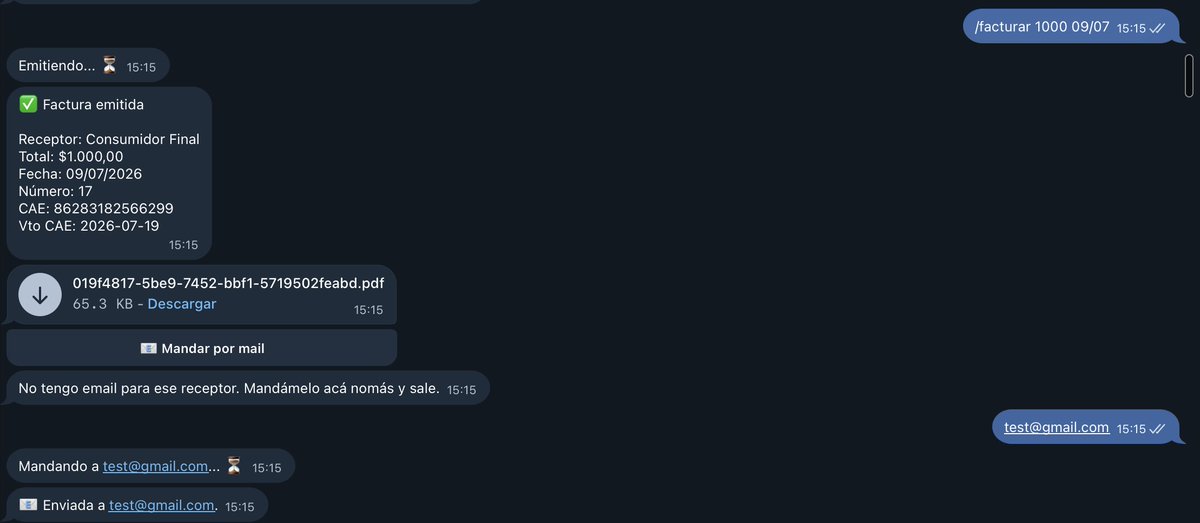
Me cansé de hacer mis facturas en la página de ARCA
Hice un bot de Telegram: escribo "/facturar 15000 CUIT FECHA" y en 5 segundos tengo el PDF con QR en el chat. Un botón y se la manda por mail al cliente.
Al que le pueda servir, dejo el repo más abajo 🤗
You have Claude Fable for only a few days. Here's how to make the most of it.
Introducing /improve: use your most capable model to audit your codebase and write plans for cheaper models to execute later.
Studies your code, figures out bugs, perf, tech debt, missing tests, what to build and writes plans any agent can run.
New skill: /improve-animations
Inspired by @shadcn’s improve skill I made one specifically for animations.
Use your most capable model to audit animations in your project and hand the execution to cheaper models.
Fable is available through July 12, so make good use out of it!
New in Claude Code: /checkup
Run /checkup to:
1. Clean up unused skills/MCPs/plugins and save context
2. Dedup your local CLAUDE.md against the checked in CLAUDE.md
3. Break up root CLAUDE.md into nested CLAUDE.md's + skills
4. Turn off slow hooks
5. Update your Claude Code to the latest version
6. Enable auto mode by default
7. Pre-approve frequently denied read-only commands
.. And a few other goodies.
/checkup confirms with you before making any changes. Enjoy!
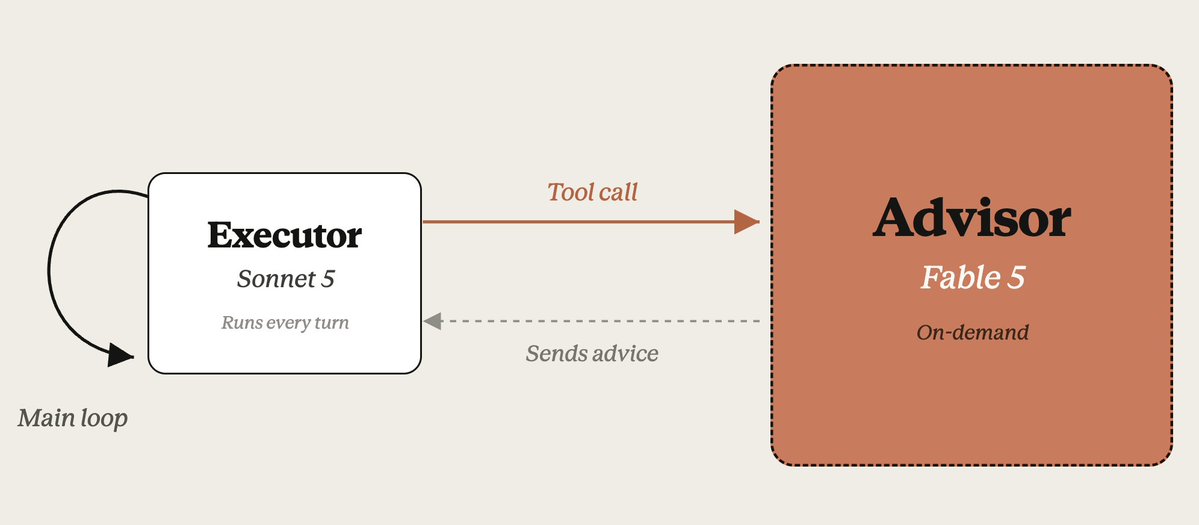
Guía de IA para GUARDAR: en vez de correr todo con el modelo caro, usás uno barato (Sonnet 5) como ejecutor y llamás al caro (Fable 5) como asesor solo cuando hace falta
Resultado: 92% del rendimiento al 63% del costo 🤖
Lo estoy usando y es una locura lo bien que funciona
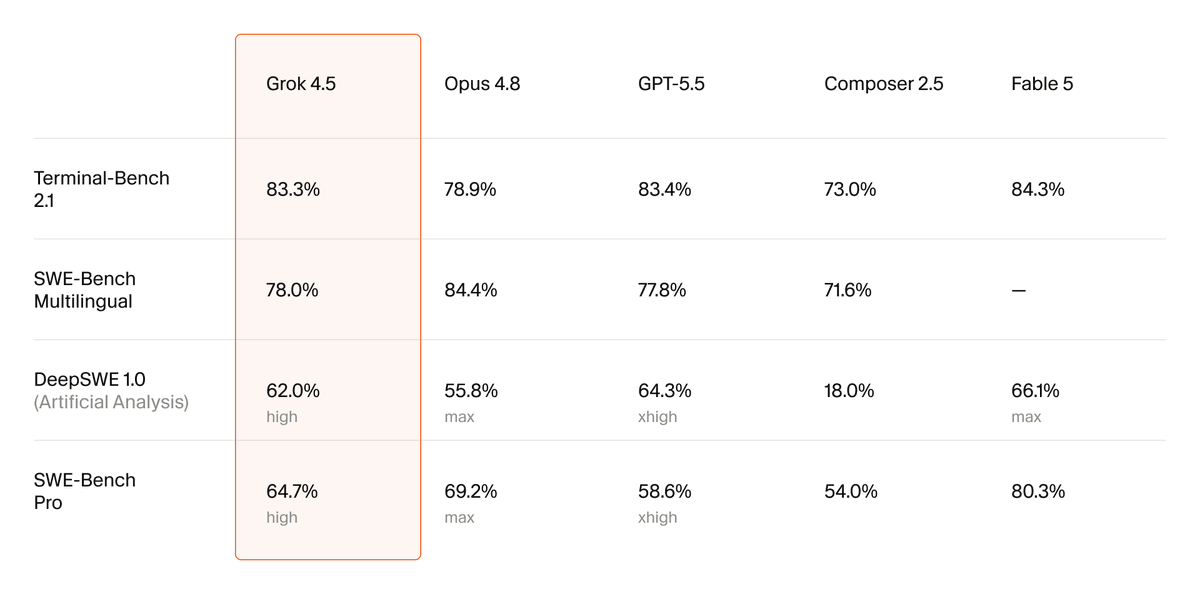
Announcing Grok 4.5, our first model trained specifically for coding and agents. It was trained with Cursor and offers frontier intelligence at leading speeds and cost efficiency.
https://t.co/i8HpU7w64k
A few patterns we frequently use with Fable 5:
Use Fable 5 as an "advisor."
An executor (Sonnet 5) calls Fable 5 for guidance.
Most tokens are billed at the lower executor rate.
We’ve received notice that the Department of Commerce has lifted export controls on Claude Fable 5 and Mythos 5.
We'll begin restoring access tomorrow, and will share an update soon.
We’re grateful to our users for their patience, and to everyone who worked with us on redeploying the models.
Orca’s mobile app lets you run Claude Code, Codex, OpenCode, Pi, etc. from your phone.
Review diffs. Edit files. Keep agents moving while on the go.
Open source: https://t.co/psFGkUa4sn 9k⭐️
Available on iOS & Android.
Human judgement in engineering is ironically even more crucial now. Deciding what to build. Deciding on the right architectures. Deciding whether you regenerate from scratch $$$ or reuse existing legos. Managing tech debt. You can do anything now, but you can't do everything.
si querés entender cómo funciona un agente, construí uno desde cero.
usar Claude Code, Codex o Cursor te sirve para aprender a trabajar con agentes, pero no te muestra lo más importante: cómo funcionan por dentro.
empezá por las piezas que hacen que un agente funcione:
1) LLM
conectá un modelo. mandale una tarea simple y recibí una respuesta. esa es la unidad mínima:
input → modelo → output.
2) instrucciones
agregá un system prompt. ahí definís cómo tiene que comportarse el agente: qué rol cumple, qué reglas sigue, qué puede usar, qué debe evitar y cómo tiene que responder.
3) contexto
pasale la información que necesita para trabajar: historial, archivos, documentación, datos del usuario o estado del proyecto. el agente trabaja con lo que le das.
4) tools
sumale funciones que le permitan actuar: leer un archivo, buscar información, llamar una API o ejecutar un comando. el modelo no las ejecuta solo: las pide, y tu código las ejecuta.
5) memoria
guardá fuera del chat lo que conviene recordar: decisiones, preferencias, resultados o estado del proyecto. después lo recuperás y se lo volvés a pasar como contexto.
6) loop
un agente no responde una sola vez: recibe una tarea -> mira el contexto -> decide el próximo paso -> pide una tool si la necesita -> observa el resultado -> vuelve a decidir.
ese ciclo se repite hasta que puede responder, pedir más información o frenar porque no sabe cómo seguir.
construir uno desde cero te obliga a tocar cada pieza.
y ahí está el verdadero aprendizaje: entendés qué hace el modelo, cómo lo guían las instrucciones, por qué importa el contexto, cuándo usar tools, qué conviene guardar en memoria y cómo todo eso se conecta dentro de un loop.
después de eso, cualquier agente que uses se vuelve mucho más fácil de entender, diseñar y mejorar.