🚨🚨Exciting news alert 🚨🚨
I successfully defended my doctoral dissertation.
Big that is to all who support me during this process. It has been a long road full of lessons and surprises. I am glad to have such great colleagues at @IncherK and @uni_kassel
📣Congratulations Francisco! @FrancoPF completed his doctorate with a successfull disputation on Dec. 8th; His dissertation is entitled "Testing the impact of large-scale digital support on Students-Paths towards College Education". https://t.co/WnLVWGfVHP
New article in @PNASNews:
We all know that ChatGPT loves to delve, bolster, leverage, encompass, showcase, underscore, et cetera. I analyzed full text of 7.3 million journal articles published 2020-2025, hunting for 228 words that spiked after ChatGPT launched in late 2022.
Improve your economic data analysis by using jackknife standard errors under clustering. This is a minor code change, and can lead to greatly improved inference. This paper provides the theoretical foundation.
New paper by @BruceEHansen
https://t.co/DZZZmbjgnN
#REStud#EconX
📢 ¿Conoces los cursos internacionales ILPES-CEPAL 2026?
Invitamos a funcionarias y funcionarios públicos, equipos técnicos, académicos y profesionales de América Latina y el Caribe a participar en programas sobre planificación, gestión pública y desarrollo territorial sostenible.
✨ La propuesta académica contempla modalidades virtuales, híbridas y autogestionadas, con materiales interactivos, clases en línea y herramientas prácticas que fortalecen las capacidades técnicas, operativas, políticas y prospectivas (TOPP) necesarias para enfrentar los desafíos actuales de la región.
👉 Explora el catálogo completo aquí: https://t.co/VsFsrenHUe
📢 Final Call for Papers: Advances with Field Experiments (AFE) 2026
Join leading researchers using field experiments to answer big economic questions.
Submit your abstract by May 29.
https://t.co/RiALxsweBU
⭑⭑ New Postdoc Fellowship opportunity ⭑⭑
Starts this fall at the brand-new @JohnsHopkins School of Government & Policy—> https://t.co/sw2Aa5OZU5
Our Cities & Communities cluster has some of the best people in the world; apply to work with them—>
https://t.co/e2bIVcSNc4
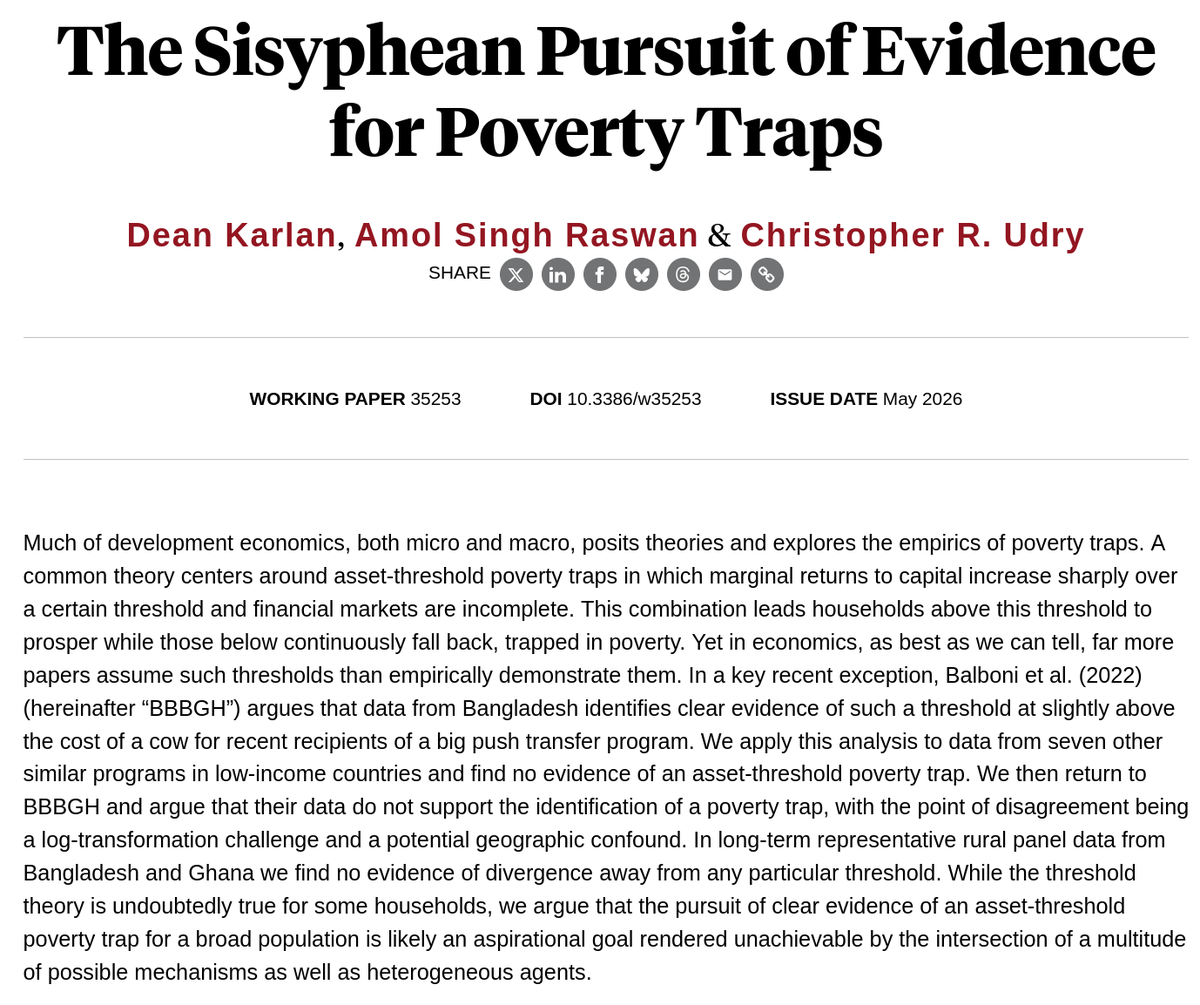
Amazing new WP. It revisits the poverty trap concept and aims to replicate the famous evidence by Bandiera and co-authors on the S-shaped poverty trap.
Spoiler alert: the authors did not manage to replicate it. Why? Below is a very informative thread and the WP👇🏽
New working paper with @AmolRaswan and Chris Udry: "The Sisyphean Pursuit of Evidence for Poverty Traps."
A central idea in development economics is that poverty can trap people. We went looking for the cleanest evidence. Here's what we found – and didn't.
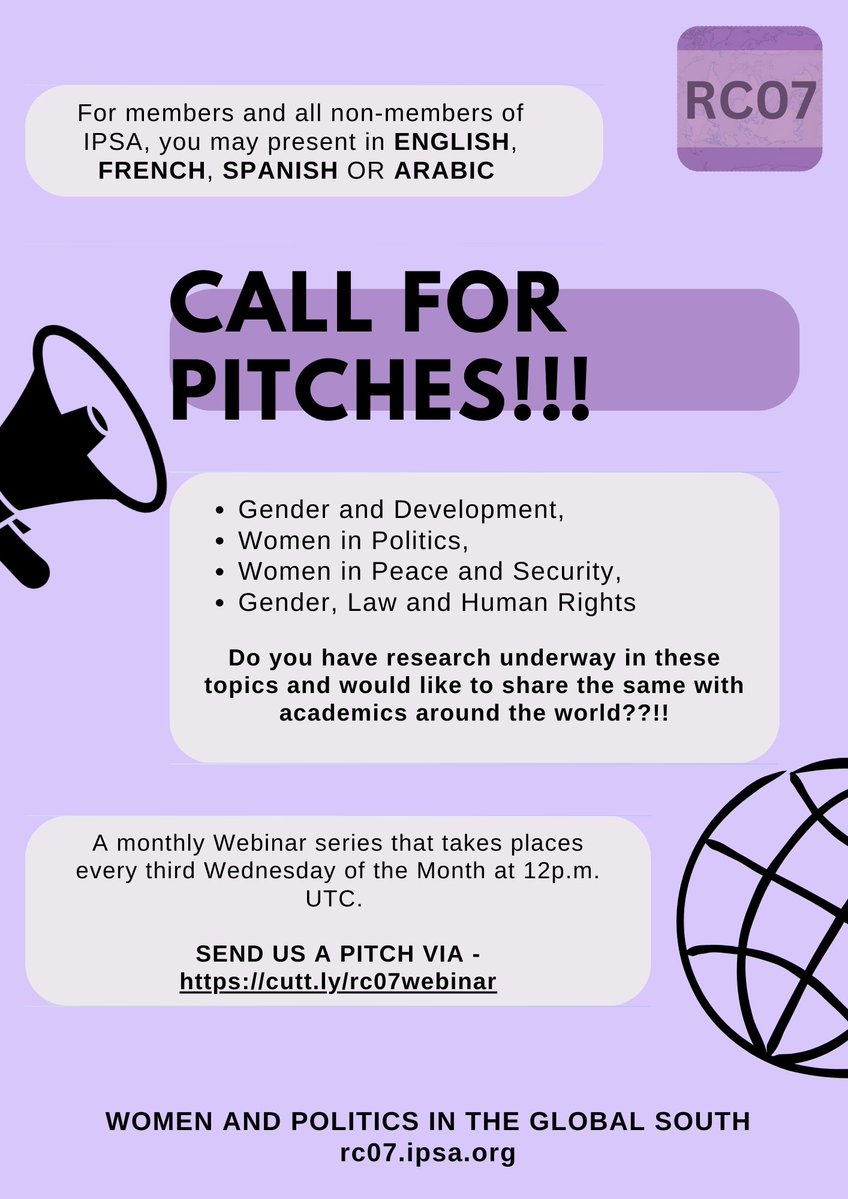
Postgrad Researchers, Early-Career Scholars & Practitioners!!!
We’re seeking regional voices for RC07’s monthly webinar series on gender, politics, law, and development in the Global South.
So send your papers!! 🔗 https://t.co/cbragb9Nsj
#IPSA#RC07Webinar
Postdoc (3 Years) for Research on "Teachers, Inequality and Collective Action in the MENA Region", Max Planck Institute for Political and Social Science, Göttingen.
https://t.co/nmYyjKf4r9
Un aporte muy preciso de @belkissanchezc, respecto a la validación por ejercicio profesional.
Es urgente contar con estándares académicos claros para evitar interpretaciones subjetivas respecto a procesos de titulación.
Sobre una parte de la explicación de Lavinia Valbonesi y la obtención de su título universitario:
Es impreciso repetir y repetir eso de "la ley aprobada en el año 2010".
En efecto, lo que se aprobó en 2010 fue la Ley Orgánica de Educación Superior, ¿qué regula esta ley? A las universidades, escuelas politécnicas e institutos técnicos y tecnológicos del Ecuador. Posterior a esa aprobación y su primer reglamento emitido en 2011, la ley fue reformada con el paso de los años y con eso se expidieron reglamentos de aplicación a partir de esos cambios.
Originalmente, en 2014 el reglamento contemplaba la validación por trayectoria profesional, pero se limitaba a casos específicos, especialmente en el campo artístico. No fue sino hasta 2022 cuando el Consejo de Educación Superior amplió la figura de validación por ejercicio profesional.
Según el artículo 84 del Reglamento de Régimen Académico, la experiencia profesional puede equivaler a asignaturas, cursos, o incluso a la totalidad de una carrera.
Con este nuevo reglamento, por así decirlo, la validación ya no se limita solo al campo artístico, sino que reconoce experiencia laboral, profesional, artística, y cultural.
Ahora bien, ¿qué debe evaluar la universidad? evidencias, verificar trayectoria, realizar pruebas o entrevistas, revisar portafolios, y garantizar estándares académicos.
Entonces, tratar de confundir y hacer creer que esta posibilidad de validación, en los términos como hoy es posible, está vigente desde 2010, es al menos para mí equivocado, porque antes el mecaniso era más rígido y ni siquiera aplicaba para el campo de la comunicación.
📣JOBS📣
I am hiring a PhD student & a postdoc for @FWF_at project on the history of security innovations in Global East.
Interested in sociological & STS research on security? Apply here:
https://t.co/17wCDCqvVC...
https://t.co/17wCDCqvVC...
Cool office neighbourhood included!
Econ students in Sweden: this is a fantastic RA post.
If you’re interested in Swedish policy around the justice system, or applied economics research more generally, this is a great opportunity to learn from top researchers.
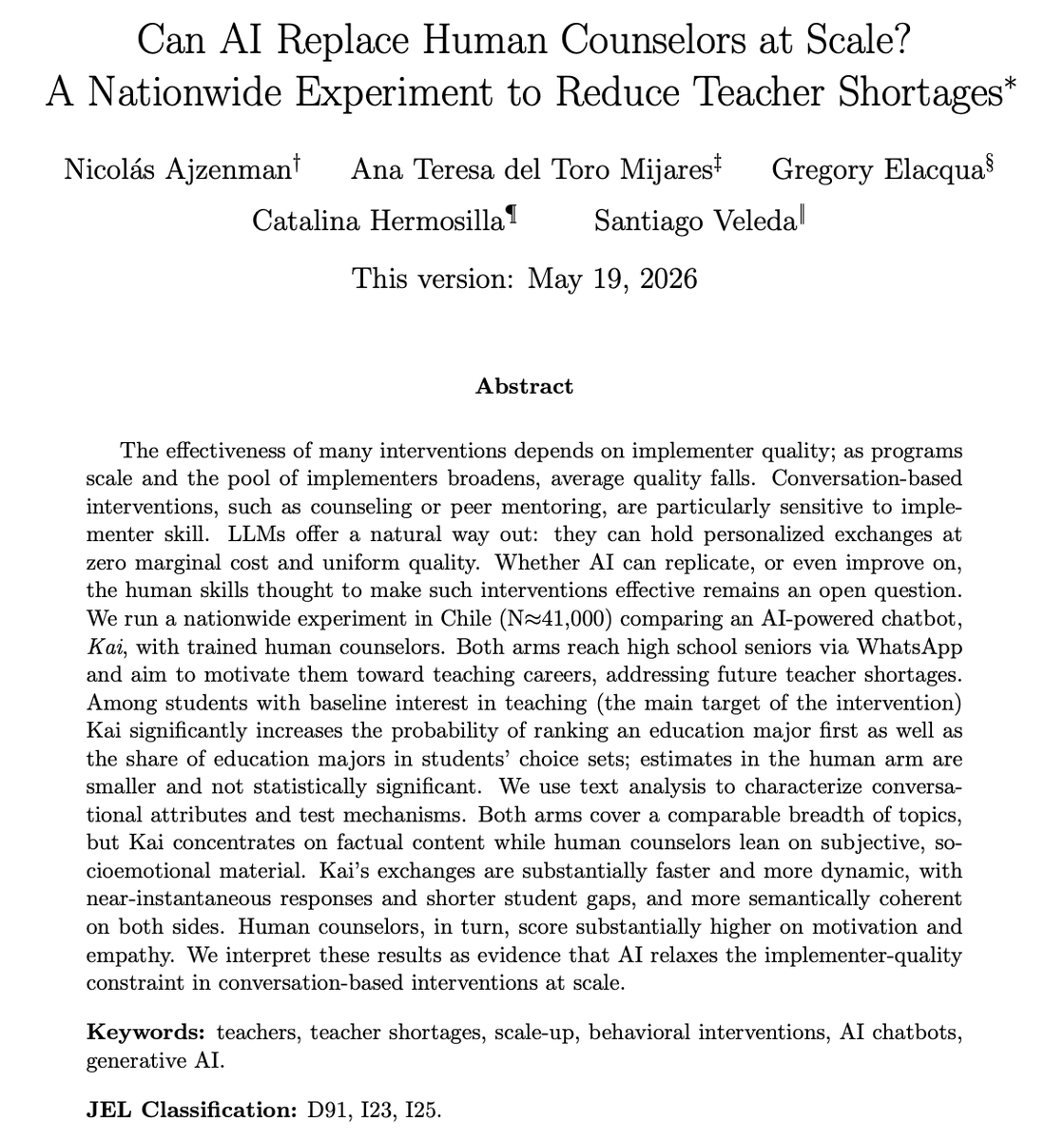
New WP 🥳
Can AI replace human counselors?
Large RCT (n=41K) comparing an AI chatbot vs. trained human counselors to motivate high school seniors toward teaching careers.
Summary: If anything, bots outperformed humans at a smaller cost and reduced human quality heterogeneity.
💥New Working Paper Alert💥During the pandemic school closures, my co-authors and I launched a pioneering #RCT to test whether online tutoring in very small groups could help vulnerable students recover learning losses. 🔬
🏋 At the time, there was enormous skepticism about whether meaningful learning could happen online, especially for disadvantaged students. However, the results of the pilot were spectacular: improvements of more 30% in math grades, reduction of school repetition by more than 50% and improvements in students’ confidence and aspirations. That paper was published in the Journal of Public Economics.
💡 But for anyone working in public policy small pilots are not super useful. Will they still work when run at scale? Will it work when the funders and researchers leave the control of the program to public agencies or governments, facing big administrative and political economy constraints, limitations in professional management or access to top quality teachers?
This is what we study in our new paper, now published as a WP at the Centre for Economic Performance of the The London School of Economics and Political Science (LSE) (see link below):
👉 “From pilot to policy: experimental evidence from scaling online tutoring”
We partnered with the regional government of Navarre in #Spain to scale an online mathematics tutoring program to more than 1,300 vulnerable students across 46 schools. Crucially, the program was implemented entirely by the government, using interim public-school teachers already integrated into the public education system. 🤝
The results show both the promise and the reality of scaling evidence-based policy.
👩🏫 Students assigned to tutoring improved their math grades by 0.15 standard deviations and their standardized test scores by 0.11 standard deviations.
The effects are smaller than in the original pilot; clear evidence of John List “voltage drop” that often occurs when programs scale. But importantly, a strong impact of online tutoring survived under realistic government implementation conditions.
We also find that increasing tutoring groups from 2 students to 3 students per tutor did not significantly reduce effectiveness, suggesting a potentially important path for improving cost-effectiveness at scale.
Very grateful to my co-authors María Calle García, Lucas Gortazar, Maria Hernandez de Benito, Claudia Hupkau, and TERESA MOLINA MILLAN, as well as to the Ministry of Inclusion, the Government of Navarre, schools, tutors, students, and families who made this project possible.
📣 Call for Papers — BREAD/ @ITAM_mx / @AgendaCAF Conference on Development Economics
🇲🇽 ITAM, Mexico City
📅 Oct 23–24, 2026
🗓️ Submission deadline: June 19, 2026
Submit: https://t.co/up8T1dFibH
🧵👇
@santiak Esto solo nos demuestra que sin una investigación clara de lo que conlleva alcanzar la dichosa excelencia, es muy fácil equivocarse y condenar a individuos a malas decisiones solo por una opinión sesgada.
Acá el artículo por si estás interesado
https://t.co/1R1ya4iOwj
@santiak Lo mismo dice día con el emprendimiento. Como empresarios exitosos como Gates y Jobs eran college dropouts, muchos individuos abandonaron sus carreras para seguir sus pasos. Por supuesto, fue una decisión errónea misma que el mercado se encargó de castigar.