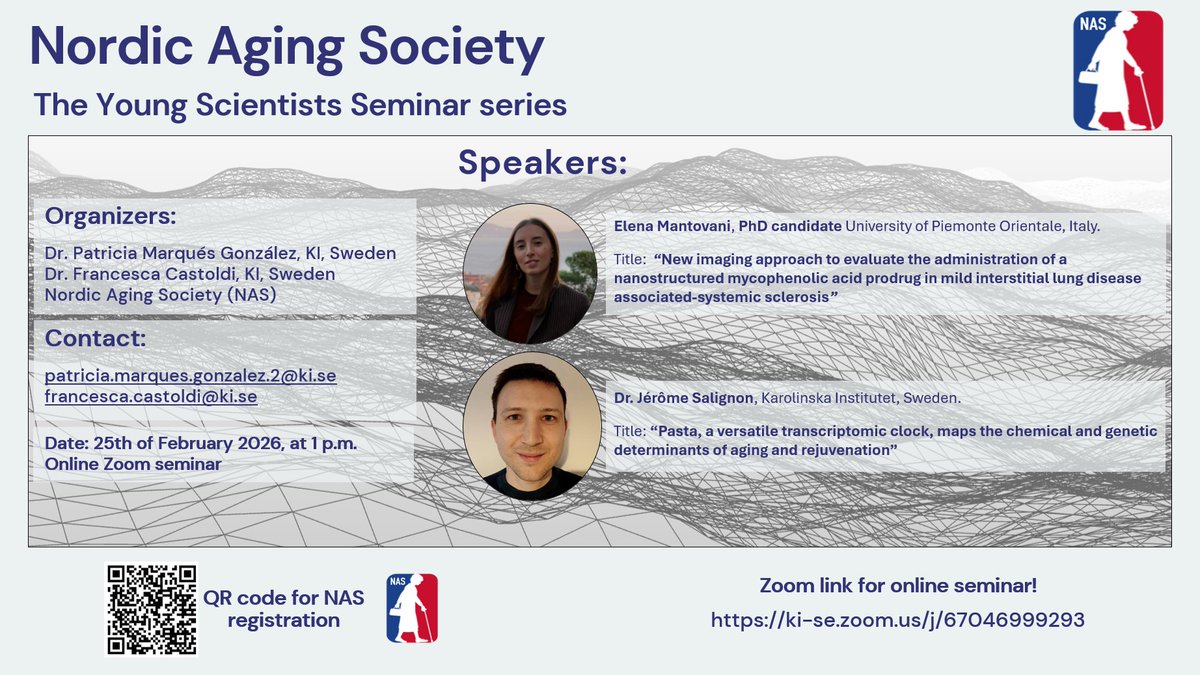
@NordicAging is announcing the next Young Scientists Seminar Series event!
📆 When? May 20th at 13:00 p.m. (GMT+2:00)
🌍 Where? https://t.co/stojixraL5
❓Why? To encourage young researchers to share their ideas and create their own scientific network in the ageing field !
we uncover the senolytic mechanism of conjugated polyunsaturated fatty acids (PUFAs), specifically α eleostearic acid (α-ESA), demonstrating that these compounds eliminate senescent cells by inducing ferroptosis, rather than classical programmed cell death pathways.
@Pmarques_G and I are happy to announce our next Young Scientists Seminar series from the @NordicAging
📅February 25th at 13:00 PM (GMT+2)
Elena Mantovani, PhD candidate
Dr. @JeromeSalignon will present their reserach!
🌎You can join online here: https://t.co/R6SrmYTz8l
Postdoc time is often harder than PhD.
You have little time. Competition is higher. And you MUST stand out.
+ Your contract may end any moment.
+ Your salary is often low (for your age/education).
+ You’ve just relocated and prepare to relocate again.
No wonder that Max Planck Society survey showed that depression and anxiety of postdocs is rising.
Interestingly, Max Planck Institutes have substantial internal funding. So, in theory there should be less pressure to apply for grants, and everyone should be enjoying science. And yet the pressure on postdocs is immense.
📍 Many postdocs want to stay in academia.
They want to apply for faculty positions or become senior scientists.
Some of them achieve it. Others don’t.
❗️Why things don’t work out:
In a recent workshop Q&A session, I discussed various scenarios and behind-the-scenes processes that PhD students should keep in mind if they’re considering a postdoc:
“Postdocs: Competition, Hardship and Faculty Positions”
Watch it on here: https://t.co/nlwF8WaLJP
(I’ll appreciate if you ‘like’ this video - you will GREATLY help it reach more students.)
@Pmarques_G and I are happy to announce our upcoming Young Scientists Seminar series from the @NordicAging
📅August 20th at 13:00 PM (GMT+2)
Muhammad Arif (University of Gothemburg)
Sierra Lore (University of Copenhagen)
🌍Registration here: https://t.co/J6azKR5nsh
@Pmarques_G and I are happy to announce our upcoming Young Scientists Seminar series from the @NordicAging
📅August 20th at 13:00 PM (GMT+2)
Muhammad Arif (University of Gothemburg)
Sierra Lore (University of Copenhagen)
🌍Registration here: https://t.co/J6azKR5nsh
Had the pleasure of presenting my PhD research last week at the yICSA Symposium at the Karolinska Institute! It was a great experience to share my work on cellular senescence and connect with so many scientists.
Urolithin A provides cardioprotection and mitochondrial quality enhancement preclinically and improves human cardiovascular health biomarkers
https://t.co/xN5VkYbeyA
📣 Join us in Sweden 🇸🇪! Next yICSA symposium will be taking place on Tuesday, May 6th and May 7th, at Biomedicum, Karolinska Institutet.
Keynote speakers: @SpaldingLab & @mcollado_CIMUS
Register: https://t.co/by5VTJlPT3‼️
What sad news. RIP Sammy Basso. You were a great man and a great scientist. A few weeks ago I had the pleasure of hearing your beautiful speech at the CureMito conference. You gave an incredible lesson on how to deal with illness, and a strong inspiration for scientists.
Does anybody in the #reprogramming and #partialreprogramming field know if this paper has been consistently reproduced? And if yes, why this is not routinely used for iPSCs generation and in vivo partial reprogramming?
https://t.co/iDzXjgxyCP