@Tesla@SpaceX@xai Explosive upward potential. If Terafab goes into production as planned, it will mark a turning point for TSLA's transition from a "high-valuation automaker" to an "AI infrastructure leader," similar to the FSD hype of 2020-2021 but on a larger scale
TERAFAB: the next step to becoming a galactic civilization
Together with @SpaceX & @xAI, we're building the largest chip manufacturing facility ever (1TW/year) – combining logic, memory & advanced packaging under one roof.
To harness as much power as possible from the Sun, we need to send 100 million tons of solar capture into space – per year.
This requires massive scale.
– Capability to launch millions of tons of mass into orbit
– Solar-powered AI satellites
– Millions of @Tesla_Optimus robots to help build it out
All of these need chips: 100-200GW of chips for Optimus alone, plus terawatts for solar-powered AI satellites.
That's more than all the chip manufacturers in the world combined can provide today, or even by 2030 (based on projected production growth).
We're building TERAFAB to close the gap between today’s chip production & the future's demand – a future among the stars
https://t.co/tHumlppgMm
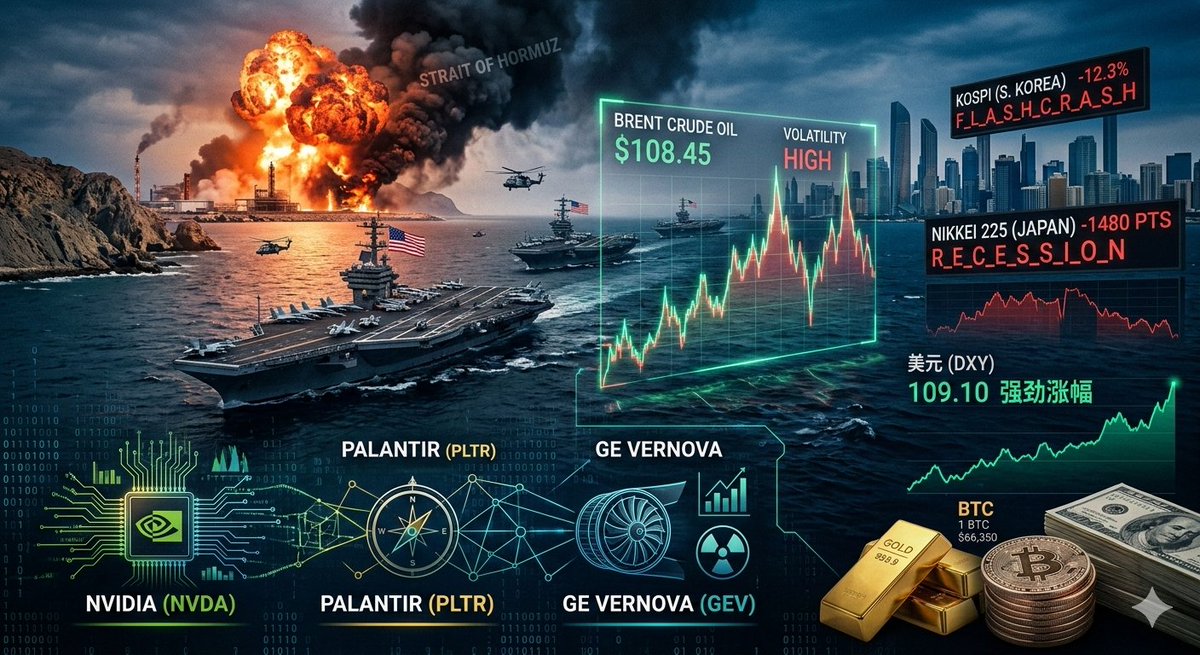
This crisis is a violent revaluation of what matters. In 2026, the winning strategy is no longer about "growth at any cost," but about security, energy autonomy, and strategic technology.
2026 Macro Storm: Global Asset Realignment Amid the Middle East Crisis
In March 2026, the escalation of military strikes between the U.S.-Israel alliance and Iran, coupled with the hardline succession of Iran’s new Supreme Leader, Mojtaba Khamenei, has triggered a seismic shift in global finance. This is not merely a geopolitical tremor but a fundamental "Paradigm Shift" for oil, equities, gold, and digital assets.
1. Oil: From Energy Anchor to Strategic Weapon
With the Strait of Hormuz facing a near-total blockade, Brent Crude has surged past $100, with some analysts projecting a spike to $150 if the conflict remains protracted.
Macro Logic: Oil is no longer just a fuel; it has become a tool for global liquidity redistribution. As non-U.S. nations scramble for increasingly scarce oil priced in USD, the greenback is experiencing a "morbid strength," further draining global liquidity.
Inflationary Pressure: Sustained triple-digit oil prices have effectively killed hopes for a Federal Reserve pivot in the first half of 2026, forcing the world into a "High Rates, High Energy Costs" trap.
2. The Asian "Drain": Hemorrhage in Japanese and South Korean Markets
The most acute pain is being felt in East Asia, where resource-poor economies are facing a "triple whammy" of soaring energy costs, supply chain breaks, and currency devaluation.
South Korea (KOSPI): The index suffered a "flash crash" in early March, triggered by fears of a total energy cutoff. Major tech titans like Samsung Electronics and SK Hynix—critical to the global AI supply chain—have seen double-digit pullbacks as energy-intensive semiconductor fabrication costs skyrocket.
Japan (Nikkei 225): The Nikkei plunged over 6% in a single session. Despite its massive national reserves, Japan relies on the Middle East for roughly 95% of its oil. The market is now pricing in a potential recession as the "import-led inflation" erodes corporate margins and consumer power.
3. Investment Opportunities: The "Wartime Resiliency" Portfolio
While broad indices suffer, capital is concentrating in companies that provide "Strategic Autonomy" or "Defense Lethality."
Defense & Intelligence AI: * Palantir (PLTR): A primary beneficiary of "war digitization," providing critical real-time battlefield analytics and logistics for U.S. and allied forces.
AeroVironment (AVAV): A leader in tactical drone systems, which have become the defining hardware of the 2026 conflict.
The Nuclear Renaissance (Anti-Oil Plays):
Constellation Energy (CEG) & Vistra (VST): As oil becomes a liability, nuclear power has emerged as the ultimate hedge for powering AI data centers and national grids.
Cameco (CCJ): The world’s uranium giant is seeing record demand as nations race to decouple from fossil fuel dependency.
Wartime Cash Cows:
Exxon Mobil (XOM) & Chevron (CVX): These giants are benefiting from the "Risk Premium" in oil prices, serving as safe havens for those seeking high dividends and hard-asset exposure.
4. Safe Havens: Gold vs. Crypto
Gold: Currently oscillating between $5,100 and $5,300. While it initially dipped due to "margin call" liquidations in the equity markets, its role as the "Ultimate Credit Hedge" remains unchallenged as sovereign debt concerns rise.
Bitcoin (BTC): Despite being labeled "Digital Gold," BTC has traded more like a high-risk tech asset, slumping toward $66,000 during the initial panic. Its true test will come if the traditional SWIFT system faces regional disruptions, potentially transforming it into a "digital underground pipe" for cross-border settlements.
Path Forward: The Individual’s Survival Guide
Identify "Hard Assets": Pivot toward companies with Technical Moats or Resource Monopolies. Avoid industries reliant on low-cost global shipping and cheap credit.
De-Leverage: In a high-volatility environment (3-5% daily swings), leverage is a death trap. Preservation of principal is more important than chasing the "perfect" entry.
Strategic Diversification: Maintain exposure to USD-denominated hard assets (Energy, Defense) and physical Gold to hedge against the erosion of purchasing power.
@WhiteHouse@VP@SecWar The peace, security, and rights we take for granted today are often achieved through great personal sacrifices, or even their lives, by a very small number of people
@ClayTravis if Tesla (or any autonomy leader) truly solves Level 5 autonomy, it will likely be remembered as the more "impressive" feat because it represents the first time humanity successfully delegated physical agency to a machine at scale
@sama This statement is more like a political victory than a mere technical one. It rose to where Anthropic fell, wrapping the same bottom line in more euphemistic language.
@WatcherGuru The current AI industry has entered a "dark forest" phase: no one is absolutely clean, but whoever gets caught in the act first will become a target of public criticism
@StockSavvyShay The vast majority of AI companies (including OpenAI, Google, and Meta) used the same common dataset (such as Common Crawl) during early development. These datasets are mixed with a large amount of unauthorized copyrighted content
@elonmusk This is the most common phenomenon currently. Small companies (or followers) record their responses by asking large companies a large number of questions about their models (such as Claude or GPT-4), and then train their models with these high-quality responses
@business The Strait of Hormuz is the "autonomous driving control system" of the global economy, and now both the United States and Iran have placed their hands on the emergency brake button, and the whole world is praying that no one actually presses it
@Tesla If previous AI driving relied on algorithms to "simulate" humans, then these 8 billion miles have truly "internalized" human survival experiences in various extreme environments