@AberdareNic this will take some time and is not going to impact what is due to go to clinical trials now, but hopefully the following generation of therapies.
@AberdareNic thanks Nicola. Others developing gene therapies can incorporate this technology to make them safer. We also hope this extra safety and reduced toxicity will allow all of us to be bolder and try "stronger" gene therapy approaches for sporadic ALS.
Great perspective from Yi Zeng and Aaron Gitler.
Wonderful collaborations and long journey with @ClaireLePichon and @ule_lab.
And funding to start and now continue the work from UCL NgTP/@SRausingTrust @The_MRC@mndassoc@MNDoddie5@TheCrick
Out @ScienceMagazine! New tech to activate ALS gene therapies only in the right cells at the right time - Increased safety to have more options for ALS.
We do it by taking advantage of cryptic splicing.
https://t.co/tPNurQJREV
@UCLIoN@TheCrick@OscarWilkins16@MaxZYJChien
#RepeatExpansionDisorders are up to three times more common than current estimates. Underdiagnosis or reduced penetrance?
by our wonderful dream team @kriski_ibanez@mattzano@chrsclrksn + Bharati Jadhav & Andy Sharp
https://t.co/wyyE2cbZw2
We find TDP-43 loss to cause presynaptic defects, which are rescued by ASOs correcting a single cryptic exon in UNC13A.
Surprising effect of just one cryptic exon and promising strategy for ALS!
Matt Keuss @PeteHarley95 in great collaboration with @jbneuro
https://t.co/zEOUW0kkJb
New postdoc opportunity to work on splicing and ALS therapeutics @TheCrick and @UCLIoN. Basic molecular work with true translational potential.
4 days still to apply.
https://t.co/ylJ0Gh3xYb
We're looking for someone with a creative mindset and excellent modern molecular biology skills (DNA manipulation, Illumina, Nanopore etc) to join our team at @ucl and @TheCrick in the @FrattaLab developing candidate gene therapies for ALS. Apply here: https://t.co/0PRT5jCDvv
Why small mindedness is having big consequences @Brain1878
I live under its shadow. I suspect most of you do too. It is the great mountain of small things. The higher it gets, the bigger the shadow it casts: a malignant darkness that pervades our lives.
https://t.co/tgA8uCdrtH
This work was led by @SamBryce_Smith and a joint effort with @mariasecrier and many others.
Parallel efforts from the Gitler and La Spada labs also identify the link between TDP-43 and 3'UTR changes and out now:
https://t.co/uK02EbByXB
https://t.co/UJbmvbUtzf
TDP-43 loss causes mis-splicing in ALS/FTD. We now show it also induces widespread cryptic 3'UTRs. This increases RNA stability, translation and function of ELK1 and other TFs. Also provides novel targets for biomarker and therapeutics development.
https://t.co/vX85W0FDeK
Really excited about our latest preprint, where we uncovered a neuroprotective role for neuronal polyunsaturated fatty acids in FTD and ALS. Led by @AshlingGiblin and @AlexCammack https://t.co/NIm2FmGZV5 1/9
New BioRxiv paper on using cryptic splicing to unlock precision gene therapy activation for ALS, FTD & other TDP-opathies! Key contributions @MaxZYJChien Josette Wlaschin +many others from @ClaireLePichon@ule_lab@FrattaLab labs and more. A thread 🧵 1/13 https://t.co/CbuBmZvMpL
Want to deliver gene therapies broadly, but activate them only in diseased neurons?
TDP-REG "hacks" TDP cryptic mis-splicing to drive expression only WHEN and WHERE needed! Less toxicity, wider therapeutic window, new options for sporadic ALS therapies.
https://t.co/VWvioiXmAN
Check out our new preprint on generation and characterisation of C9orf72 polyGR and polyPR knock-in mice. A huge effort over many years by @milioto_carmelo and many collaborators incl. @marcaurelbusche@soyonhonglab
https://t.co/E9IK58H2V8 1/5
We are recruiting a lab manager! If interested in helping shape a growing lab and directly contribute to molecular and cellular translational research in ALS, in London, please apply below:
https://t.co/fWyR9CewVn
Pleased to share this first-author review, out now in @MolNeuro!
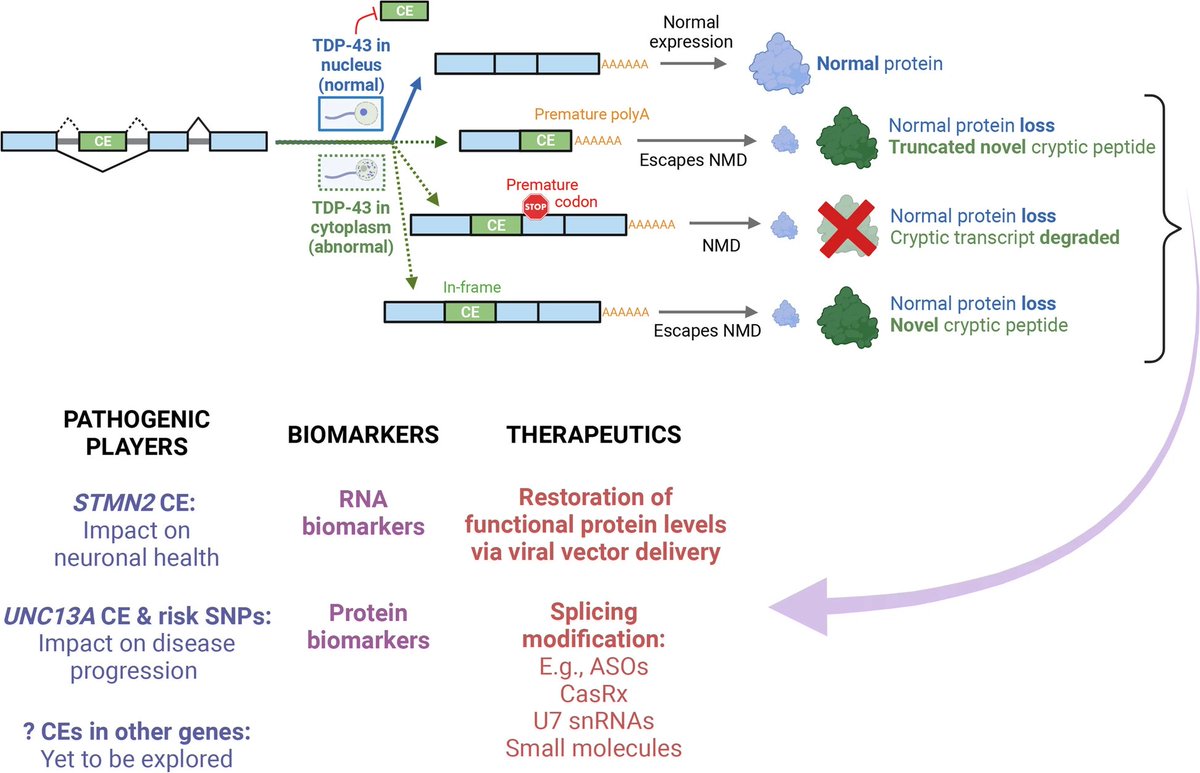
'The era of cryptic exons: implications for ALS-FTD'
We discuss recent discoveries & the exciting opportunities that cryptic exons offer for the development of novel therapies & biomarkers in #ALS#MND#FTD 🧠🧪