@OILMAN24x7@RichardHanania Oh please.
We could wipe both India and Iran off the map within a month in a real war.
Take the stupid rules of engagement crippling our soldiers then the Indians and Iranians would become dogmeat.
@B_1Tactical You do know that the original 1911 went 6,000 rounds without a malfunction during military trials, right?
Loosen the rails and tolerances and it's as reliable as a Glock.
Elegantly crafted. Seamlessly contoured. Thoughtfully detailed. motorola signature 27 is designed to a higher standard.
#MotorolaSignature#SignatureStatement
Autonomous cars have strings on them.
They're connected.
They can be shut down and even driven remotely.
They watch and report on you.
And when they break down, it costs a fortune to fix them.
An older car has no strings. You get in and go.
That's autonomy.
That's freedom.
Why do people have so much faith in this technology?
Trucks are already complicated enough with the new exhaust systems and sensors all over them, and now we're adding computers and communications to them as well?
Overcomplication leads to higher maintenance, more downtime, and more failures.
The trucks that don't drive themselves break down enough as it is.
I don't trust technology that's more complicated than it is innovative.
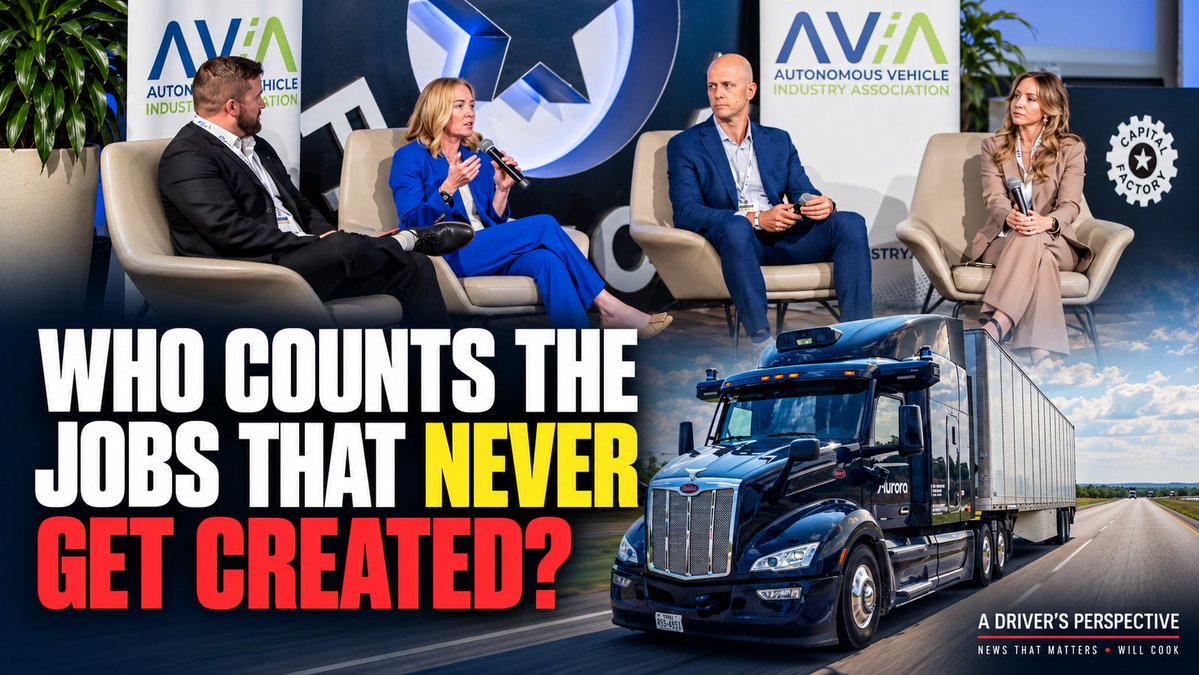
AUTONOMOUS TRUCKING COUNTS THE JOBS IT SUPPORTS. WHO COUNTS THE JOBS THAT NEVER GET CREATED?
The Autonomous Vehicle Industry Association’s recap of Autonomy Summit 26 highlights career opportunities in vehicle assembly, maintenance, engineering, and fleet operations. It also cites a Steer analysis estimating that autonomous trucking supports 17,000 jobs and $3.3 billion in economic output.
Those numbers deserve examination. So does the other side of the employment equation.
The analysis was commissioned by Aurora, an autonomous trucking company. That does not make its findings wrong. It does mean readers should understand who funded the research—and what the headline figures actually establish. Jobs supported by an emerging industry are not, by themselves, proof of a net employment gain. (https://t.co/iaeQP95fkO)
From where I sit, after 36 years behind the wheel, the workforce discussion needs to go further.
How many permanent jobs will these fleets require at scale? Where will those jobs be located? What will they pay compared with the work being replaced? Who pays for retraining, and how does a worker support a family during that transition?
For dispatchers, brokers, recruiters, safety personnel, and operations managers, there is another question: how will your own position change as transportation companies reorganize around automation?
We should investigate those effects carefully. We should also measure something a layoff announcement cannot capture: FUTURE HIRING THAT NEVER HAPPENS.
If a company grows its freight volume while needing fewer additional people, opportunities can shrink without a single existing employee receiving a pink slip. The next generation encounters fewer openings. A small operator may face a harder path into business. An experienced worker may find fewer options when it is time to change employers.
That possibility deserves a place beside the promises of new technical careers.
I believe businesses should be free to innovate and compete. Workers deserve enough transparency to make informed decisions about their own futures. A claim that no college degree is required still needs a job count, a location, a wage, and a realistic path into the position.
AVIA’s recap ends by calling on Congress to establish a national framework for deployment. Before workforce benefits become a selling point for that policy, lawmakers should ask for the complete employment picture.
COUNT THE NEW JOBS. COUNT THE DISPLACEMENT. ACCOUNT FOR THE OPPORTUNITIES THAT MAY NEVER EXIST.
What evidence would convince you that the workforce benefits reach the people whose work makes today’s transportation system possible?
Will Cook
A Driver’s Perspective
#AutonomousTrucking #FutureOfWork #ADriversPerspective
Because Bruce Lee.
Whatever Bruce was, charlatan or actual fighter, he had a big mouth, a bigger ego, and a small frame.
But people loved him.
Even Chuck Norris had enough sense to never say who would win in a real fight (Chuck would) because he respected Lee's legacy.