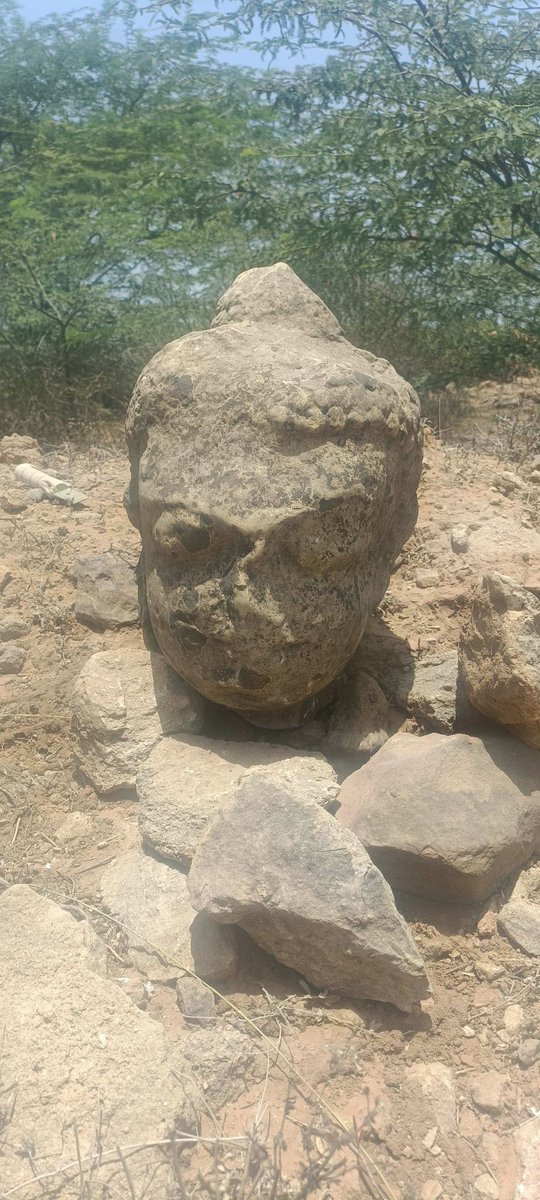
The Buddha's head, possibly Kshatrapa or Gupta period, near Dwarka, Saurashtra region.
I have been seeing it in this condition for almost 20-25 years, @ASIGoI is in totally neglected mode.
Photo credit: Myself.
@saltbylutyens Who is Ajit Bharti? A non-state actor who uses hate speech and specializes in spreading hatred and creating a specific narrative. How justified is it to give him a platform?
Jain and Buddhist history is authentic and well-documented through extensive archaeology, inscriptions, and literary traditions spanning centuries. They do not need such fabricated or exaggerated claims.
The material from Kankali Tila in Mathura is indeed valuable and shows a long and rich history of Jain presence there, but it is not 3000 years old. The attached screenshot is from Vincent A. Smith’s scholarly book The Jain Stūpa and other Antiquities of Mathurā (1901), which describes a small Jain votive stūpa (just 10½ inches high) found near the Holi Gate.
The inscription on it begins with “Namo arahato Vardhamānasa” in characters similar to those of the Kushan period (1st–3rd century CE), or perhaps a little later.
Smith clearly notes that this shows early use of such miniature votive stūpas by Jains, but still firmly places it in the early historical period, not in the Harappan era.
Mainstream archaeology dates the important Jain remains, sculptures, and ayagapatas from Kankali Tila roughly from the 2nd century BCE to the 12th century CE. This already represents many centuries of continuous Jain activity and artistic achievement at Mathura a heritage that stands strong on its own verified evidence. There is no archaeological support for a direct link to Harappan culture or for dating these artifacts to 3000 years ago.
Traditional beliefs can be respected, but physical evidence and paleography must guide historical claims. Exaggeration only weakens the credibility of genuine history.
3000 वर्ष से भी अधिक प्राचीन जैन स्तूप ।
मथुरा कंकाली टीला से प्राप्त पुरातत्व विभाग को यहां 600 से अधिक अवशेष प्राप्त हुए हैं।
हमें प्राचीन भारतीय सभ्यता,संस्कृति और सामाजिक व्यवस्थाओं के इतिहास की वृहद जानकारियां प्राप्त होती है । जो हमें हड़प्पा संस्कृति से सीधे जोड़ती हैं।
Tucked away in Jinavari village near Jamnagar, Saurastra stands this small, unassuming square shrine just 10.9 feet inside, 23 feet high, with plain walls that suddenly curve into a striking stepped pyramidal śikhara.
Built in the 5th–6th century during the Maitraka dynasty, it is one of the oldest surviving stone temples in Gujarat and a rare pre-Caulukyan masterpiece.
Even more fascinating: according to archaeologist Cousens, this unique style was likely introduced to southwestern Kathiawar by the ancestors of the Mer community of Saurastra-Kathiawar.
Its bold use of Buddhist-Gandhara architectural elements caitya windows, corbelled hollow roof, and angular stepped spire seamlessly blended into a Hindu temple. They took the best from Buddhist cave and stupa traditions and created something new that later flowered into the grand Solanki-Cãulukyan style.
Small in size, massive in significance. Gop quietly proves that Indian temple architecture has always been about fearless innovation and cultural synthesis.
Photo credit: BhaveshP by @OPPOIndia
The seventh-century rock-cut relief in the cave interior at Tham Phra Phothisat, central Thailand, is the most spectacular demonstration of this phenomenon:
An enthroned Buddha is seen preaching to the Brahmanical gods Siva and Visnu, both of whom gesture submission as they receive instruction in Buddhist dharma.
This scene illustrates the "Indianization" of Southeast Asia, where Indic religious ideas were adopted and synthesized with local traditions.
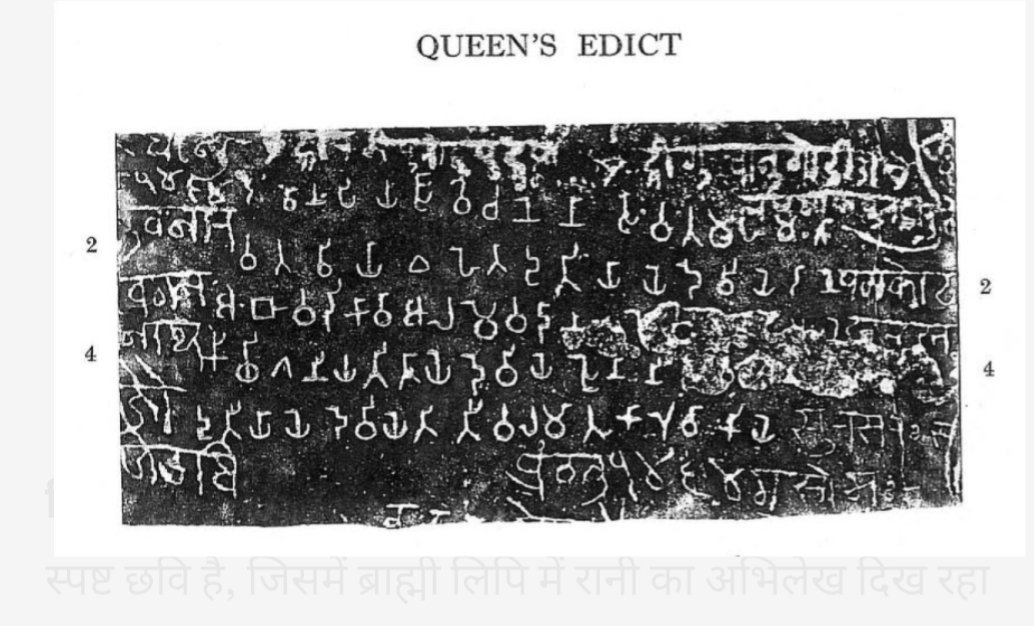
Asōka’s Queen: The Only Inscription Dedicated to His Queen.
Inscribed on the Allahabad Pillar (Prayag) Among the hundreds of rock and pillar edicts of Emperor Asōka (268–232 BCE), the name of any of his queens appears only once in this unique inscription.
Carved on the lower portion of the Allahabad Pillar, this edict is known as the Queen’s Gifts Edict.
Devānampiyasa vacanena savata mahāmātā vaktavyā :
E heta dutiyāye deviye dāne ambā-vaḍikā vā, ārāme vā, dāna-gahe vā, e vā pi aṃne kiṃci gaṇiyati tāye deviye tāni hevaṃ dutiyāye deviye ti,
Tīvala-mātu Kāruvākiye.
“By the word of the Beloved of the Gods, the Mahamatras everywhere are to be told: Whatever gifts of the Second Queen whether mango-groves, or gardens, or almshouses, or anything else that is reckoned as a gift all these are to be reckoned as of that Queen, the Second Queen Kāruvākī, the mother of Tīvala.”
This is the only known historical mention of Asōka’s second queen, Kāruvākī, and their son, Prince Tīvala.
Asōka personally ordered that all charitable donations made by the queen mango orchards, pleasure gardens, rest houses, and other public welfare works must be officially recorded in her name alone, and not credited to the king or the state.
The edict reflects Asōka’s respect for his queen’s independent piety and his desire that her good deeds (punya) be properly attributed to her.
From the point of view of known history, this is the first recorded mention of a queen of any emperor in the Indian subcontinent.
While Emperor Asōka is famous for his support of Buddhism, here's a fascinating inscription from his grandson that proves the Mauryan dynasty extended patronage to another major contemporary sect, the Ājīvikas.
Dasaratha’s Nagarjuni Hill Cave Inscription (3rd century BCE):
सिद्धं। देवानंपियेन दसरथेन राजिना महामात-पुता-भिसितेन एस वपियका-कुभा दानं आजीविकानं।
This is powerful epigraphic proof that the Mauryas actively supported multiple heterodox sects both Buddhists and Ājīvikas demonstrating remarkable religious pluralism and tolerance at the highest level of the empire.
This inscription also shows the organizational importance of the Buddhist and Ajivika religions of that time.
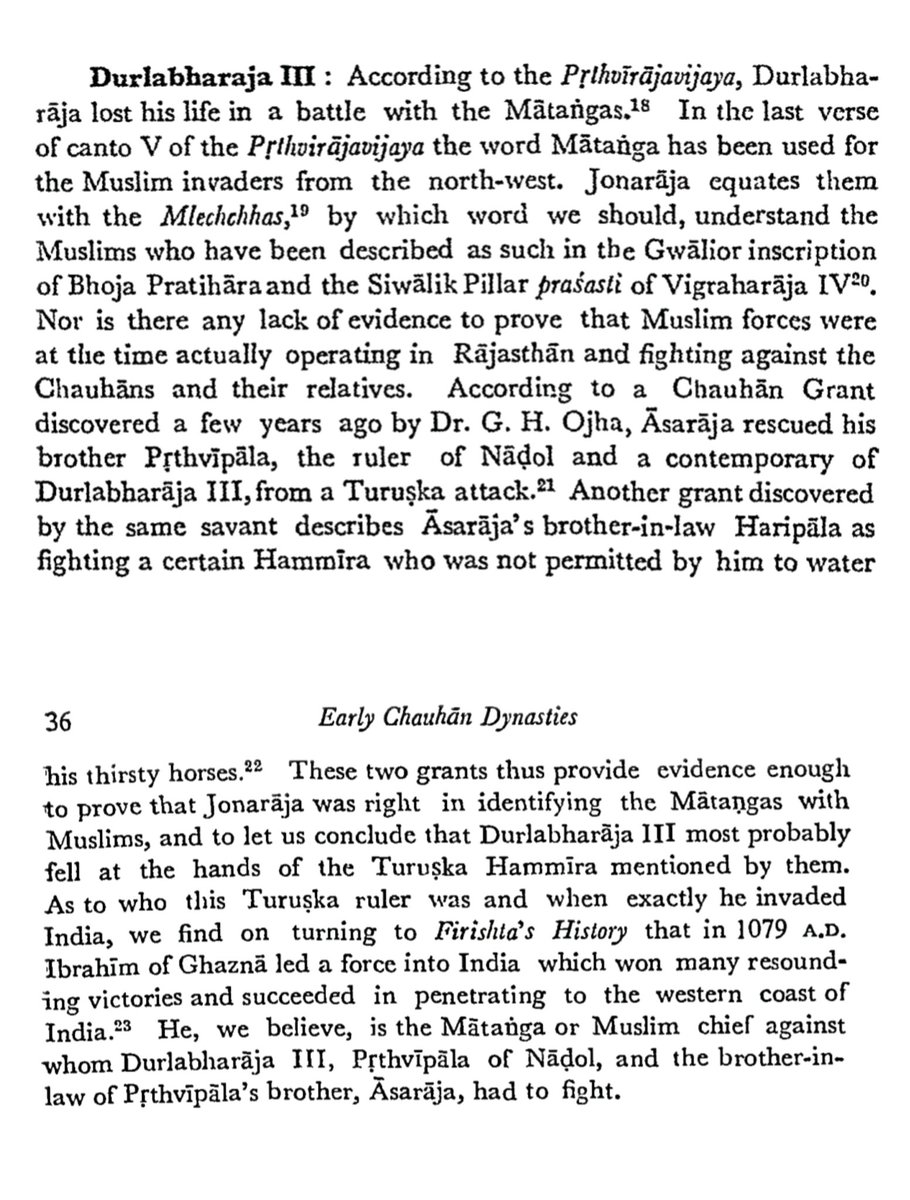
According to the Prithvirajavijaya, Chauhan ruler Durlabharaja III lost his life fighting the Mātangas the Muslim invaders from the North-West. The term Mātanga was used as a synonym for the Mlechchhas (Muslims), as also mentioned in other contemporary inscriptions.
Two important Chauhan grants discovered by Dr. G.H. Ojha provide strong evidence:
Asaraja rescued his brother Prithvipala of Nadol from a Turushka attack.
Haripala fought against a certain Hammira who was denied water for his horses.
Historians identify this invasion with Ibrahim of Ghazna’s campaign in 1079 AD. This incidence marks one of the early resistances by the Chauhans (Rajputs) against the expanding Muslim invasions in Rajasthan.
This relief narrates the story of the Haryanka ruler’s visit to the Buddha in four scenes.
In the lower left corner, Ajatashatru and his wives are going forth on elephant back to seek out the Buddha. To the right, Ajatashatru is dismounting from his elephant in Jivaka’s mango grove (Jivaka amravana).
The left rear of the panel shows the king and his queens standing with hands folded in adoration at nighttime. The last scene to the right rear depicts Ajatashatru kneeling in veneration before a pair of footprints (buddhapada), a throne (asana) and a parasol (chhattra).
The label inscribed sideways along the pilaster enclosing the panel on the right says "Ajatasatu Bhagavato vandate"
To those claiming Ajatashatru is just a Buddhist myth. The Bharhut Stupa pillar (2nd century BCE) literally says:
“Ajatasatu Bhagavato vandate”
He was a real 5th-century BCE Magadhan ruler and contemporary of the Buddha.
#Archaeology doesn’t lie.
Ancient Inscription Addresses Lord Buddha as “Bhagavato Mahadevasa”!
On the railing of the Bharhut Stupa (2nd century BCE) in Madhya Pradesh, a remarkable inscription has been found: "Bahuhathika Asana Bhagavato Mahadevasa".
Means “The many-handed seat (or throne) of the Lord Mahadeva.” Here, “Bhagavato” is the common Buddhist title meaning “the Blessed One” or “Lord”, and “Mahadevasa” refers to the “Great God” or “Great Lord”.
In the early aniconic Buddhist tradition, Buddha was never shown in human form. He was represented by symbols like the empty Vajrasana, Bodhi tree, or footprints. Devotees raised their hands in worship hence “Bahuhathika” (many-handed).
Sir Alexander Cunningham, who excavated Bharhut in 1874, wrote in his book The Stupa of Bharhut (1879): “The inscription… (Ba)hu-hathika âsana — (Bha)gavato Mahadevasa.
It is possible, therefore, that this Pillar may have formed part of the Railing surrounding a Vajrâsan.”
This clearly refers to Lord Buddha, not any other deity. In ancient India, the title “Mahadeva” was also used respectfully for the Buddha, highlighting his supreme spiritual status.
Some are unemployed, some are suffering losses in business, some are troubled by neighbors, some by relatives, some by their daughter-in-law, some by their mother-in-law. All these frustrations are expressed in this situation.
These are all low-class (SC/ST/OBC), undereducated people, whom these hypocritical babas exploit to run their businesses. These people are termites, eroding our ancient civilization from within.
રાજકોટ
ધીરેન્દ્ર શાસ્ત્રીનું દિવ્ય દરબાર આવ્યું વિવાદમાં
આસ્થાના નામે અંધશ્રદ્ધા ફેલાવવામાં આવી હોવાના આરોપ
ધીરેન્દ્ર શાસ્ત્રીના હુંકાર બાદ ભૂત પ્રેત ધુણવા લાગ્યા
ભૂત પ્રેતના નામે અનેક લોકો ધુણવા લાગતા અફરા-તફરી
ધુણતા ધુણતા એક મહિલાએ સિક્યુરિટી, પત્રકાર અને ભક્ત પર કર્યો હુમલો
મહિલાએ પ્રેત આવ્યાના નામે કર્યો હુમલો
લોકો ધુણતા હતા અને સ્ટેજ ઉપરથી ધીરેન્દ્ર શાસ્ત્રી તમાશો જોઈ રહ્યા હતા
સોશિયલ મીડિયામાં વિડીયો વાયરલ થતા લોકોએ અંધશ્રદ્ધાના નામે ધુણવાની કરી ટીકા
“नमो भगवते बुद्धाय, इक्खाकु-राज-पवरा-ऋषि-सत-पभवा-वंसा-संभवस्स”
This phrase indicates that the Ikshvaku dynasty considered themselves descendants of the Buddha or related clans, enhancing their Kshatriya/legal status and legitimizing Buddhist patronage (queens building stupas and viharas). This claim is historical/epigraphic, consistent with the Buddha being of Ikshvaku/Shakya descent, but the Andhra Ikshvakus used it to assert their royal legitimacy. This is not evident in the Kesanapalli or Rentala inscriptions, but is found primarily in the Buddhist-referenced inscriptions at Nagarjunakonda.
The Ikshvakus trace their lineage to the Buddha. Significantly, they did not include Rama, Dilipa, or Bhagiratha in this category. Here, the Buddha is addressed as Bhagavato Ikshvaku Raja.
Sidham:
Namo bhagavato Ikhaku-rāja-pavara-risi-satta-
pabhava-vamsa-sambhavasa deva-manusa-sava-sata-hita-
sukha-maga-desikasa.