Today, we’re releasing the open weights for Hy4.
Our natively multimodal flagship MoE (770B total / 49B active, 1M context).
Alongside the Hy4 System Card with a comprehensive safety evaluation report.
➡️ Join the Hy team for a live AMA this Friday, 8–10 AM PT on r/LocalLLaMA—drop any questions about Hy models and chat with us directly!
GitHub: https://t.co/pjJpq0KxfG
Weights: https://t.co/lnPNs1AxkJ
GGUF:https://t.co/s7zKuifKL9
License: https://t.co/Dh5FdiVJUt
System Card: https://t.co/VcFbN8xdu3
refreshing some materials
when I say models know more I mean it literaly not as some hiperbole
and the difference grows with model size although it gets harder to steer/find
6.2 is a very intelligent model and people are over indexing on its poor communication ( though this should of been fixed before release )
Feels similar to o3 though even o3 wasn’t as autistic.
i fine-tuned qwen3-vl 8b to watch a video and tell you how the shot was made. i'm calling it shot reader.
camera height, lens, angle, how the camera moves. who's in frame, where they stand, where they walk.
turns out that's hard for ai. even opus 5.5 and gemini 4, with a prompt written specifically to reverse-engineer shots, get the camera height and move both right less than half the time. open models out of the box: 5%.
shot reader gets 69%. it's 2.4x faster than opus, ~30x cheaper, and small enough to run on your own gpu.
why it matters: ai can already write blender. getting a shot right starts with reading it.
see a shot → get the plan → rebuild it in 3d, reshoot it, remix it.
open weights on hugging face, link below.
A case study of how self-funded devs can make increasingly competitive harnesses, better than many well funded labs or university groups.
As part of growing community of participants in competitions @yukonresearch, we have been increasingly encountering talented folks who aren't working in big ai labs or universities but are extremely good in building harnesses that can make big progress in frontier science problems.
One of our goal with https://t.co/9ZpEsupgtw has been to create an open platform for them to showcase the prowess and competitiveness of their harness in frontier science problems.
In a bid to make the competition fair and data driven, we took inspiration from @demishassabis's Einstein test. We took our OG competition @yukonresearch, https://t.co/leqhW4oEPP, and any submitted harness is then backtested on how it makes progress in finding resource-efficient quantum circuits for Shor's algorithm (without any internet access).
After submission of a harness, you can see how effective your harness has been in finding better and better quantum circuit for per unit dollar. One can say this is akin to innovation per unit dollar for that harness.
We encourage more of you to submit your harness to this competition.
I’ve worked on lattice superfluid vortices and solitonic hopf links in a quantum material, and condensed matter interactions of quasiparticles. Is this guy using my work?
TLDR Darkbloom is building the airbnb for compute with the goal to become a protocol: the largest data center that owns no computers. Once it is protocolized, the revenue will flow back to EIGEN.
Yukon is a centralized product for open frontier research built by Eigen Labs. Research on Yukon makes darkbloom a better product by serving faster, cheaper inference and once smaller models become capable of doing research, Yukon can start driving utilization of Darkbloom.
At Eigen Labs, our goal is to build open networks for open intelligence! If you find this mission exciting, please come join us!
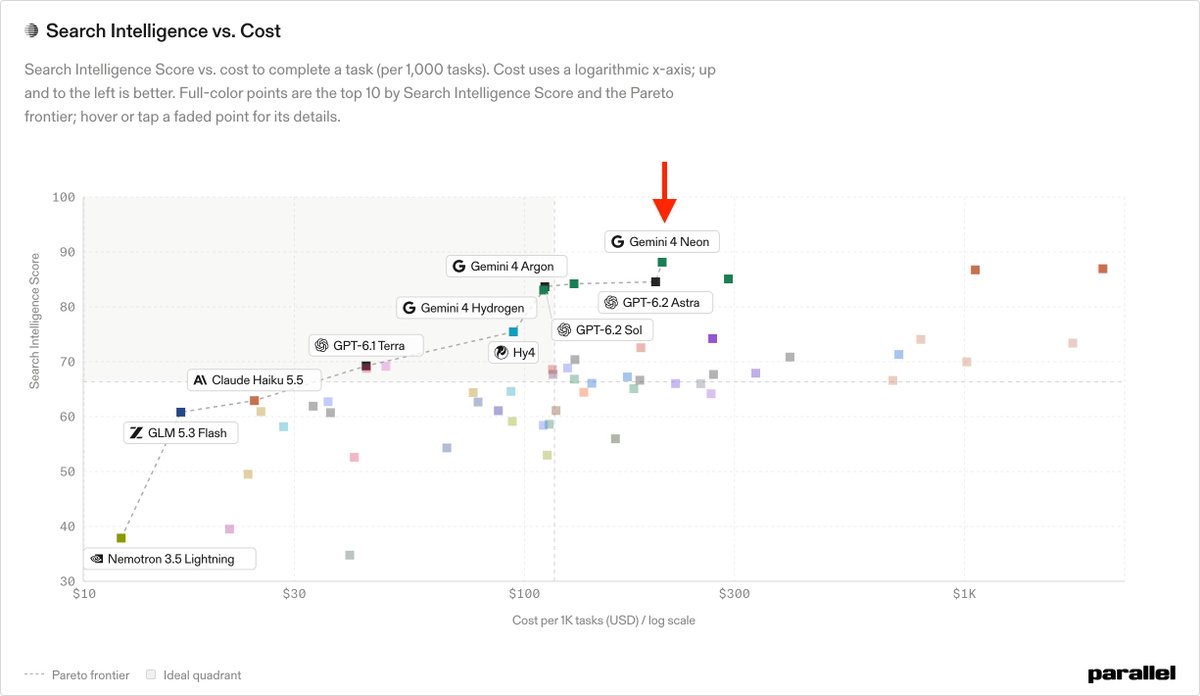
NEW: Gemini 4 Neon is the highest-performing model we've measured.
Not only is it the most intelligent model on our leaderboard, it's also up to 10x cheaper than the next best, reshaping the Pareto frontier of cost vs. intelligence on web research tasks.