People hear “1 terawatt a year” of AI chips. Here’s what that production ceiling actually unlocks.
Tesla and SpaceX have put about $16.8B on the table for phase one of that joint mega-fab - Terafab - and public filings have floated much larger multi-phase totals later. This is the opening cheque, not the max budget. They’re doing it because they need more AI chips than the world’s existing fabs will sell them!
The goal they talk about is 1 terawatt a year of new AI compute. That is a max annual production ambition, not day-one output and not a stockpile. @elonmusk puts today’s global AI chip production at about 20 GW/year. That’s where the 50× comes from. He has also said, roughly, that most of Terafab’s AI compute is for AI spacecraft, with a smaller share for Optimus on the ground.
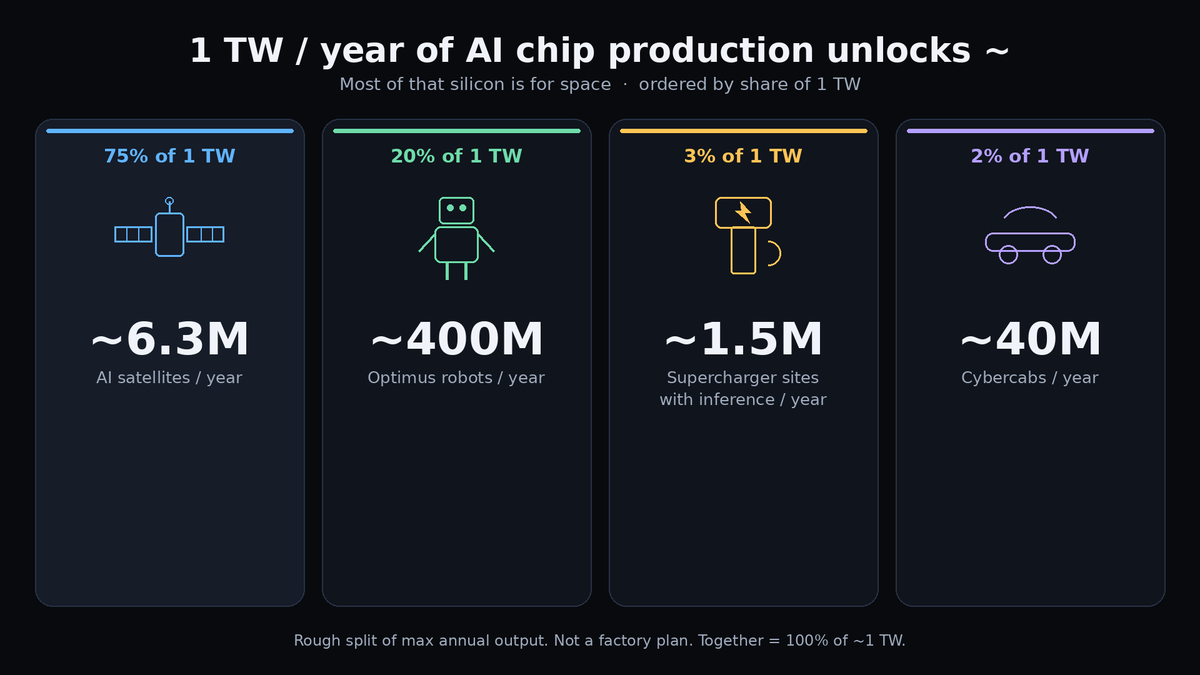
What 1 TW/year unlocks in practice (rough useful-demand illustration):
~6.3 million orbital AI satellites per year (~75%)
~400 million Optimus robots per year (~20%)
~40 million Cybercabs per year (~2%)
and a smaller slice: ~1.5 million Supercharger sites with on-site inference (~3%)
Together, those are about 1 TW. One production ceiling. Most of it is orbital.
And that’s just one year of production.
Dirt is already moving in Grimes County, Texas (Gibbons Creek Reservoir area, east of College Station).
@CuriousPejjy Dude no premium connectivity sucks. I have 2 Teslas and disabled premium connectivity on one of them and it's such a crappy experience having to tether each time I want to use Spotify.
@tslaming Somewhat surprising considering they haven't even approved FSD, but it's still a great sign because it means they will likely approve FSD sooner than later, and that'll make it the 6th country in the EU to approve FSD unless the TCMV vote in Oct just approves it EU wide.
@EVStraya That would be very welcome. If the next version makes the car drive a little further away from the median strip and not get so close to curbs when going around round abouts I would probably move from 85% on Self driving to 90%+
I'm happy even if it's paid. All hotels and resorts just have to have charing capabilities or smart power points to make it easy and convenient for EV owners.
That being said, I spent 1 month on the east cost of US and the tesls super charging network was convenient enough as a Tesla driver that I didn't really need charging at our hotels and Airbnb. The super charger network in the US is very dense.
@TimTheTerrific@niccruzpatane The avg battery pack these days is around 70kWh so you won't get 10%. In ideal scenarios you'll get 2 - 7% (realistically maybe 1-3%) which isn't terrible but I get that for almost free and very quick at home when I charge using excess solar from my solar array.
@AnsorgH@pbeisel Then I think Tesla will be able to get a foothold in that market. That being said you're probably right it will come with a lot of resistance.
@yunta_tsai@bot The user experience is really on point. I don't have to mess around with configuring my VPS constantly and hacking things around to get my agents to work they way I need them to work and to fix things when they break. @bot just works. I love it!
@CARN0N I'm paying $75 a month for 500Mbps, once I can get 250Mbps I would seriously consider switching to Starlink. I have 2 starlink dishes, so wouldn't mind putting them to good use.
I was struggling to wrap my head around what 1TW of commute at Terrafab would mean practically. So I did some research and landed on this. May be helpful to others who are the in the same boat I was in.
https://t.co/gH0axFU60n
It’s one the most ambitious project I’ve ever come across.
People hear “1 terawatt a year” of AI chips. Here’s what that production ceiling actually unlocks.
Tesla and SpaceX have put about $16.8B on the table for phase one of that joint mega-fab - Terafab - and public filings have floated much larger multi-phase totals later. This is the opening cheque, not the max budget. They’re doing it because they need more AI chips than the world’s existing fabs will sell them!
The goal they talk about is 1 terawatt a year of new AI compute. That is a max annual production ambition, not day-one output and not a stockpile. @elonmusk puts today’s global AI chip production at about 20 GW/year. That’s where the 50× comes from. He has also said, roughly, that most of Terafab’s AI compute is for AI spacecraft, with a smaller share for Optimus on the ground.
What 1 TW/year unlocks in practice (rough useful-demand illustration):
~6.3 million orbital AI satellites per year (~75%)
~400 million Optimus robots per year (~20%)
~40 million Cybercabs per year (~2%)
and a smaller slice: ~1.5 million Supercharger sites with on-site inference (~3%)
Together, those are about 1 TW. One production ceiling. Most of it is orbital.
And that’s just one year of production.
Dirt is already moving in Grimes County, Texas (Gibbons Creek Reservoir area, east of College Station).