A major step forward for Nigeria’s digital economy 🇳🇬
We have published Nigeria’s first Digital Services Sector Mapping Report and updated the CAC registry with 17 new sectors and 68 digital services, ensuring Nigerian firms are better classified, represented, and 👇🏽
Someone had been transferring $20,000 into my bank account every December for four years.
I never touched the money.
I didn’t know who was sending it.
Every time I tried to report it, the bank told me the transfer had been authorized from an account belonging to someone named Thomas Reed.
I didn’t know anyone by that name.
Then, in the fifth year, the transfer came again.
But this time, there was a message attached:
“You can spend it now.”
I immediately went to the bank.
The manager looked at the account and went silent.
Then he asked me a strange question.
“Did your father ever mention Thomas Reed?”
I said no.
"I ask for soldiers, I'm being given politicians dressed in uniform." — Major-General Johnson Thomas Umunakwe Aguiyi-Ironsi (1924-1966).
Aguiyi-Ironsi was the first Nigerian soldier to be a Major-General from the rank of Private. He joined the Army at the age of 18 in 1942 against his sister's wishes.
As Head of State, Ironsi banned the Hausa language as the lingua franca of the Nigerian military (and civil service examinations in the North) and enforced the English language (many Hausa infantry soldiers could not speak English).
In his 194 days as Head of State (the shortest military rule in Nigerian history), Aguiyi-Ironsi ensured fundamental human rights and freedom of expression were not abused.
The Head of State promulgated Decree No. 2 which removed the restrictions on press freedom the Sir Abubakar Tafawa Balewa-led civilian administration had put in place and Decree No. 44 which made it an "offence to display or pass on pictorial representation, sing songs, or play instruments the words of which are likely to provoke any section of the country," in March 1966.
Aguiyi-Ironsi also passed Decree No. 34 on May 24, 1966, which aimed to unify Nigeria into a unitary state and make the country one single entity for easy administration. #HistoryVille
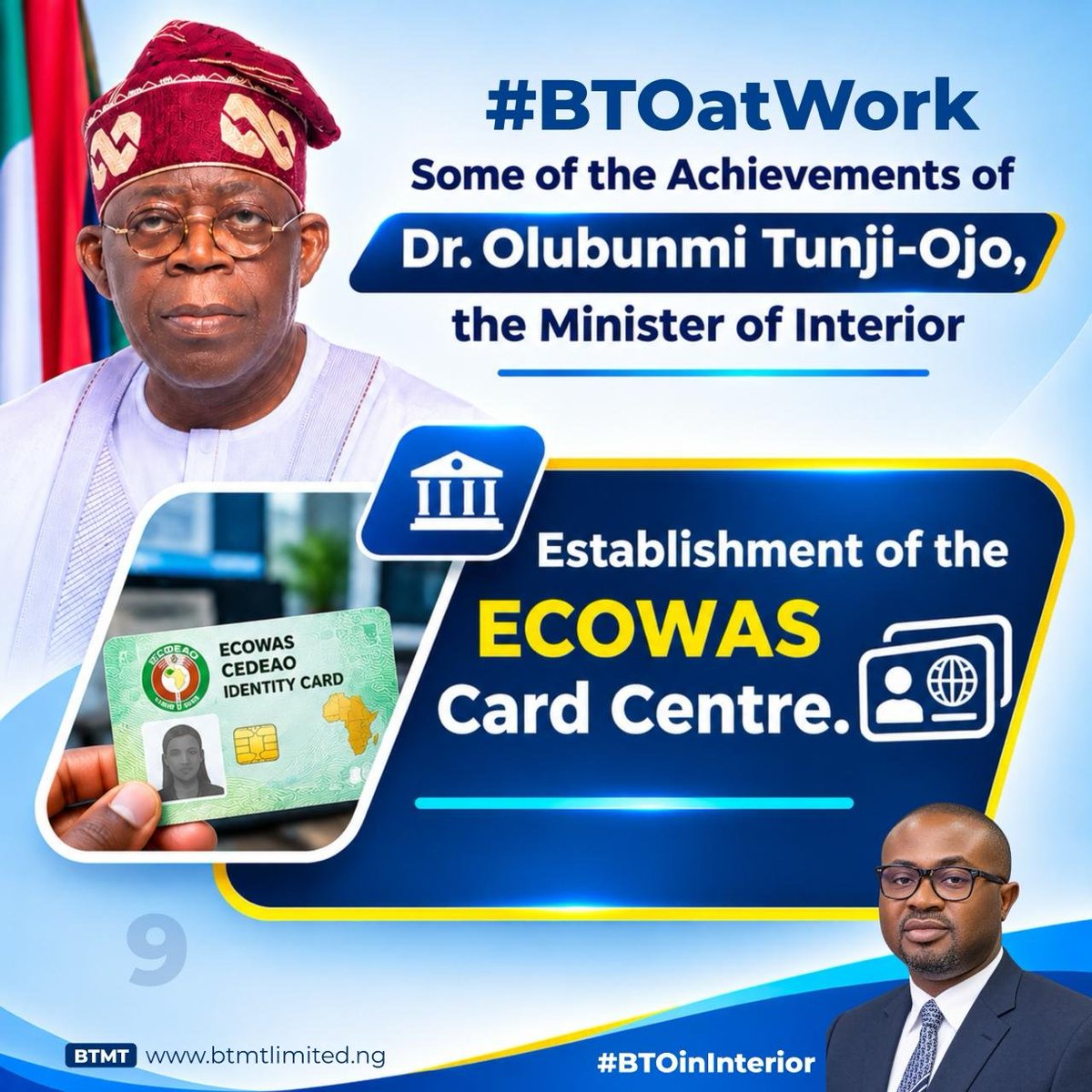
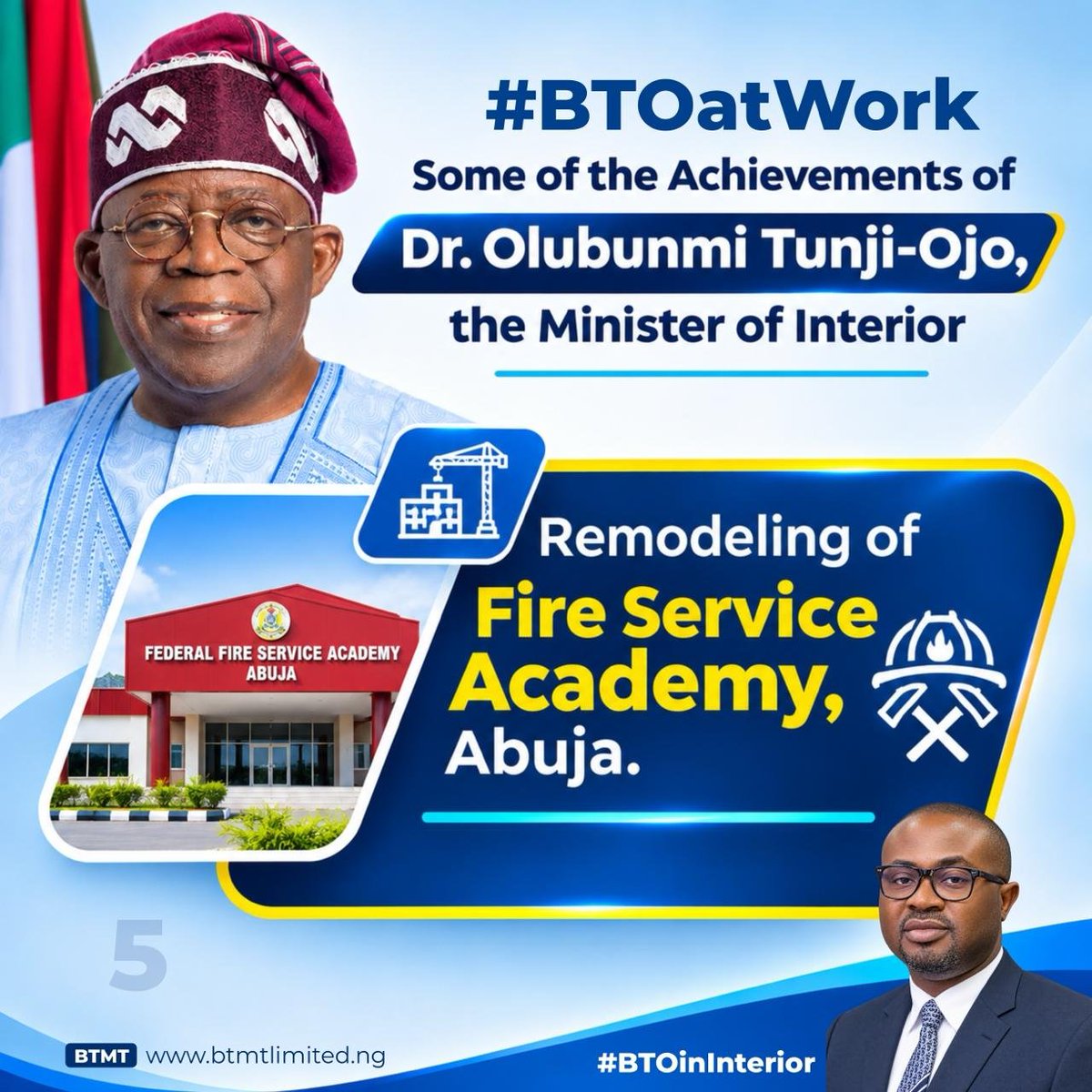
NO DOUBT, HON. OLUBUNMI TUNJI-OJO IS ONE OF THE MOST OUTSTANDING MINISTERS IN PRESIDENT TINUBU'S CABINET.
There is no denying that Dr Olubunmi Tunji-Ojo, the Honourable Minister of Interior, has continued to demonstrate exceptional leadership, dedication and a strong commitment to institutional reforms and service delivery.
Since assuming office, he has championed several transformative initiatives aimed at modernising the Ministry of Interior, improving operational efficiency, strengthening national security administration and making essential government services more accessible to Nigerians.
From reforms in passport administration and immigration services to the modernisation of correctional facilities, improved personnel welfare and the digital transformation of government processes, his leadership has continued to make a visible impact.
His commitment to innovation, accountability, efficiency and improved service delivery reflects the determination of the Tinubu administration to build stronger and more effective public institutions.
Below are some of the notable achievements and ongoing reforms under the leadership of Dr Olubunmi Tunji-Ojo, Minister of Interior.
Leadership that delivers. Reforms that matter. Results that inspire!
#BTOatWork
#BTOinInterior
“We have decided to follow BOLA TINUBU because of his leadership qualities. Obi has none. We all see Tinubu’s mentees, his aides, his commissioners, his SAs who are governors, ministers, senators, kings etc. Can you point to any from Obi? We are not supporting Atiku because of his lack of respect for power rotation. Obi and Atiku move from one party to another every election cycle. Tinubu builds his own party. Obi had opportunity to build LP but instead, he scuttled it…We have seen the audacity of President Tinubu in his reforms that removed fuel subsidy, stabilized our currency, building our foreign reserves and strengthening the economy, combatting insecurity…”
Labour Party Legacy Leaders adopt TINUBU for reelection
How do I tell my fellow Peter Obi supporters that the man many of us celebrate today as the hope of Nigeria was once associated with the government of Abacha, a military dictator, while the same Tinubu we criticise today was once risking his life as a democracy activist and freedom fighter, fighting Abacha for the return of the democracy we are all enjoying today?
Well, after reading this story, I just had to sit down and think for a very long time.
In 1993, when Abacha took over power, Tinubu was a senator representing Lagos West. He refused to accept military rule, rallied other senators, joined NADECO and demanded that Abacha hand over power to MKO Abiola.
His defiance came at a huge cost. He was arrested, detained, his passport was seized, his home was raided and eventually bombed. When the pressure became too much, he had to escape Nigeria through Badagry, disguised as a malam in a babanriga and turban.
Even in exile in Benin Republic, he continued helping other NADECO members escape Nigeria.
Then came the part that really caught my attention. According to Tinubu's account, Abacha's assassins tracked him to a hotel in Cotonou. But on the day they came looking for him, he had gone out on a motorbike to buy amala.
Now, on the other hand, when all this was happening, This Peter Obi we now see as Saint was busy doing errand boy for Abacha.
Fast-forward to today. Tinubu, who was once celebrated by many as a freedom fighter, is now seen as a bad leader, while Peter Obi who was once seen as an enemy of democracy is seen as a good guy, talking with a woman's voice, celebrated by millions as a symbol of hope.
It makes you wonder: Did people change? Did their circumstances change? Or did we simply get to see different sides of the same people?
Let me mind my business Shaa.
Copied
@
There Is A Lagos In Portugal, France, Spain, Ghana, Mexico, Indonesia But Only One Lagos Is Lagos of Nigeria:
My people, I have to confess something to you today. I was thinking it was only two Lagos in the whole world.
I thought it was only our own Lagos in Nigeria and that other Lagos in Portugal. I said, ah, so Portugal gave us this name, that is where it ends.
I was wrong. I went to check and I was shocked.
It turns out Lagos has travelled all over the world. It is not only two. It is up to 9 countries.
And the reason is simple. Lagos is not just a name. Lagos is a Portuguese word for lakes. Anywhere the Portuguese went and saw water, lakes and lagoons, they called that place Lagos.
That is why Portugal has their own Lagos in Algarve. That is the original one. They saw our own Lagos in Nigeria, they saw the water and lagoons, and they said, this place looks like our own Lagos. So they gave us the same name.
But after that, there is still more. Spain has their own small Lagos in Malaga. France has their own village called Lagos near Pau. Greece even has two Lagos, one in Xanthi and one in Crete. Ghana has their own Lagos near Kumasi. Chile has Los Lagos. Mexico has Lagos de Moreno. Indonesia has their own Lagos far from Jakarta.
So when you hear Lagos, do not rush and think it is Nigeria’s Lagos. It may be another Lagos.
But let me tell you the truth. Out of all these Lagos in the world, only one Lagos is Lagos. Our own Lagos in Nigeria is the biggest, the loudest, the most famous. The rest are just bearing the name.
So tell me, before today, did you also think it was only Nigeria and Portugal that had Lagos, or did you know there were others?
Now You Know
“Peter Obi introduced religious politics because of the Muslim-Muslim ticket. Politics is about strategy. He visited 12 major churches across the country, including my church, Winners Chapel. And I am a pastor in Winners Chapel.
As I speak to you today, Peter Obi has not returned to those churches he visited during the 2023 campaign because he knows that the 2023 agenda has failed.”
Presidential Spokesman Daniel Bwala alleges Peter Obi used a Muslim-Muslim ticket strategy during the 2023 presidential election
Popped in to visit my 100-year-old dad at his Ikorodu residence. Still as funny, sharp and mentally alert as ever. He is always such a joy to visit and spend time with him.
He never misses an opportunity to gush about his beloved wife, my late mum, who passed away five years ago at the age of 90. It is beautiful to see how fondly he remembers and speaks of her.
What a blessing to see him doing so well at 100!
Sometimes I just relax and think about how life was in what we now call Nigeria in 1809, the year Samuel Ajayi Crowther was born, and the truth is, there was nothing like Nigeria then.
What we had then was a land full of separate peoples, separate kingdoms and separate ways of life, all living side by side without knowing that one day a British man would draw a line around them and call them Nigeria in 1914.
In the north, life was just changing in a big way. Usman dan Fodio had just led his jihad, and by 1809 the Sokoto Caliphate was rising. The Hausa city states like Kano, Katsina, Zaria and Sokoto were being brought under one Islamic government, with Emirs, scholars, markets and farms. Further east, the Kanem Bornu Empire was still standing strong, with its own Mai, its own army and its own trade across the Sahara. People there prayed in mosques, traded in kola, salt, leather and horses, and they saw themselves as part of a Muslim world, not as Nigerians.
In the southwest, where Crowther himself was born, the story was different. The great Oyo Empire was already shaking. It was once powerful, with its Alaafin, its cavalry and its trade, but by 1809 it was breaking apart from inside. Wars were starting between Yoruba towns. Ile Ife was still respected as the spiritual home of the Yoruba. Benin was still a mighty kingdom on its own, with its Oba, its bronze workers and its traders. Ijebu, Egba, Ekiti and other Yoruba groups each had their own kings, their own markets and their own way of doing things. They spoke Yoruba, but they did not see themselves as one people under one flag.
In the southeast, life was even more different. There was no one big king like in Oyo or Benin. The Igbo lived in villages and towns, each one governing itself through elders, titled men and age grades. Places like Nri, Arochukwu, Onitsha and Awka each had their own power. People farmed yam and cassava, traded in palm oil and crafts, and settled their matters in village meetings. They did not owe loyalty to any emperor far away.
In the south south, in the Niger Delta, people were living by the rivers. Calabar, Bonny, Opobo and Warri were powerful trading towns. Their kings and chiefs grew rich from trading palm oil, fish and later slaves with European ships on the coast. They had their own canoes, their own gods and their own way of dealing with strangers. They did not feel connected to Kano or Sokoto at all.
In the middle belt, groups like the Tiv, Jukun, Idoma, Nupe and others were living in their own lands too, farming, hunting, trading and fighting their own local wars, with their own languages and customs.
So in 1809, a man in Kano, a man in Benin, a man in Onitsha and a man in Calabar would not have said they were from the same country. They would have said they were Hausa, Yoruba, Igbo, Efik, Kanuri, Nupe, Tiv or whatever their own people called themselves. They had different rulers, different gods, different markets and different enemies.
That is what makes Crowther story so deep to me. He was born in Oyo land in 1809, captured as a slave boy, taken to Sierra Leone, and later became a Bishop. He lived through the time when all these separate peoples were still separate, long before anyone thought to call them Nigeria.
When a man gets married, his bachelor friends respect his marriage. They do not try to lure him back to the streets. They will even remind him: "You are a married man now. You cannot be moving like us. Go back to your wife." They protect his home.
But when a woman gets married, her single friends often try to spoil her marriage. They compare her husband to other men, downplay his efforts, and give bad advice. They plant seeds of doubt and discontent.
A wise woman knows this, which is why she cuts off her single friends when she gets married.
Bayajidda was a prince from Baghdad who travelled through the ancient regions of Africa before eventually arriving in Daura, in present-day Katsina State.
One account of the legend holds that Bayajidda first settled in my hometown, Gaya, in present-day Kano State, where he obtained a knife from local blacksmiths. He subsequently travelled towards Daura, carrying the knife.
At the time, Daura was ruled by Queen Daurama. The town’s famous well, Kusugu, was said to be guarded by a fearsome serpent known as Sarki. The serpent reportedly prevented residents from drawing water except on Fridays.
When Bayajidda confronted the serpent, he reportedly used the knife he had obtained in Gaya to kill it, thereby freeing the people of Daura to draw water from the well. In recognition of his bravery, Queen Daurama married him.
Their descendants became central to the traditional account of the emergence of the Hausa Bakwai (the Seven Hausa States): Daura, Kano, Katsina, Zazzau, Gobir, Rano and Biram.
In this tradition, Gaya was not merely a place Bayajidda passed through, it was where local blacksmiths fashioned the knife that enabled him to overcome the serpent in Daura.