What actually happens to caffeine after you drink it?
your liver breaks caffeine into three separate biologically active molecules, each with different effects.
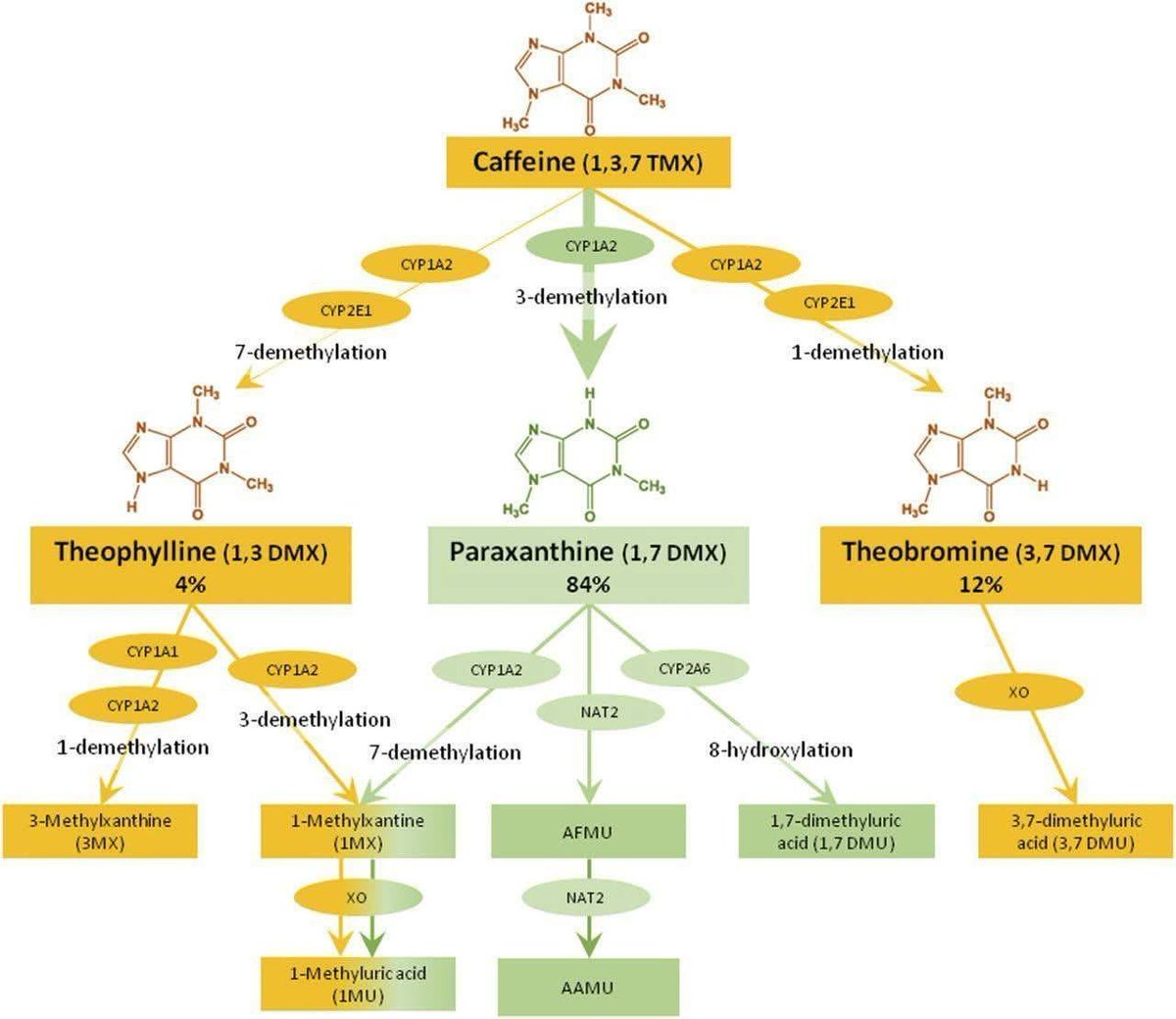
This pathway shows exactly how your body metabolizes caffeine, and why people respond so differently to the same cup of coffee.
When caffeine enters the bloodstream, 95% of its metabolism occurs in the liver and is controlled by the enzyme CYP1A2, one of the most genetically variable drug-metabolizing enzymes in humans.
Caffeine (1,3,7-trimethylxanthine) is broken down into three major metabolites:
1️⃣ Paraxanthine (1,7-DMX) - 84% of caffeine metabolism
This is the dominant metabolite.
Paraxanthine increases lipolysis, raises free fatty acids, and enhances alertness without as much vasoconstriction as caffeine itself.
Further metabolism produces AFMU, 1-methylxanthine, and 1-methyluric acid through NAT2 and XO pathways.
2️⃣ Theobromine (3,7-DMX) - 12%
Theobromine is the primary stimulant in chocolate.
It acts as a vasodilator, smooth muscle relaxant, and mild diuretic.
It is further metabolized into 3,7-dimethyluric acid via xanthine oxidase.
3️⃣ Theophylline (1,3-DMX) - 4%
Theophylline has bronchodilating properties and is actually used clinically for asthma.
It is metabolized into 3-methylxanthine and 1-methylxanthine through CYP1A1 and CYP1A2 pathways.
🧬 Why this diagram matters
Genetics determine how fast you metabolize caffeine.
Fast metabolizers (CYP1A2*1A) clear caffeine quickly → fewer jitters, higher tolerance, shorter half-life.
Slow metabolizers (CYP1A2*1F) break it down slowly → stronger effects, longer half-life, higher risk of sleep disruption and blood pressure effects.
NAT2 and other enzyme variants shape downstream metabolite balance.
This is why some people can drink coffee at 9 p.m. with no issue…
and others get heart palpitations from half a cup.
Your caffeine response isn't random, it's biochemistry + genetics.
📚 Source
Nehlig A. “Inter-individual differences in caffeine metabolism and factors driving caffeine consumption.”
🇺🇸 | AHORA: Microsoft anuncia que ha desarrollado un sistema de inteligencia artificial que crea un "camino hacia la superinteligencia médica" que puede lidiar con casos "diagnósticamente complejos e intelectualmente exigentes" y diagnosticar enfermedades con cuatro veces más precisión que un panel de médicos.
💥 ¿Quieres crear gráficos de dispersión que NO solo se vean bien, sino que también incluyan TODOS los detalles estadísticos que necesitas? ¡Usa 📦ggstatsplot! 🙌
🛠️ Ejemplo en acción: ggscatterstats permite hacer diagramas de dispersión listos para publicar📈
#Python#MachineLearning By Example: https://t.co/3mO7oBt4gc v/ @PacktPublishing
+
GitHub: https://t.co/XmXK8pz96h
——
#ML#DataScience#DataScientist
——
518-pages! What you will learn:
🟣Machine learning best practices throughout data preparation and model development
🟣Build and improve image classifiers using convolutional neural networks (CNNs) and transfer learning
🟣Develop and fine-tune neural networks using TensorFlow and PyTorch
🟣Analyze sequence data and make predictions using recurrent neural networks (RNNs), transformers, and CLIP
🟣Build classifiers using support vector machines (SVMs) and boost performance with PCA
🟣Avoid overfitting using regularization, feature selection, and more
Este símbolo ☭ debería causar la misma repulsión y rechazo que este 卍. Bajo la bandera del socialismo se hicieron genocidios, hambrunas, y en una ocasión casi provocan que Europa y parte de Asia quedaran completamente inhabitables (Chernobyl).
El socialismo es muerte y miseria.
Free Certification Courses to Learn Data Science in 2025:
1. Python
🔗 https://t.co/dIF8TuaOLu
2. SQL
🔗 https://t.co/Ge4bFjars9
3. Statistics and R
🔗 https://t.co/41ya4HlxPS
4. Data Science: R Basics
🔗https://t.co/56xixoYoMg
5. Excel and PowerBI
🔗 https://t.co/oWULVWbQPg
6. Data Science: Visualization
🔗https://t.co/eQ7buwP4QU
7. Data Science: Machine Learning
🔗https://t.co/RYTIF3cocp
8. R
🔗https://t.co/aPvThGhFHw
9. Tableau
🔗https://t.co/94KUoem3Bf
10. PowerBI
🔗 https://t.co/gOV6kIG2kQ
11. Data Science: Productivity Tools
🔗 https://t.co/0fvxcgIQ4W
12. Data Science: Probability
🔗https://t.co/J0eC5jlOGX
13. Mathematics
🔗https://t.co/b62getHyo7
14. Statistics
🔗 https://t.co/Y82ToFqsFs
15. Data Visualization
🔗https://t.co/Yz8e2T6mdn
16. Machine Learning
🔗 https://t.co/VoHcNGJvfC
17. Deep Learning
🔗 https://t.co/TY3cjGHXdK
18. Data Science: Linear Regression
🔗https://t.co/5N2UOWUgxw
19. Data Science: Wrangling
🔗https://t.co/zTsUAAn1hE
20. Linear Algebra
🔗 https://t.co/UPNbNapSf0
21. Probability
🔗 https://t.co/UdOPPPyYJ8
22. Introduction to Linear Models and Matrix Algebra
🔗https://t.co/3hOAvinvhe
23. Data Science: Capstone
🔗 https://t.co/ac8w6CLS9T
24. Data Analysis
🔗 https://t.co/tKh5FYjMRM
25. IBM Data Science Professional Certificate
https://t.co/gFsFS3B6zu
26. Neural Networks and Deep Learning
https://t.co/SPyU710NvG
27. Supervised Machine Learning: Regression and Classification
https://t.co/ATOsYimRAJ
Thank you to everyone supporting my song ‘Karmageddon’. As some of you might know I am now an independent artist after I lost my manager because I didn’t change the lyrics of this song, and also left my label. Your support means the world. If you’d like to hear the full track click this link: https://t.co/8xhXASDE38
Researchers challenged longhorn crazy ants and humans with the same task: maneuvering a T-shaped object through two consecutive open doorways. Single humans always outperformed single ants, but ant groups could beat human groups. In PNAS: https://t.co/nV1ZXoFpSh