Learn how to calculate the area under a constant function using definite integration In this video we solve
[ int_1^5 3 dx ]
Using a graph and the area of a rectangle we get
Learn how to solve a definite integral using a graphical approach This video explains how to calculate the signed area below the X axis using a simple rectangle method
من قوانين فاراداي وماكسويل إلى عبقرية نيكولا تسلا وكفاءة أنظمة الطاقة الحديثة، تقف الهندسة الكهربائية Electrical Engineering عند تقاطع الفيزياء والرياضيات والإبتكار ...
مجال حول فهم الكهرباء والمغناطيسية إلى طاقة تُشغل العالم، إشارات تنقل المعلومات، وتقنيات ترسم ملامح المستقبل !
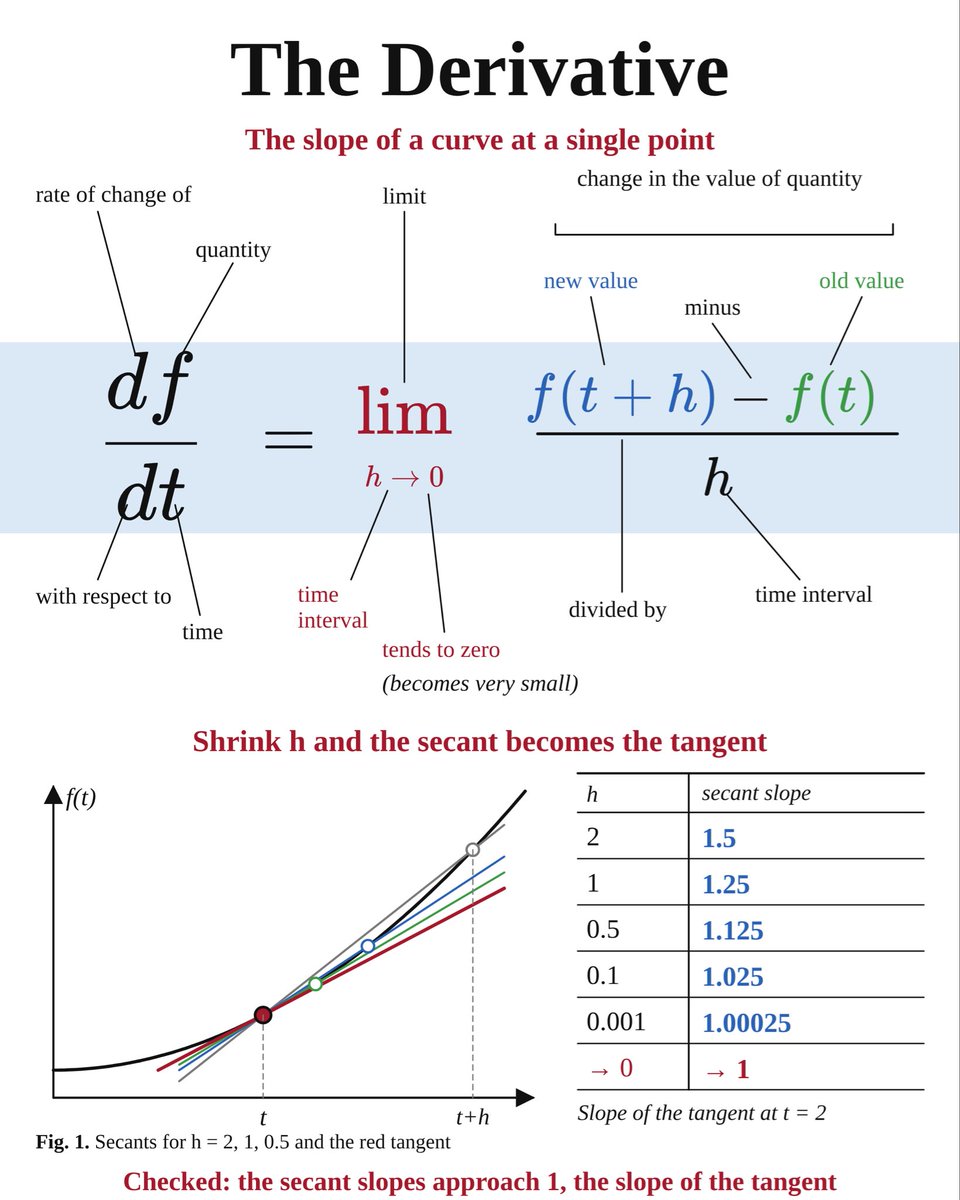
Your car's speedometer never measures speed directly. It measures how far you moved over a very short time and divides.
That is the whole idea of the derivative, and it took two people working separately, Newton and Leibniz, to turn it into a tool in the late 1600s.
Every point in space wears three different names at once.
Cartesian (x, y, z) gives straight-line distances from fixed planes. Cylindrical (ρ, φ, z) wraps the same point around an axis. Spherical (r, θ, φ) measures outward from a single origin. The arrows show the exact maps between them: ρ = √(x² + y²), r = √(ρ² + z²), x = r sin θ cos φ.
The formulas are reversible. Change the labels and the geometry stays identical.
One space, three languages.