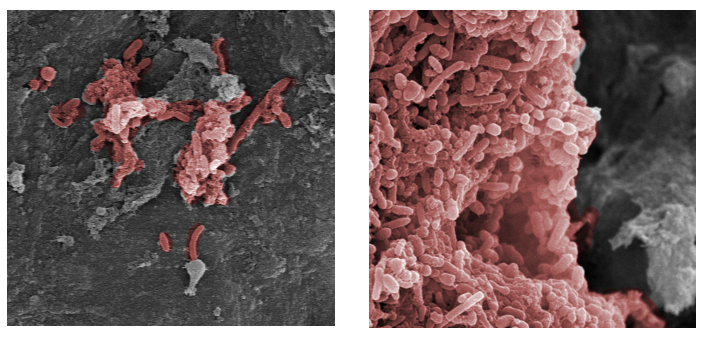
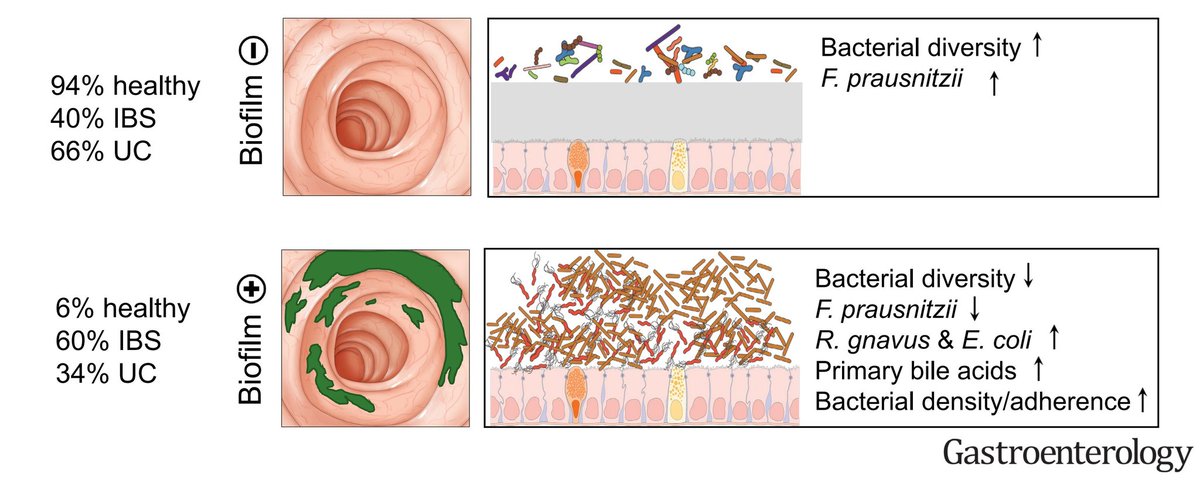
IBS and UC have endoscopically visible mucosal biofilms that represent a disrupted microbiome and Bile acid malabsorption as possible mechanism of diarrhea.
https://t.co/x07ohQDR9R
@AGA_Gastro@aktibes @MedUni_Vienna
https://t.co/52reeGDSAR
In our preprint we use AI to connect epimerization of host derived BA with disrupted gut-liver feedback in >4000 patients, elevated BA select for epimerising strains (M gnavus and E. coli) in IBD providing a molecular mechanism for GI dysbiosis / BAD
https://t.co/kGfcjbFRuW
In this comment we suggest that SIBO and IBS share ileal bacterial biofilm formation as pathomechanism, which correlates with increased biomass and disrupted bile acid metabolism.
currently studying if biofilm removal via endoscopic lavage improves sys
https://t.co/xZqq1wiX2I
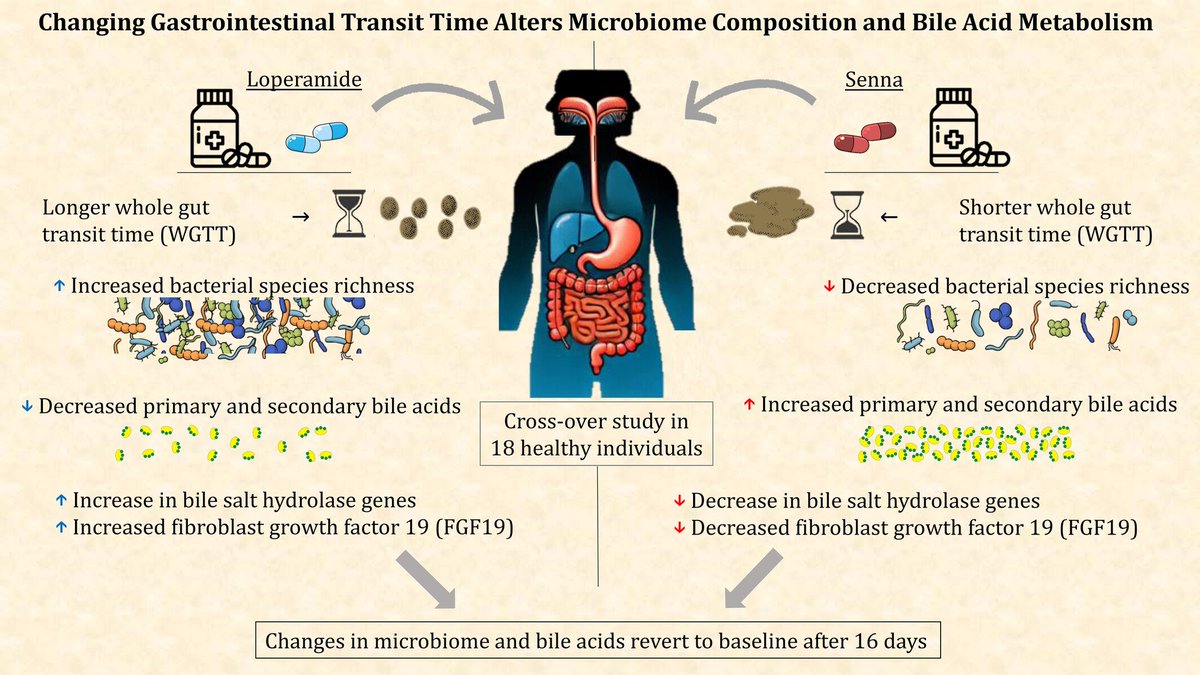
We show lower transit time alone decr. microbiome diversity + BA metabolism and incr. fecal BA. Many 'omics studies and breath testing (SIBO) don't take this into account, hindering true progress on IBS/IBD pathomechanism.
@NGMJournal@ESNM_eu@ANMSociety
🌎 Today, on World IBD Day, I am raising awareness for an often overlooked and underrecognized condition in IBD: bile acid malabsorption (BAM). Timely diagnosis and the use of current treatments, such as dietary interventions and medications, are crucial in improving quality of life. In certain situations, even potentially inducing remission, as was the case for me.
Read more in this newly written informative article, which covers some of the essentials and treatments of BAM as well as some important studies that highlight the role of bile acids in IBD: https://t.co/Zrkj9YYzGy
#worldibdday #crohnsdisease #bileacids #bileacidmalabsorption
An altered gut mucus and microbial biofilms might be one root behind the rise #IBD@john_damianosMD & colleagues review dietary interventions that work (and don't work) for strengthening gut barrier mucus:
🔴 Dietary factors damaging the mucus layer:
🔸 Emulsifiers (e.g., carboxymethylcellulose and polysorbate 80)
🔸 ⬆️ levels of unhealthy fats, refined grains, sugar, salt, alcohol, and ultra-processed foods
🔸 ⬇️ of dietary fiber
🟢 Dietary factors that enhance the mucus layer:
🔸 Dietary fiber: a balance between dietary fiber sources is key
🔸 Some prebiotics: germinated barley foodstuff, psyllium, inulin/FOS, and xylooligosaccharides show promise in IBD
⚠ It's better to personalize dietary fiber intake based on individual gut microbial makeup (which is primarily shaped by diet) and disease activity
🔸 Probiotics
Evidence of probiotics is lacking in Crohn's disease
👉 Some probiotics appear efficacious for:
✅ Inducing clinical remission
✅ Preventing relapse in ulcerative colitis
✅ Preventing relapsing pouchitis
🔸 Fermented foods
💡 They are a potential source of microbial metabolites that could potentially downregulate intestinal inflammation
Looking forward to present my talk about "Epimerization of Host-Derived Bile Acids By R.gnavus as a Hallmark of Microbiota Dysbiosis" at #KSHumanMicro25#KSHostMicrobe25
Connecting bacteria to specific metabolites, will enhance out mechanistic understanding of #IBD / #IBS
If you ask many highly educated IBD patients, they will hypothesize that biofilms are a relevant factor in some IBDs. Here is an important study and much more attention is warranted on this topic.
@IldikoMe Also recommend this recent school of thought
https://t.co/2dmyRdwNWN
Binning bacs ecologically shows more oxygen tolerant species overgrowing during IBD flares (also in muc. biofilms)
chicken / egg still unclear but I suspect certain bugs sustain inflammation to keep their niche
@IldikoMe Thank you for highlighting our work @IldikoMe ! biofilms seem to reflect a disturbed eco-system with reduced diversity, increased mucus invasion and bile acid alterations + malabsorption (might also explain symptoms in remission). I continue working on the biofilm-immune axis :)
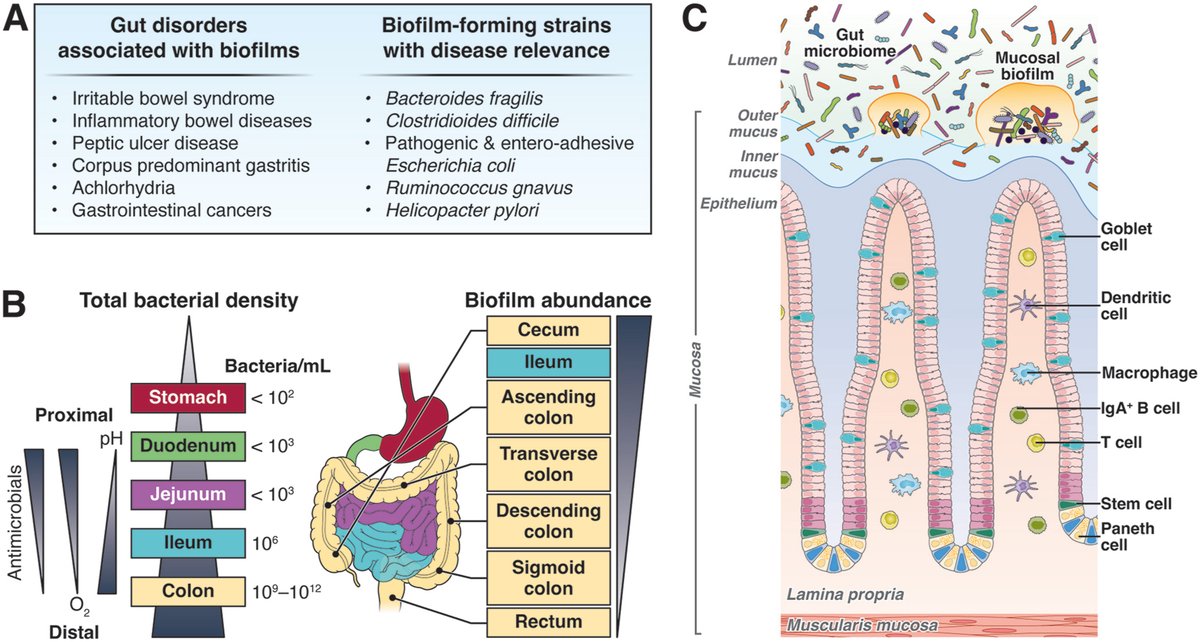
🌟 Review on gastrointestinal biofilms covers #endoscopic detection, disease relevance, and therapeutic strategies. Read it the article here: https://t.co/W7z0qdiYbD
🌟 Review on gastrointestinal biofilms covers #endoscopic detection, disease relevance, and therapeutic strategies. Read it the article here: https://t.co/W7z0qdiYbD
Our review about endoscopically visible mucosal #biofilms is out in @AGA_Gastro. We discuss pathophysiology, potential treatments and highlight knowledge gaps and open research questions
https://t.co/Udkvj0vj4H
@MedUni_Wien@univienna
Together with @OrglerElisabeth and @chmoei we show that presence of Methanobrevibacter influence mucosal #biofilm and might be linked to gut hypoxia
Archaea influence composition of endoscopically visible ileocolonic biofilms
https://t.co/9FLM6VyyKl
Saori Kashiwagi showed some really amazing data that #mucus degrading #Ruminococcus gnavus cross feds #AIEC - this could be particularly relevant in #IBd. #DDW2024
@DDWMeeting
Excited to present a lecture on bile acid-bacteria-immune interactions in #IBS and #IBD !
✅ 5/21 Tuesday 8:30
Endoscopically visible biofilms as novel mechanism of bile acid diarrhea✨
#DDW2024
@DDWMeeting
Excited to present a lecture on bile acid-bacteria-immune interactions in #IBS and #IBD !
✅ 5/21 Tuesday, 8:30 am
Endoscopically visible mucosal biofilms as a novel mechanism of bile acid diarrhea
#DDW202