#Avances | 🔔 Un estudio de @MassGenBrigham proponen un nuevo estándar para evaluar el desarrollo de los dispositivos cerebrales implantables bajo el concepto "Human Fidelity"
👉 Plantea incorporar esta variable como un criterio #medible durante todo el proceso de diseño, desarrollo e implementación #clínica
https://t.co/aJYaJVyHH3
For over a decade, my colleagues and I have sat with patients and families participating in trials or living with implantable brain devices. We listened to their stories, concerns, and the difficult path to access devices in the research and clinical settings. We were also delighted to hear how much better many of them are doing.
Considering the surging public and private investment in implantable brain devices including brain-computer interface (BCI) systems and others, my colleagues and I kept coming back to some key questions: will these technologies actually reach the people they are being built for? Will these patients and clinicians want to adopt the technologies? What can we do to promote trust, access, and uptake of these technologies if safe and effective?
Today, in The American Journal of Psychiatry @APAPubJournals, Dr. Amanda Merner @armerner_psych and I introduce an evidence-based approach to promote responsible development and adoption of neurotechnologies.
We call it Human Fidelity:
“The measurable degree to which a device, its access workflows, and associated messaging are aligned with the empirically determined needs and expectations of key stakeholders across the full development and clinical translation pipeline.”
The argument is simple. Human Fidelity is a performance variable — in the same sense that reliability and scalability are performance variables. It belongs in the engineering vocabulary, not only the ethics vocabulary. You can specify it, measure it, benchmark it, and improve it.
The paper organizes the work around five domains where the gap between intention and reality is most pressing: access and uptake, invasiveness, the brain as control center, patient-centered outcomes, and long-term device maintenance and patient support after trials end.
Implantable brain devices like deep brain stimulation (DBS) and RNS have been FDA-approved for movement disorders and epilepsy for years, and the results in treatment-resistant depression and OCD are genuinely promising. But only a fraction of eligible patients reach currently available implantable brain devices — and that is a measurable problem we can address and improve with Human Fidelity.
Grateful to the patients, caregivers, researchers, clinicians, funders, and device developers whose experiences are the foundation of this work.
Read the paper: https://t.co/7u6yacQK8q
#HumanFidelity #Neuromodulation #DBS #BCI #ResponsibleInnovation #HealthTech #Neuroscience #Neurosurgery #Psychiatry #BiomedicalEngineering #Neurotech #Neurotechnology #Brain
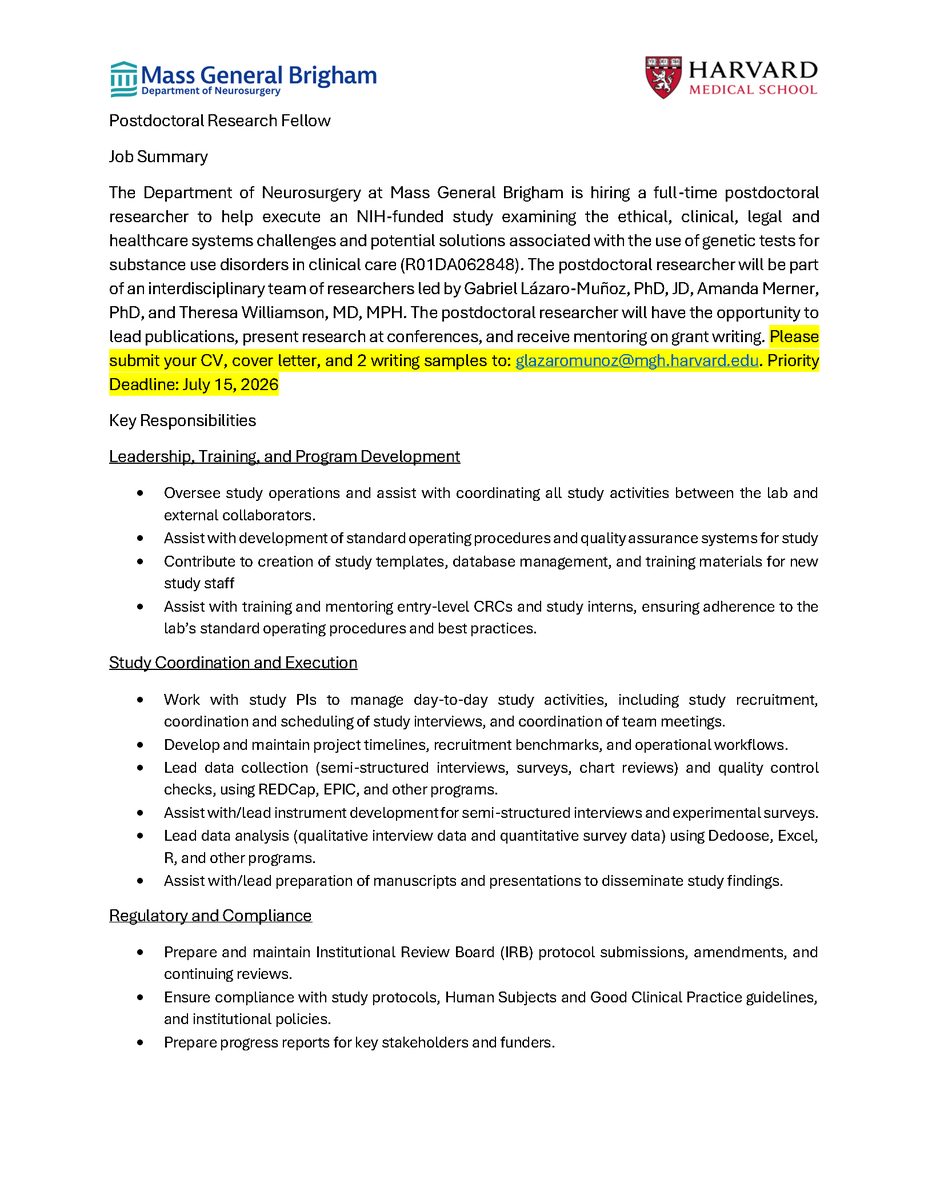
We are hiring a postdoctoral fellow to work on an NIH-NIDA funded study on the implementation of substance use disorder genetic testing tools in clinical care (R01DA062848 PIs: GLM, Amanda Merner @armerner_psych, Theresa Williamson @Twilli7). Please see job description below. Priority Deadline: July 15, 2026.
The deadline to submit a poster abstract for the 2026 BRAIN Conference is fast approaching! Don’t miss this opportunity to share your work with the #BRAINInitiative community. Submissions are due June 28 at 11:59 PM ET.
Learn more: https://t.co/Xa1IiKsLCp #studyBRAIN
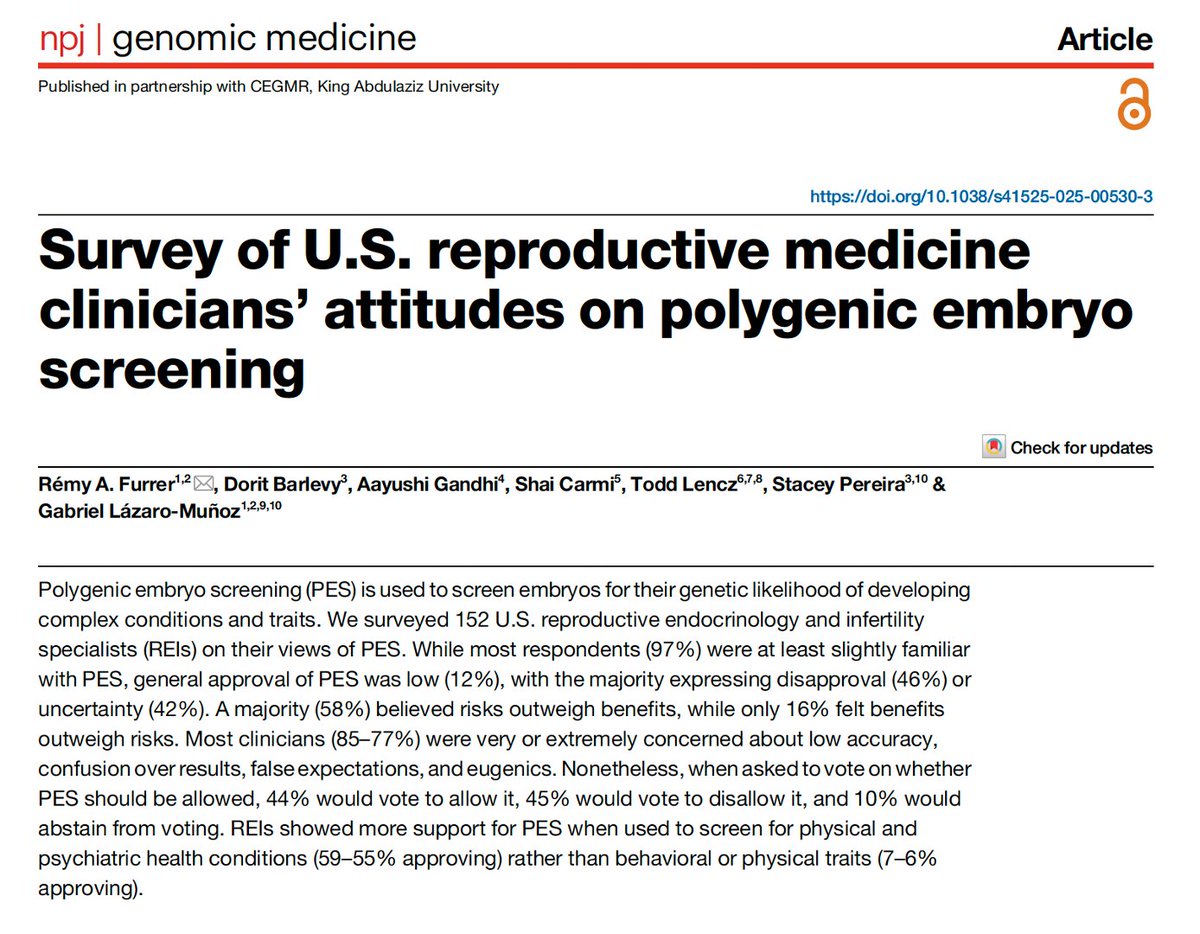
Polygenic embryo screening is being marketed commercially – but how do IVF clinicians view it?
• General approval is low (12%)
For specific uses:
• 59% approved of health-related embryo selection
• 6% approved of trait-based selection
🧵 Survey findings in NPJ Genomic Medicine
Polygenic embryo screening is being marketed commercially – but how do IVF clinicians view it?
• General approval is low (12%)
For specific uses:
• 59% approved of health-related embryo selection
• 6% approved of trait-based selection
🧵 Survey findings in NPJ Genomic Medicine
In this interview with Julian Morrow from @ABCaustralia we discuss: What happens to patients when neurotechnology is abandoned? https://t.co/DcEGRMeLFT via @ABCaustralia
This paper shows that stakeholders are particularly worried about eugenics if PES / PGT-P is used to screen for traits like intelligence, height, skin color.
Genetics in Medicine @GIMJournal
https://t.co/q8iwP3L87e
Talked to the Today Show about Polygenic Embryo Screening (PES; PGT-P) and some of the concerns raised by these technologies such as worries that they may promote eugenics thinking and practices.
https://t.co/Ijhd3uSifu via @TODAYshow@MGBResearchNews
US public perceptions abt PES / PGT-P: people are interested in the tech but almost 90% are concerned that it can promote eugenics. The public is split on approval of screening for intelligence, abt 20% approves of screening for skin color JAMA Net Open https://t.co/Xlf9qf1yfW
Associated Press article on the challenges patients with treatment-resistant conditions face when trying to maintain beneficial experimental neural devices, once trials end. With quotes from the brilliant and inspiring Brandy Ellis. #neurotechjustice
https://t.co/eplCtVZkUO
EUGENICS AND POLYGENIC EMBRYO SCREENING: PUBLIC, CLINICIAN, AND PATIENT PERCEPTIONS OF CONDITIONS VERSUS TRAITS
Led by Dorit Barlevy and @RemyFurrer with co-authors @ShaiCarmi@ToddLencz and @SPereira_PhD
We just published this paper in Genetics in Medicine examining how different populations view and use the concept of "eugenics" when discussing polygenic embryo screening.
EUGENICS AND POLYGENIC EMBRYO SCREENING... https://t.co/HlnrleFQJ1
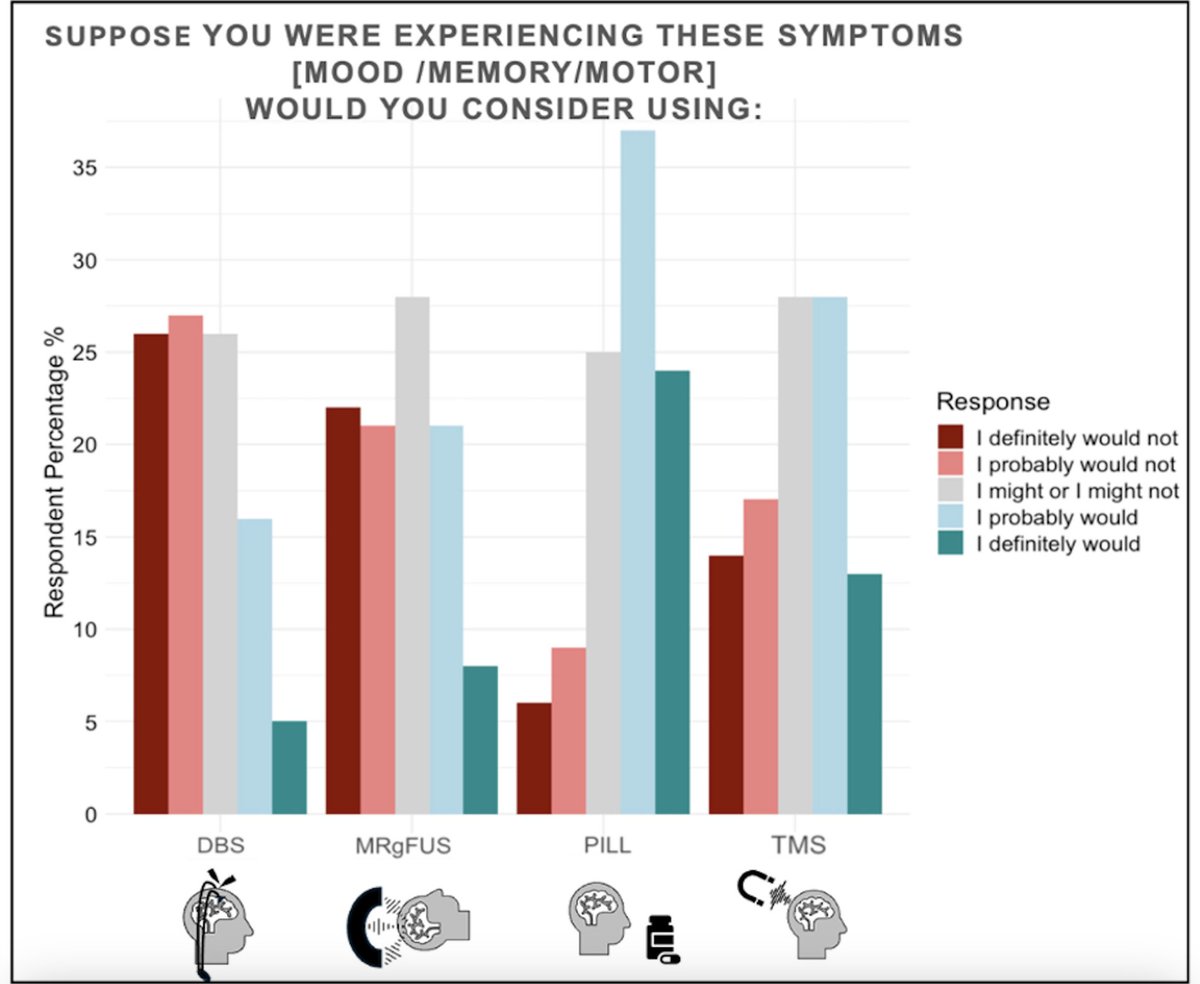
Would you consider using these neurotechnologies if you were experiencing severe mood, memory, or motor symptoms?
Here’s how 1000+ U.S participants responded when asked that exact question.
Collaborators: @armerner_psych @GLMbioethics @Twilli7@MGBneurosurgery@MGBResearchNews
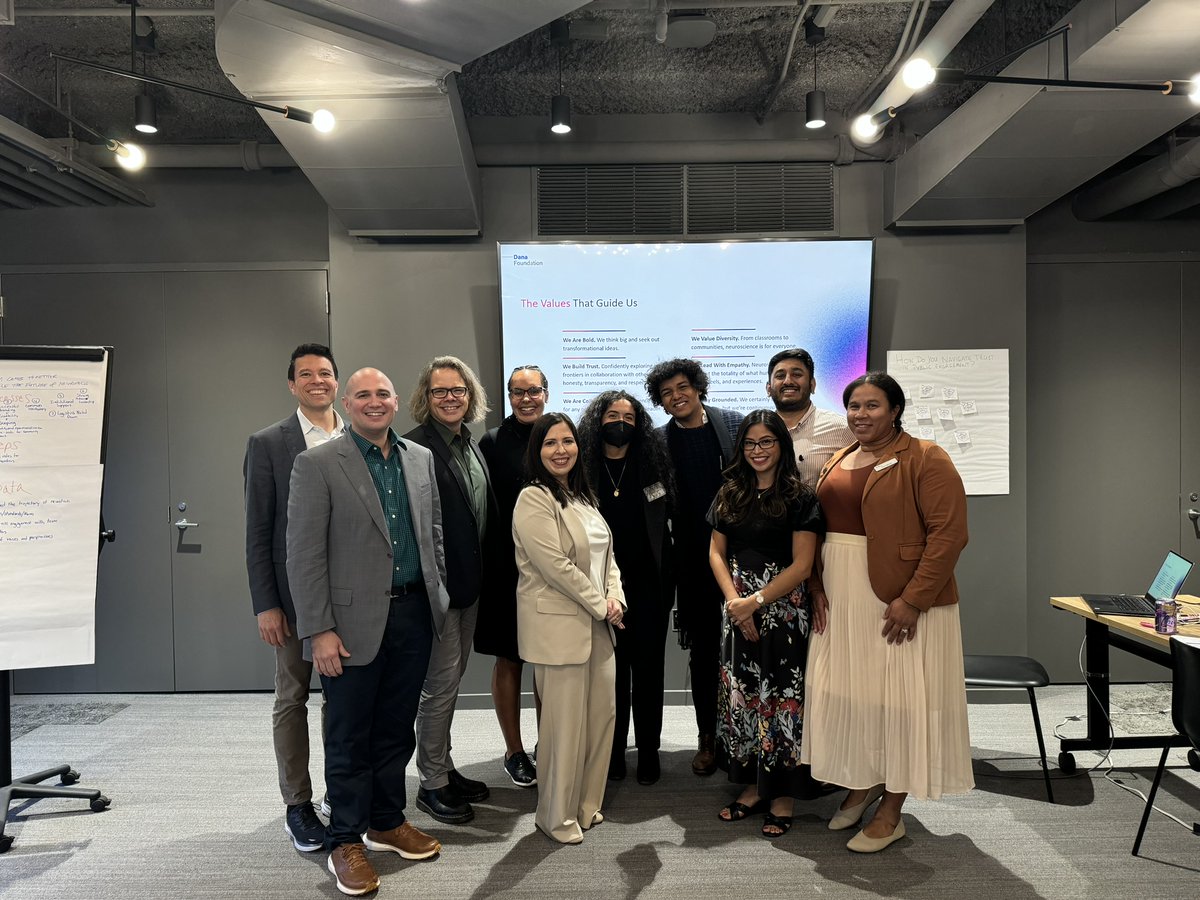
It takes a coalition to build visionary new programs. It was fantastic this past year to work with Dr. Marcela del Carmen, President of @MassGeneralNews and @MassGeneralMDs and @dana_fdn President and CEO Caroline Montogo to create a framework for supporting next generation strategic neuroscience initiatives. The @dana_fdn is supporting work here @MGBneurosurgery to advance the societal impact of neuroscience technology. Individual investigators in our department like @Twilli7 and @GLMbioethics have used the catalytic power of foundation partners and AMC leaders to push forward with the most innovative, cutting edge programs. We are fortunate to have visionaries like Drs. del Carmen and Montogo who support our community.
Highlights of 2024: One of the exciting initiatives for me as chair of @MGBneurosurgery this past year, was witnessing the launch of NJAM, the Neurotech Justice Accelerator at Mass General Brigham, @MassGeneralNews led by neurosurgeon Theresa Williamson MD MPH @Twilli7, Gabriel Lázaro Muñoz PhD JD @GLMbioethics and Dr. Francis Shen JD PhD with a major grant from the @dana_fdn. Read more about NJAM in the attached article and its goals in helping to develop ethical and legal frameworks for the use of rapidly advancing novel neurotechnologies.
📢Job Alert: Join the Neurotech Justice Accelerator at Mass General Brigham (NJAM), a @dana_fdn Center for Neuroscience and Society. NJAM will provide a forum and training ground to reimagine the future of #neurotechnology in society.
Learn more 👇
(1/3)
Congratulations to Ana Lucía Battaglino, MA and Erika Versalovic, PhD, researchers in our @GLMbioethics Brain Bioethics Laboratory, for their award-winning work at @neuroethicsinfo's Annual Meeting! https://t.co/W2HLBtS9o5 #HMSBioethics