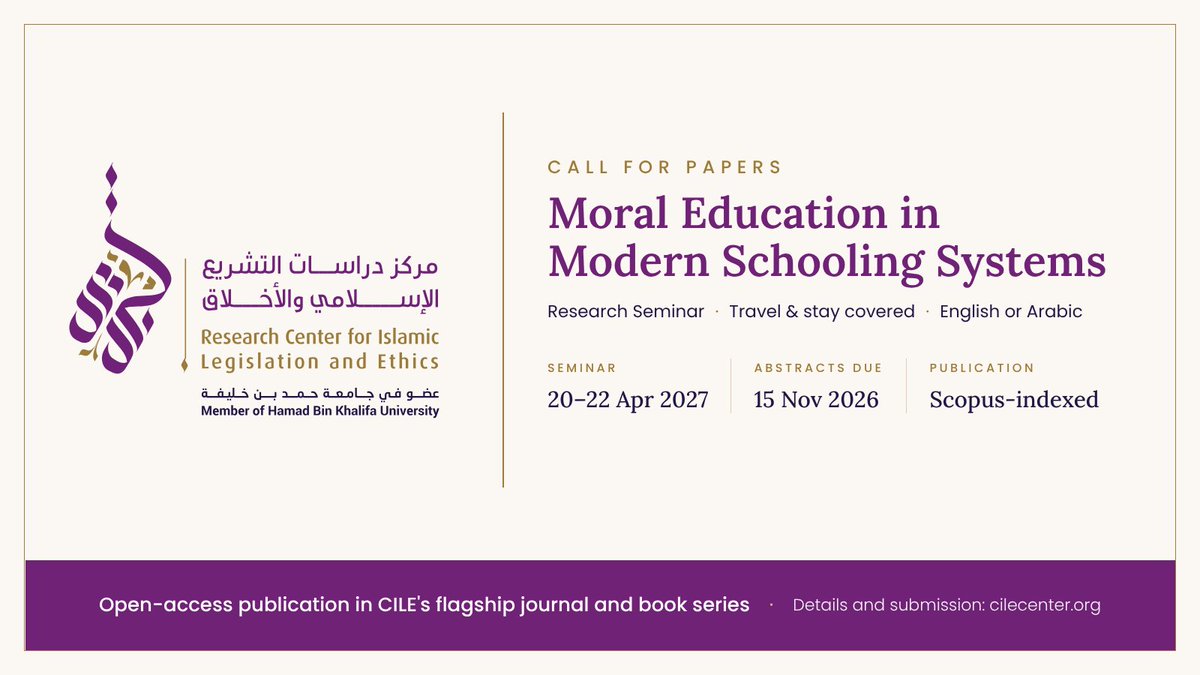
Call for papers: what can the Islamic tradition of adab and tarbiya contribute to moral education in modern schools? @CILE_Center (@HBKU_CIS, @HBKU) invites abstracts by 15 November 2026 for a research seminar in Doha, 20–22 April 2027.
@danicajdillion@CILE_Center Through also our Global Alliance for AI Ethics (#GAAIE), we work to bring diverse moral traditions, religious and secular, into AI governance.
My work on Islamic perspectives on AI and medical accountability: https://t.co/KaPjnY80n1
and on AI and work: https://t.co/trF7t0kRUy
@danicajdillion Yet AI does not read such texts well. In our IslamGPT project at @CILE_Center, AI tools found passages on the topic of a fiqh question, but struggled to find the one giving the actual ruling. ArabicNLP 2026 Best Paper:
https://t.co/UEtCnhxOGz
In Bangkok for the Global Forum on Bioethics in Research (@WHO), as a member of its Planning Committee. Theme: digital footprints and real-time data in health research. Key question: when data touch families and communities, what is needed beyond individual consent? #GFBR2026
Legal personality for AI must not become a liability shield for those who profit from it. My open-access chapter, our @wishqatar report, and my earlier thread on AI personhood:
https://t.co/KaPjnY80n1
https://t.co/r7ACplzWyw
https://t.co/0A274jfJWV
#IslamicEthics#AIEthics
I agree: machines are tools, not persons. This is the dominant view, close to a soft consensus though not unanimity, as @UNESCO's Recommendation on the Ethics of AI (2021) shows: "AI systems should not be given legal personality themselves."
When a clinical decision passes through an algorithm, who answers for any resulting harm? At "Ruling Bodies", Paderborn University (6–7 Nov), I argued Islamic law has long ruled three bodies in clinical care: the patient's, held in trust; the physician's skill; the institution.
Shared liability is not new: in 2004 the International Islamic Fiqh Academy ruled on the liability of medical teams and institutions. New are those behind tools that clinical teams neither control nor fully understand; they should sit on research and clinical ethics committees.
Selected participants follow the closed seminar's proceedings online (Qatar-based ones may also attend in person at HBKU) and engage with its researchers and some IIBA Board members. Apply by 1 Dec.
Call: https://t.co/XcMNcp27aY
Apply: https://t.co/F6apKxuaZg
#IslamicBioethics
Students and early-career researchers: apply by 1 December 2026 for the @CILE_Center Winter School (@HBKU_CIS, @HBKU), with the International Islamic Bioethics Association, held online on 11–13 January 2027 alongside our seminar on Reproductive Ethics and Kinship.
Students and early-career researchers in Islamic studies, bioethics, law, medicine, sociology, anthropology and gender studies are invited to take part; others are welcome to attend. Send a CV and letter of interest; for the Slam or Debate, a title and abstract (max. 300 words).
آخر موعد لتقديم الملخصات 31 ديسمبر 2026، والندوة في الدوحة 14–16 سبتمبر 2027.
الدعوة والورقة المرجعية: https://t.co/55gVuqbbta
التقديم: https://t.co/3wHp1qR9E8
#الأخلاق_الإسلامية#الاقتصاد_الإسلامي
دعوة إلى تقديم أوراق بحثية: هل الحياة الاقتصادية ميدان للتنافس، أم للأمانة والاستخلاف؟
يعقد مركز دراسات التشريع الإسلامي والأخلاق، @CILE_Center، ندوة بعنوان "الرؤى الكونية الاقتصادية والأخلاق في الفكر الإسلامي"، الدوحة، 14–16 سبتمبر 2027. تُقبل الملخصات حتى 31 ديسمبر 2026.
وكلتاهما مفتوحة الوصول، وهما المجلة والسلسلة الوحيدتان المتخصصتان في الأخلاق الإسلامية والمفهرستان في سكوبس اللتان تنشران بالإنجليزية والعربية. ويغطي المركز تكاليف السفر والإقامة وجميع تكاليف النشر بالوصول المفتوح.