GLOBE connects students, teachers, scientists, and the public from around the world to better understand the Earth. @NASA @NSF @NOAA and U.S. State Dept.
#ICYMI: Watch the GLOBE Program's 31st Anniversary Broadcast here. Thanks to everyone who joined us live to celebrate this incredible milestone! 🌏🥳
https://t.co/LYumRnAATT
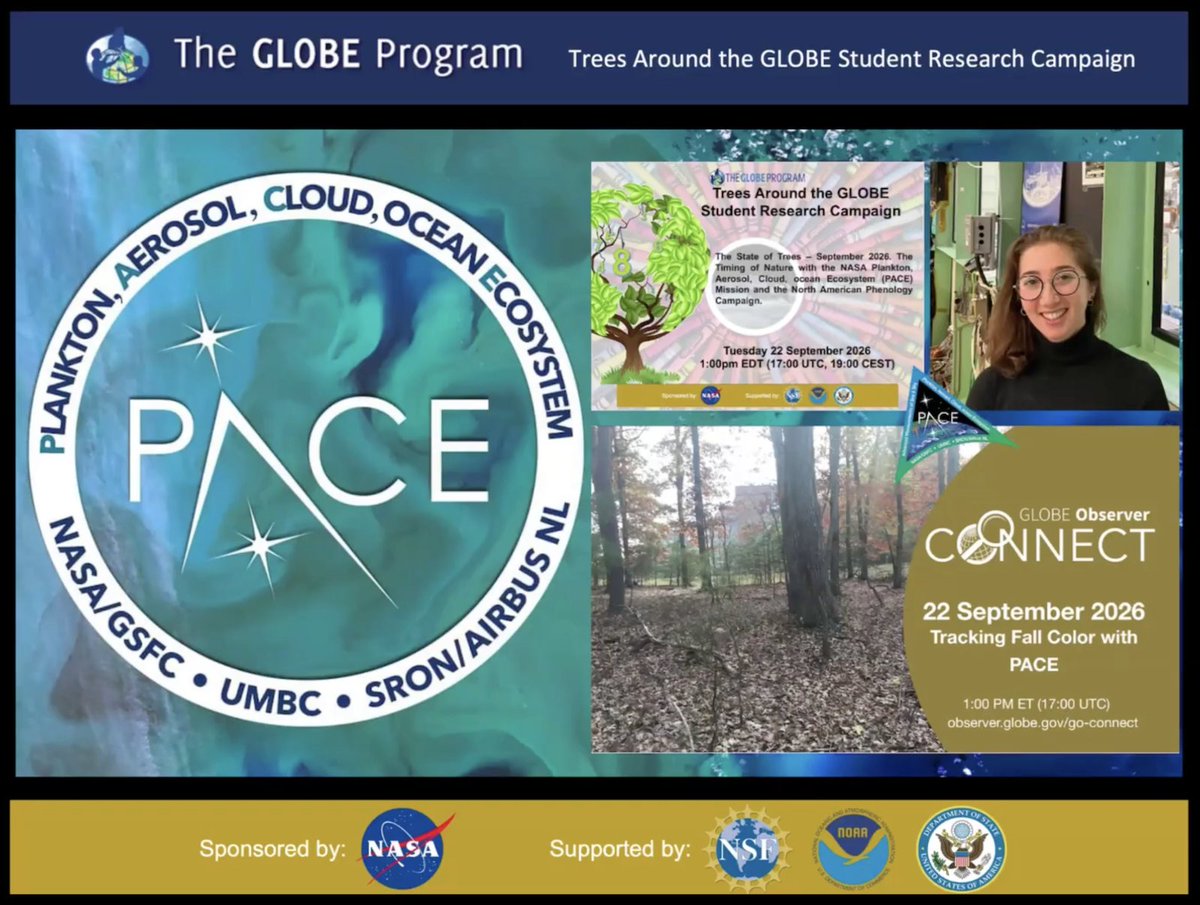
#ICYMI On the 22nd of September 2026, we held the GLOBE Observer Connect event, in conjunction with the Trees Around the GLOBE’s September 2026 campaign webinar. The event, entitled “Tracking Fall Color with PACE,” was a conversation with NASA Plankton, Aerosol, Cloud, ocean Ecosystem (PACE) mission vegetation scientist, Skye Caplan. Skye discussed some of the ways she is using PACE data to study plants on land, including the new leaf color product and how you can use GLOBE Land Cover to document changing leaf colors to help verify the unique new PACE leaf color product. Read more, and check out the GLOBE Observer Connect event recording at https://t.co/TkXH2cx7Ac!
#QuickGLOBETip for making GLOBE Clouds observations!
How opaque is your sky? Tip #10: Determine visual opacity by looking at how much sky and sunlight you can see coming through the clouds.
Explore this page for more tips and resources: https://t.co/lHJaBBftNH
New #GLOBEResearch!
📃Title: The 2025 Aviation Weather Mission: Cadet Engagement and Evaluation Results
👥Authors: Marilé Colón Robles, Ashlee M. Autore, Matthew Nyman, Heather Fischer, Shannon Babb, Roman Vitanza, Jessica E Taylor, Kristen Weaver, Holli Kohl, Tina Rogerson, Theresa Schwerin
The 2025 Aviation Weather Mission was a collaboration between NASA and the Civil Air Patrol. Using the GLOBE Observer app, over 3,000 volunteers across 42 states, Puerto Rico, and Washington, DC, monitored the skies making aviation-related weather observations, tracking airplanes, and collecting ground-based airplane and contrail type information.
🌐Read it here: https://t.co/nvqFFTZK3j
If you missed last month's website learning and support session, we shared a quick and practical overview of the updated https://t.co/h0Hs7ivDL9 account-creation process. Watch the recording: https://t.co/6bWWbeNhyf
Do you have questions about My Observations+ on https://t.co/VghnAaMydk?
Join us next week for our second website learning session, on the 28th of October at 1 pm ET (17:00 UTC), where we will cover features of My Observations+ and provide time for participants’ general website questions.
Learn more and register: https://t.co/NAFm6qJ4sA.
How are scientists using data from NASA’s PACE satellite to study plants on land? Hear from PACE vegetation scientist, Skye Caplan, in this webinar recording and learn how you can support NASA’s PACE mission by documenting changing leaf colors with the GLOBE Land Cover tool!
Learn more: https://t.co/40YXbyO0By
“Participation in Trees Around the GLOBE has significantly enriched our work with students and encouraged us to move learning beyond the classroom. Through these activities, students develop not only scientific knowledge but also important competencies such as critical thinking, problem-solving, mathematical and data literacy, digital skills, teamwork, communication and independent research.” GLOBE Trainer and Educator - Dubovac Primary School, Karlovac, Croatia
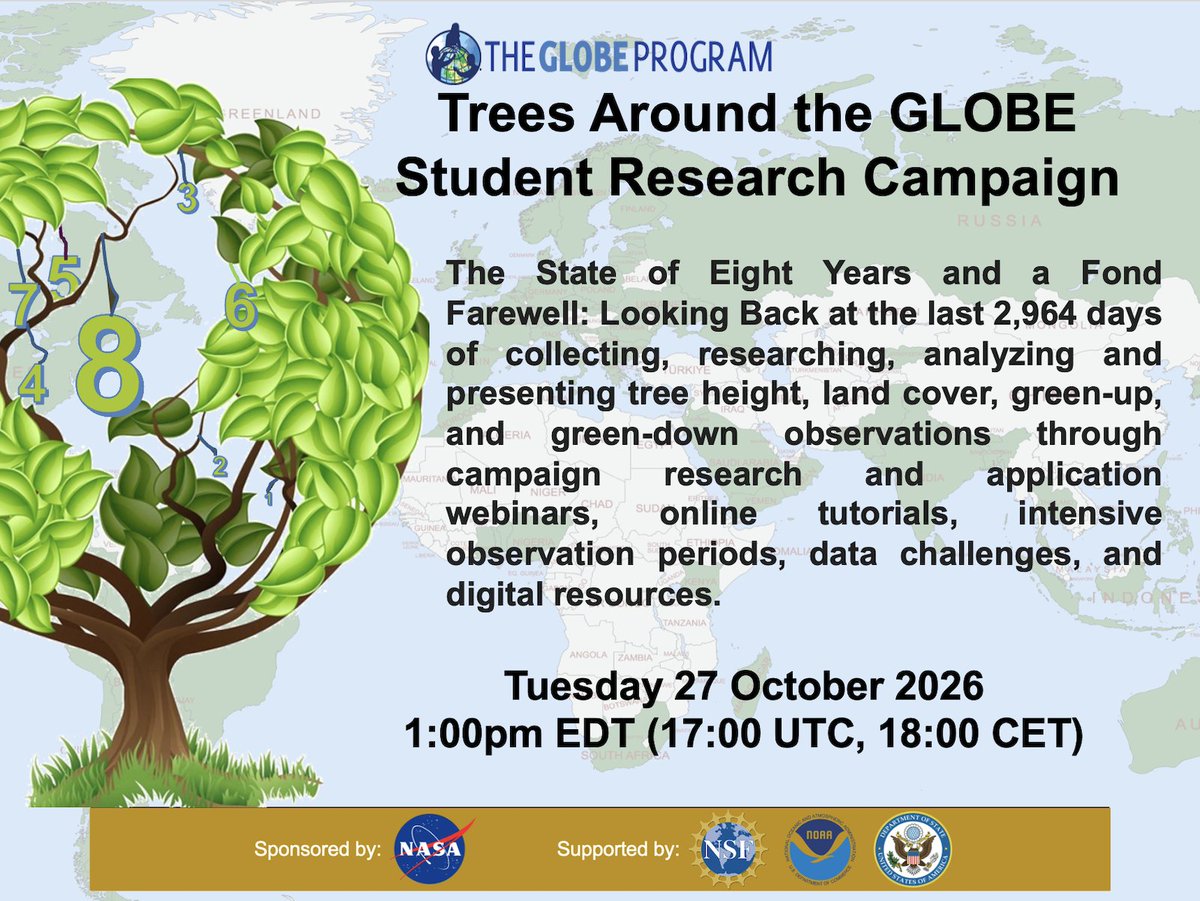
Please join us in one week for the final Trees Around the GLOBE Campaign webinar, "The State of Eight Years and a Fond Farewell: Looking Back at the last 2,964 days of collecting, researching, analyzing and presenting tree height, land cover, green-up and green-down observations through campaign research and application webinars, online tutorials, intensive observation periods, data challenges, and digital resources.” Learn more at https://t.co/OBkZDnuFk8. Please join us for our final campaign webinar!
We have 4,751 PACE Clouds Challenge matches and counting with 2 weeks left to go!
Please keep them coming! These observations, taken within a 5-minute window of the PACE satellite passing overhead, will help PACE scientist Dr. Andy Sayer compare what we see from the ground with what PACE sees from space—and better understand how well the satellite detects cloud edges and total cloud cover.
Learn more and join the PACE Clouds Challenge at https://t.co/zHLRIKibFV.
Do you have a question about My Observations+?
On the last Wednesday of each month, we offer a learning session with friendly, practical support for the https://t.co/ezbcq8Nus6 website. The second session, on the 28th of October at 1 pm ET (17:00 UTC), will cover features of My Observations+ and provide time for participants’ general website questions.
Learn about the upcoming sessions at https://t.co/NAFm6qJ4sA.
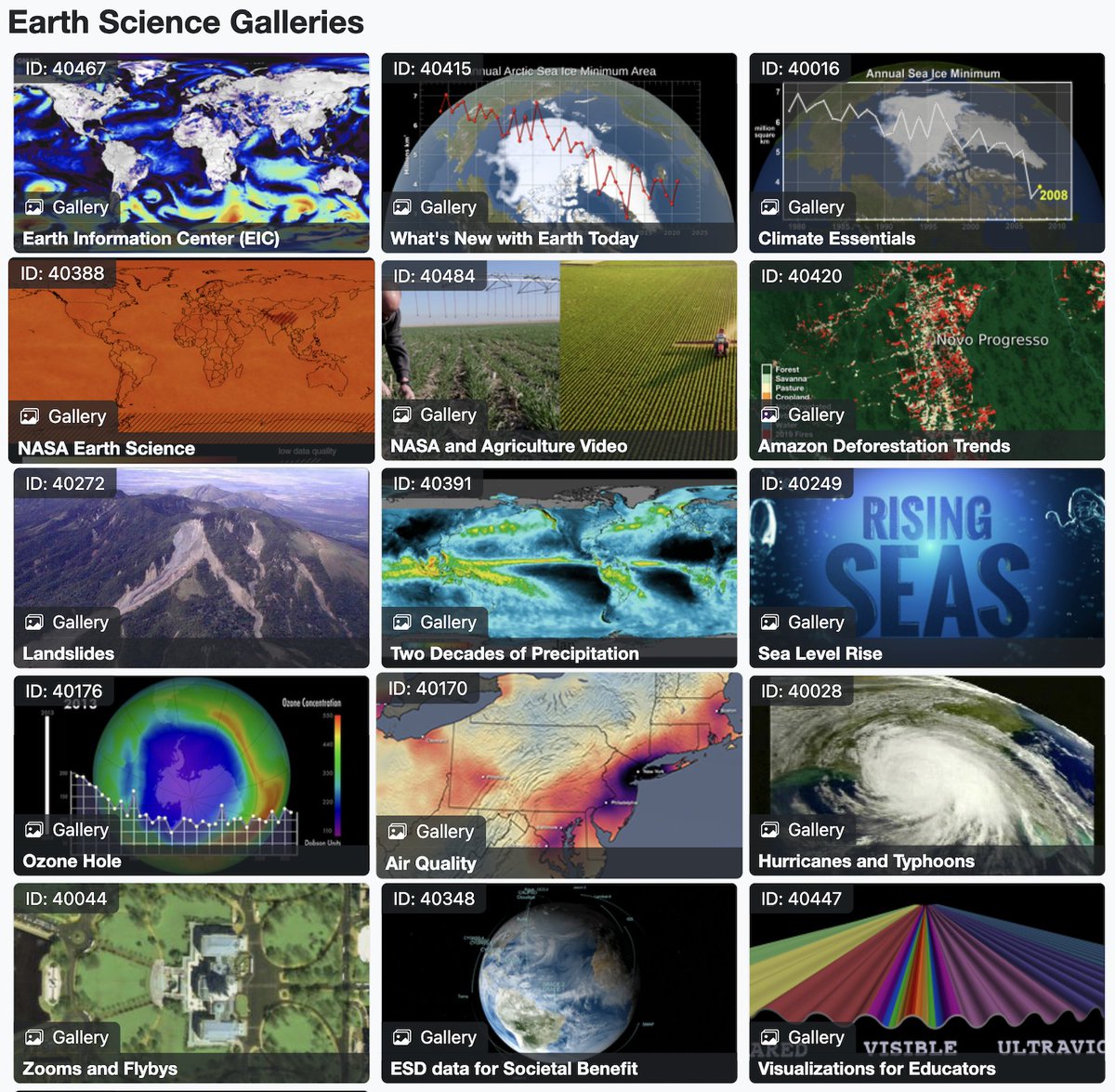
Did you know that the NASA Scientific Visualization Studio has an entire Earth Science gallery that contains data visualizations, animations, and images from missions that help us to understand our planet’s interconnected systems, from a global scale down to minute processes? You can explore the galleries at https://t.co/jK8NO5UUvX!
#QuickGLOBETip for making GLOBE Mosquito observations!
Learn to identify mosquito habitats. Tip #9: Pools that aren’t properly maintained can become breeding grounds for mosquitoes.
Explore this page for more tips and resources: https://t.co/8B6wISuHt5
Watch the full webinar, Tracking Fall Color with PACE, to learn more about how PACE scientists will use GLOBE land cover data: https://t.co/2E5oEzBn01. Learn how to participate in the North America Phenology campaign at https://t.co/xK5lESJkMH.
Are you documenting changing leaf color using the GLOBE Land Cover tool for NASA’s PACE mission?
Find photo observation tips from PACE vegetation scientist Skye Caplan in this short video: https://t.co/cT9TXrvBww
The Trees Around the GLOBE Research Campaign ran an intensive observation period (IOP) during “Tree Check Month” this August.
Participants took Tree Height and Land Cover observations, noting any signs of pests or damage on trees being observed. Participants submitted 617 Tree observations from 273 global sites and 432 Land Cover observations from 227 global sites!
Learn more about the results from the IOP at https://t.co/b8CrfgMg1W.
"What an amazing project and process you have managed and mentored with this campaign. This has been transformative in my own professional development and awareness as well as data shared with students. Trees have become not just something I admire but cornerstones of my teaching. I talk about the importance of trees all the time in classes and conversations.” – U.S. STEM Educator
Please join us in two weeks for the final Trees Around the GLOBE Campaign webinar, "The State of Eight Years and a Fond Farewell: Looking Back at the last 2,964 days of collecting, researching, analyzing and presenting tree height, land cover, green-up and green-down observations through campaign research and application webinars, online tutorials, intensive observation periods, data challenges, and digital resources.” Learn more at https://t.co/OBkZDnuFk8. We invite you to come with your thoughts on the campaign!
It's Earth Science Week!🌎
Celebrate by getting outside & admiring fall foliage with the @GLOBEProgram's North American Phenology Campaign.🍂
Your observations can help PACE scientists better map leaf color from space!
Get started: https://t.co/2Y6VjhuciL
What is the best way to time your observations for the PACE Clouds Challenge?
Set alerts for PACE satellite overpasses in the GLOBE Observer app, and you’ll be notified 15 minutes before the flyover.
About 5 minutes before the PACE flyover (set yourself an alarm if that’s helpful!), go outside and start your Clouds observation.
Take all 6 photos even if you have something blocking your view of the sky and remember to send in your observations!
Find more tips, trainings, and resources to help you get started at https://t.co/hYASTDn4Gf.
Help document changing leaf colors with the GLOBE Land Cover tool!
Check out the Tracking Fall Color with PACE webinar recording to learn how you can support NASA’s PACE mission through the North America Phenology campaign. Hear from PACE vegetation scientist, Skye Caplan, who describes some of the ways she is using PACE data to study plants on land.
Learn more: https://t.co/40YXbyO0By
As you may know, we are right in the middle of the PACE Clouds Challenge (https://t.co/zHLRIKibFV), which runs from 15 September - 1 November 2026. But, have you checked out all the amazing things the NASA PACE mission is observing? Go “On Tour Around the Globe with PACE” with this feature from the NASA Scientific Visualization Studio at https://t.co/v2aA8VYFUw!