CONNECTING INNOVATION TO INDUSTRY - BUILDING BRIDGES BTWN TECH/BUSINESS FOR HUMANS
Luxury PVT. Banker, GenAI/GPT, WEB3, Defence/Space tech, Tech Strategist.
Goldman Sachs analyst Jim Covello who called the AI spend problem two years early:
"I don't think we have a valuation bubble
I think we have an earnings bubble" (05:26)
By his estimate, the world will have spent north of $3 Trillion on AI by the end of 2026
Enterprise adoption so far? "Very disappointing"
- His test for any real tech revolution is simple:
"What profit pool does it disrupt?"
> Google killed print ads
> Amazon killed retail
> AI's?
That's the question he says he "has a difficult time answering"
The tell that worries him most:
Circular financing - suppliers funding the customers who buy their chips. "In the olden days that used to be called vendor financing" - and that set off alarm bells
And he's not a doomer.
He says the skepticism itself is healthy - the exact opposite of the 1999 "gold rush" that had none.
The people who can tell an earnings bubble from a valuation bubble are about to have a very different year from the ones just trading the headlines.
10 minutes with Goldman's top analyst ↓
Bookmark it and Watch Now
A former World Bank president has sounded the alarm, revealing that the Federal Reserve has lost over a trillion dollars—and counting—turning it into nothing more than a massive hedge fund for the rich and powerful.
He claims the Fed is borrowing money from banks at 5.4% interest, then pouring it into government bonds, creating the illusion that the government’s financial situation is better than it actually is.
He warns that this scheme isn’t just limited to the U.S.—it’s happening across central banks worldwide.
🚨 THE AI CREDIT BOOM IS STARTING TO CRACK:
The bond market is sending a warning that equity investors are ignoring.
CDS spreads for major AI infrastructure players have surged to record highs, led by Oracle and CoreWeave, as credit investors demand higher compensation to fund the massive AI buildout.
Credit stress is spreading across the sector, with spreads also widening for Meta, Microsoft, Amazon, and Alphabet as investors reassess the risks of the debt-heavy AI investment cycle.
This comes as AI infrastructure requires unprecedented amounts of capital as companies are spending billions on data centers, chips, and power capacity, even before those investments generate meaningful returns.
To finance this expansion, hyperscalers are increasingly turning to debt markets.
Alphabet, $GOOGL, has raised more than $85 billion in debt over the past year, pushing its total debt balance above $100 billion, while hundreds of billions in AI-related corporate debt compete with governments for long-term investor capital.
If AI profits fail to catch up with spending, higher borrowing costs could pressure margins, force spending cuts, and eventually hit stock market prices.
The AI trade is now being challenged by the rising cost of financing the race.
50% of U.S. GDP growth is now coming from AI investment.
Specifically, one category in the GDP report:
Computers & Peripheral Equipment.
This category includes AI servers and GPUs, and surged 72% YoY in Q1 2026.
I don't believe we've ever seen anything like this, at least in the GDP data going back to the 1950s.
This spending likely increased further in Q2 based on recent hyperscaler earnings reports, further increasing the U.S. economy's reliance on the AI buildout.
However, at some point this growth will slow.
It's not realistic to continue expecting 70% YoY AI spending growth, especially with hyperscalers like Google now negative on free cash flow.
When the spending does slow, GDP growth will be adversely impacted, and the stock market could be as well.
This chart makes you realize just how reliant the U.S. economy is on a very, very narrow slice of investment.
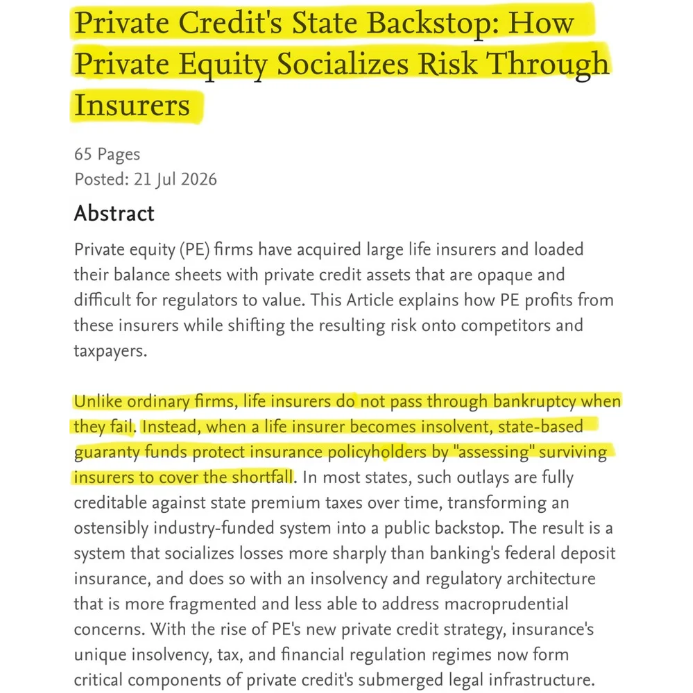
MICHAEL BURRY JUST WARNED THAT PRIVATE EQUITY MAY BE USING LIFE INSURERS TO PUSH LOSSES ONTO THE PUBLIC.
Burry is highlighting a new paper by two Yale/Texas researchers, "Private Credit's State Backstop: How Private Equity Socializes Risk Through Insurers."
Firms like Apollo, KKR, and Blackstone have bought up life insurers. They've filled these insurers' balance sheets with private credit, loans that are hard for regulators to check or price properly.
Life insurers now hold $849 billion in this kind of debt, more than double what they held in 2014.
Here's the trick: If one of these insurers can't pay its bills, states step in to protect policyholders. They do this by charging other insurance companies a fee to cover the gap.
Those companies then get to subtract that fee from the taxes they owe the state. So in the end, the public pays for it through lower state tax collections, without it ever being called a bailout.
This has already started happening. Two companies, First Brands and Tricolor, went bankrupt in 2025 after lenders realized they couldn't properly value the debt they were holding.
And the next risk is AI: Big tech companies are funding their AI data centers using the same kind of complex, hard to value debt.
If AI spending doesn't pay off fast enough, that risk doesn't stay with tech companies. It lands on the same insurers already holding piles of this debt.
Elon Musk just gave the clearest AI timeline we’ve heard so far.
In under 10 minutes he lays out:
1) AI surpasses all human intelligence in ~5 years
2) Humans most likely lose control within 10 years
3) Most probable outcome: an age of amazing abundance
4) “Even if there was a stop button — we probably shouldn’t press it”
This is denser and more direct than most hour-long podcasts on the topic.
If you still think AI is “just another tool”, this 10-minute segment will recalibrate you.
The popular quote "Don't speak negatively about yourself, even as a joke. Your body doesn't know the difference. Words are energy and they cast spells, that's why it's called spelling" Bruce Lee :
Godfather of AI: "If you sleep well tonight, you may not have understood this lecture."
This 47-minute lecture is the best thing I've seen about AI in the last few months.
Hinton built the neural networks behind every AI alive, then quit Google to warn us it's already ahead of us on most cognitive tasks.
Despite that, most people open Claude, type one thing, close the tab and think they're using AI, but they're using maybe 10%.
The people using the other 90% aren't typing prompts at all. They're running agents in parallel, wired into graphs that check their own work.
Watch the lecture, then read my step-by-step guide on graph engineering below.
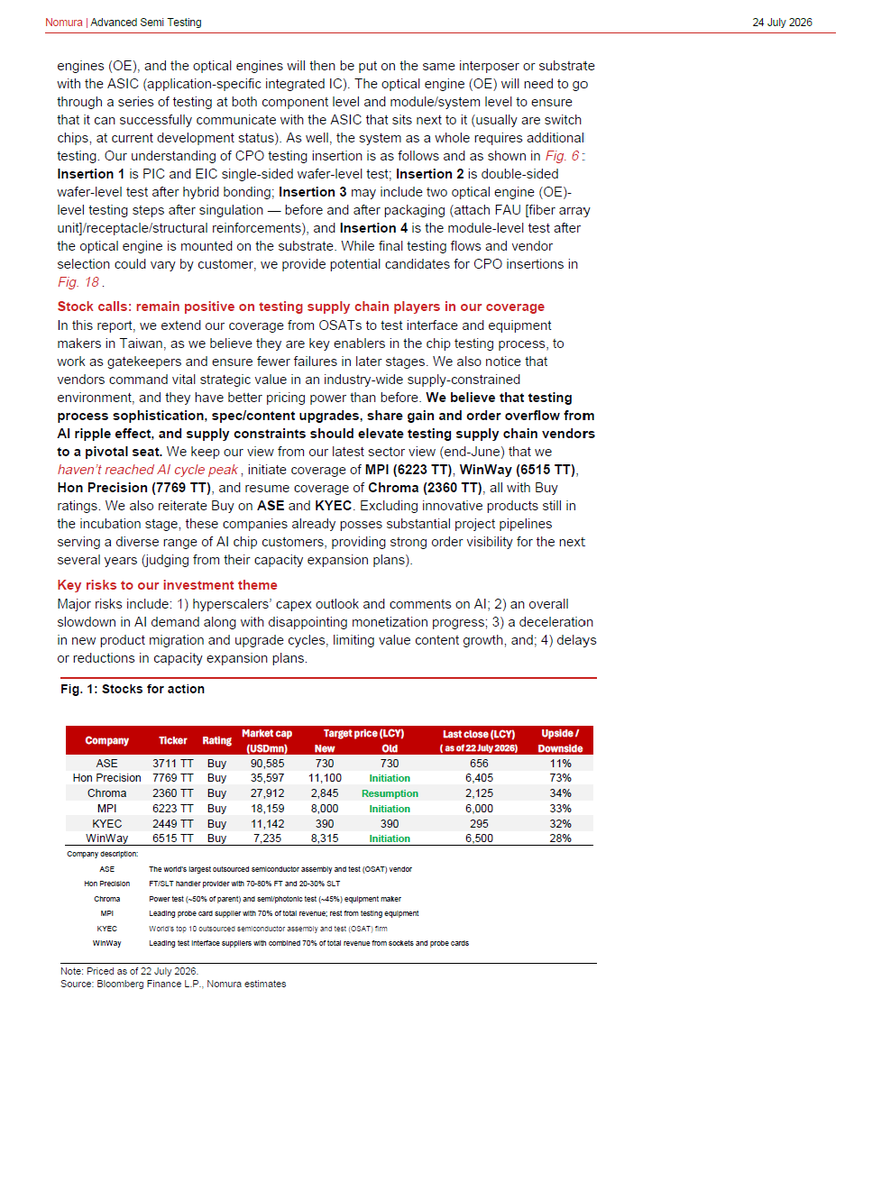
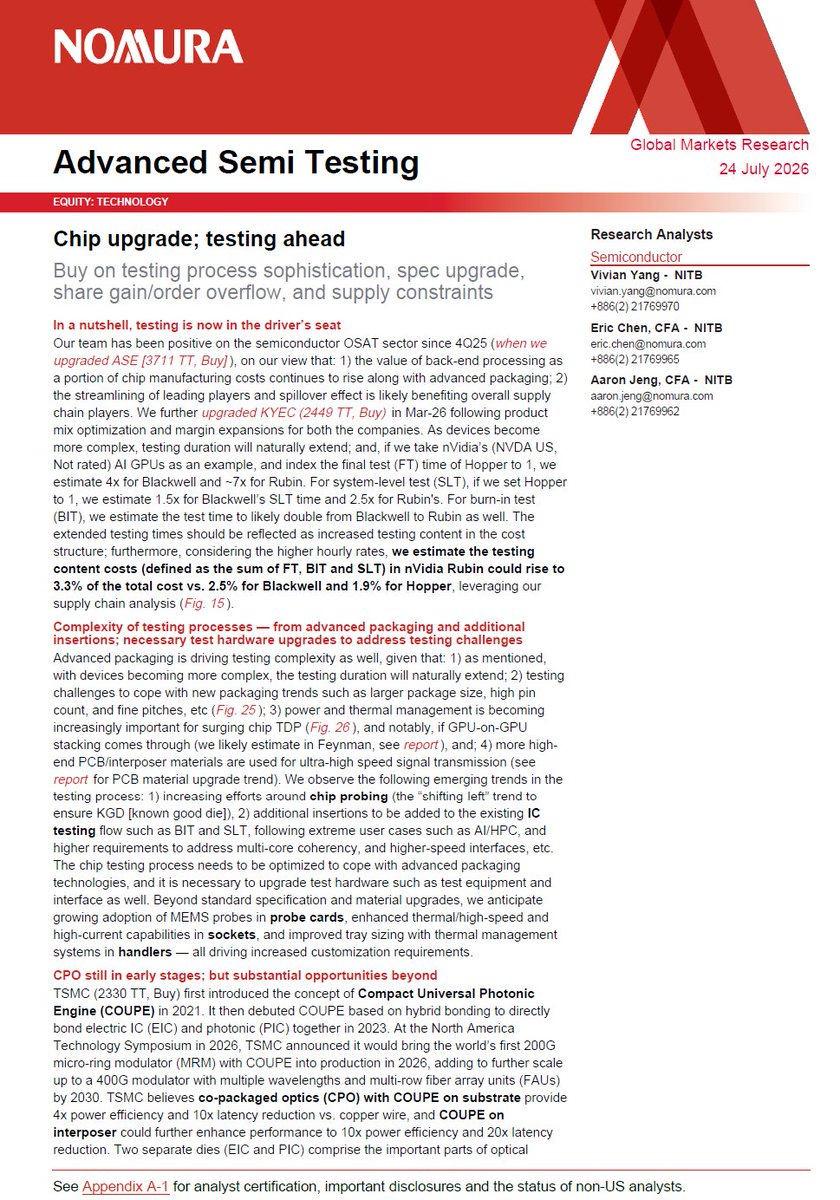
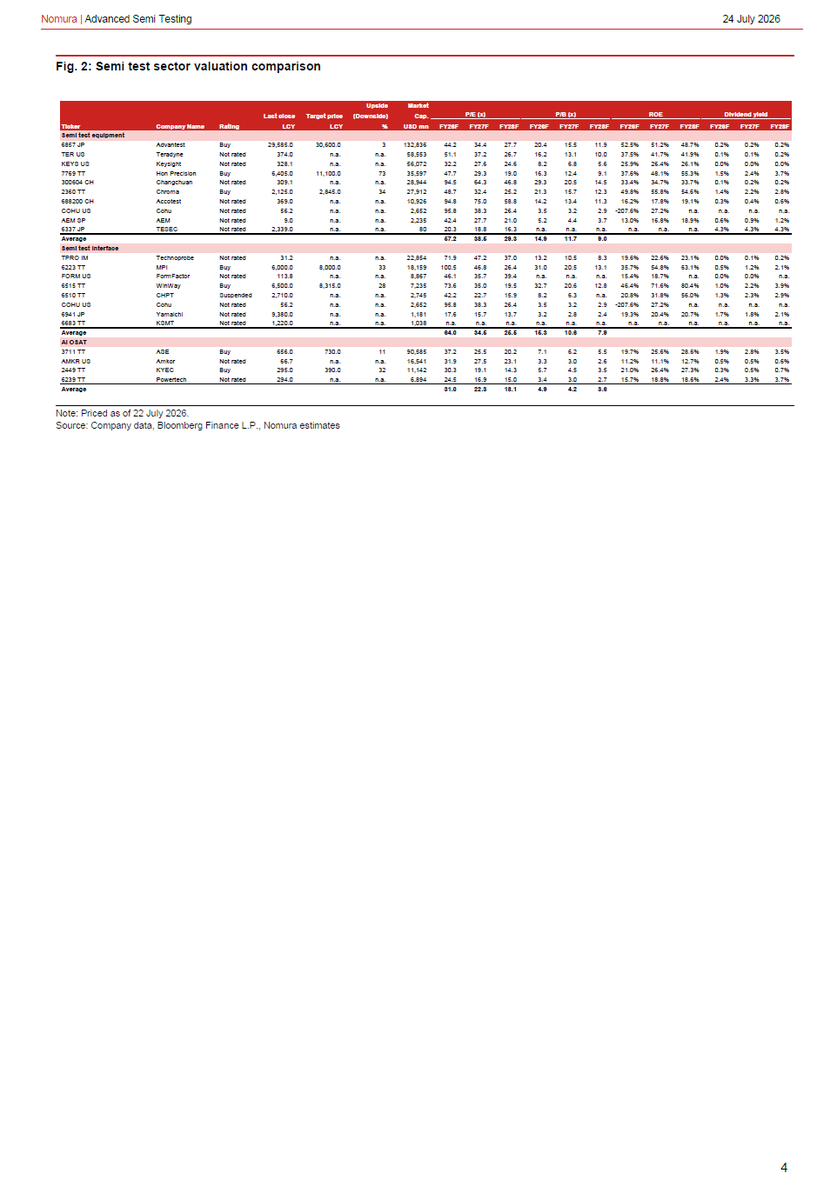
Nomura's report reinforces what we believe is one of the most underappreciated structural shifts taking place across the semiconductor industry today, namely that testing is no longer a low-value manufacturing step performed at the end of production, but is rapidly evolving into one of the most critical value-added processes within the entire AI hardware supply chain, because as chips become exponentially more complex through chiplets, stacked HBM, advanced packaging, silicon photonics and eventually co-packaged optics (CPO), the economic cost of failure rises disproportionately, making every additional dollar spent on testing significantly more valuable than it was during previous semiconductor cycles.
The market has understandably spent the past two years focusing almost exclusively on GPU designers, HBM suppliers and advanced packaging companies, yet what this report demonstrates is that testing is quietly becoming the next bottleneck, because increasingly sophisticated AI accelerators cannot simply be manufactured, they must be validated repeatedly throughout the production process to ensure every component performs flawlessly before being assembled into AI systems that may ultimately be worth several million dollars each, effectively transforming testing from a manufacturing support function into an essential yield protection mechanism.
Historically, testing was largely viewed as a necessary manufacturing expense whose primary objective was to filter out defective chips before shipment, but AI has fundamentally altered that equation because testing today is increasingly about protecting economic value rather than merely measuring quality, and when a single package contains multiple GPU chiplets, twelve stacks of HBM, advanced substrates, hybrid bonding interfaces, silicon photonic engines and increasingly expensive packaging materials, discovering a defect late in the production process can destroy vastly more value than in previous semiconductor generations.
That is precisely why Nomura estimates testing content continues to increase materially with every GPU generation, using Hopper as the baseline, where final testing time increases approximately fourfold for Blackwell and roughly sevenfold for Rubin, while system-level testing rises approximately 1.5 times for Blackwell and 2.5 times for Rubin, with burn-in testing roughly doubling, resulting in testing content increasing from approximately 1.9% of total GPU cost for Hopper to 2.5% for Blackwell and approximately 3.3% for Rubin, a progression that may appear modest when expressed as percentages but becomes extraordinarily meaningful when applied to AI systems whose selling prices continue rising dramatically.
Perhaps the most important observation in the report is not simply that testing content is increasing, but that testing itself is migrating earlier throughout the manufacturing process, effectively shifting from a single inspection performed after fabrication into a continuous validation framework that begins at wafer probing, continues through known-good-die verification, hybrid bonding validation, package testing, burn-in qualification and ultimately system-level testing before deployment inside hyperscale AI clusters, meaning the industry is increasingly adopting multiple quality gates rather than relying on one final inspection at the end of production.
This shift has enormous implications for the supply chain because every additional testing insertion creates incremental demand for specialized equipment, probe cards, sockets, handlers, MEMS probes, thermal management systems and high-speed interfaces, thereby expanding the opportunity set well beyond traditional outsourced semiconductor assembly and test companies, which explains why Nomura has broadened its coverage to include interface suppliers and test hardware manufacturers rather than limiting its investment thesis solely to OSAT providers.
Another theme that deserves significantly more attention is the interaction between advanced packaging and testing, because while investors have understandably focused on CoWoS capacity as one of the industry's largest bottlenecks, packaging capacity alone cannot solve the industry's challenges if testing capacity fails to expand at a similar pace, since every additional layer of complexity introduced through chiplets, hybrid bonding, HBM stacking, heterogeneous integration and silicon photonics simultaneously increases the probability that expensive failures will occur after substantial value has already been added to the product, making testing increasingly indispensable as AI hardware becomes more sophisticated.
The discussion surrounding co-packaged optics is equally compelling because most investors naturally associate CPO with optical component suppliers, whereas Nomura correctly argues that the real opportunity extends much further into the testing ecosystem, given that every optical engine must communicate flawlessly with adjacent ASICs under extremely demanding thermal, electrical and optical conditions while maintaining signal integrity across increasingly complex architectures, thereby introducing entirely new categories of testing that simply did not exist in previous semiconductor generations and creating an additional secular growth driver for testing vendors.
We also agree with Nomura's conclusion that the AI infrastructure cycle remains considerably earlier than many investors assume, because every successive GPU generation is becoming disproportionately more difficult to validate than its predecessor, allowing testing content to grow materially faster than semiconductor unit volumes themselves, which means the industry's next major beneficiaries may not necessarily be the companies designing the chips, but increasingly the companies ensuring those chips actually function reliably inside increasingly expensive AI systems.
Our preferred way to position for this theme is to own the entire testing value chain rather than focusing solely on OSATs, because different parts of the ecosystem benefit from different stages of the testing process. ASE (3711 TT) remains our highest-conviction OSAT exposure given its scale, broad customer base and dominant position across advanced packaging and testing. Hon Precision (7769 TT) stands out as one of the most attractive pure-play beneficiaries of final testing and system-level testing, areas where AI complexity is expanding the fastest. WinWay (6515 TT) offers differentiated exposure through sockets and probe cards, which should experience rising content per AI accelerator as electrical and thermal requirements become increasingly demanding. MPI (6223 TT) is well positioned through wafer probing, benefiting directly from the industry's shift toward earlier testing insertions and known-good-die validation. KYEC (2449 TT) remains an attractive second OSAT exposure with meaningful leverage to AI testing demand, while Chroma (2360 TT) provides exposure to automated testing equipment, allowing investors to participate in the hardware upgrade cycle required to support increasingly sophisticated AI devices.
Ultimately, we believe semiconductor testing has quietly transitioned from a manufacturing support function into one of the industry's most valuable strategic chokepoints, and just as HBM suppliers, advanced packaging companies and foundries have enjoyed structurally stronger pricing power because they occupy indispensable positions within the AI value chain, testing vendors increasingly appear poised to achieve similar economics as AI hardware becomes more heterogeneous, more thermally demanding, more optically integrated and substantially more expensive to manufacture, making testing one of the highest-conviction secular investment opportunities across the broader semiconductor ecosystem.
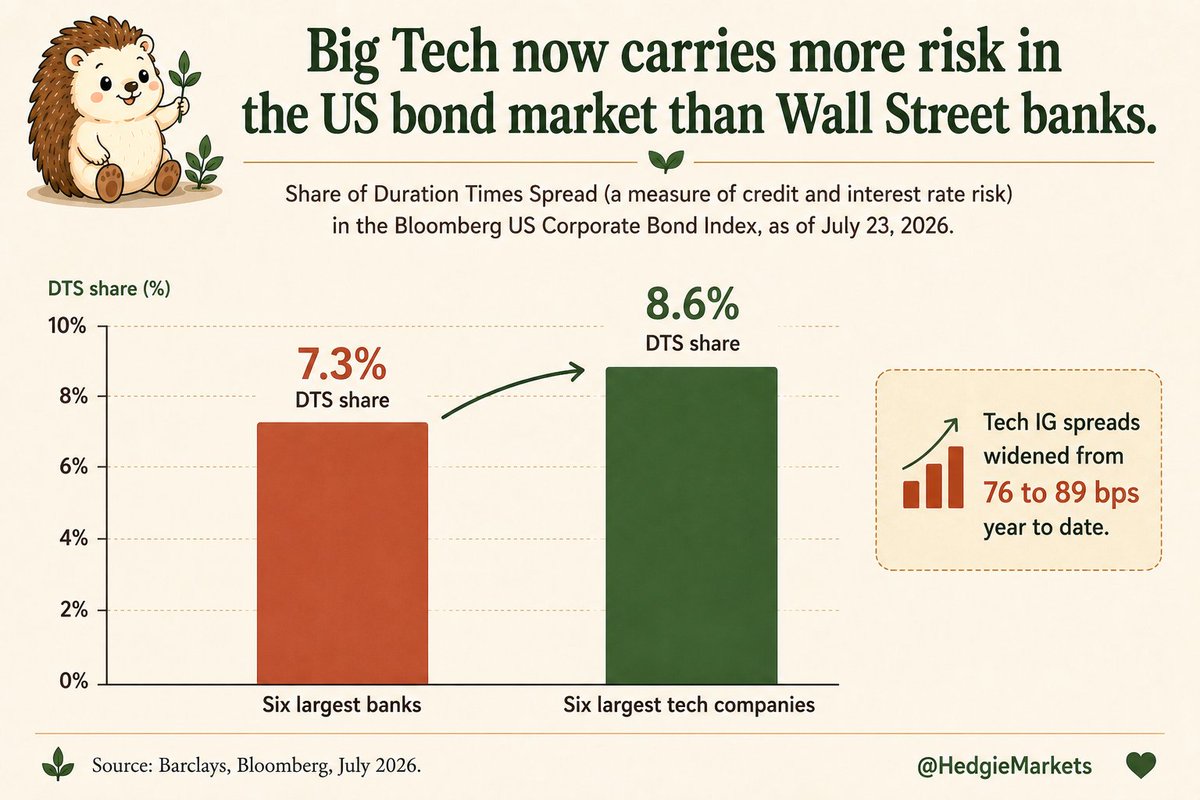
🦔When AI companies need money they can't generate from their own business, they borrow it by selling bonds to investors. They've borrowed so much so fast that Big Tech debt now carries more risk in the US bond market than the six largest Wall Street banks, according to Barclays.
Investors are getting nervous. The extra interest they're demanding to lend to tech companies has jumped 17% this year. When Amazon tried to borrow $25 billion this month, the reception was lukewarm. When SpaceX borrowed, the bonds lost value so fast that traders said they'd never seen a deal fall apart that quickly. Meta is going back to borrow more next week.
My Take
Two years ago these companies funded everything from their own cash. Now they're borrowing at a pace that's overtaken the banks in terms of how much risk they're adding to the bond market. That happened because AI infrastructure costs more than even the most profitable companies on earth can pay for out of pocket. Alphabet raised capex to $200 billion and burned through more cash than it generated for the first time in its history. Amazon, Meta, and Oracle are all in the same position.
The lenders are getting pickier, and that's where it gets uncomfortable for anyone holding these stocks. When a company can borrow cheaply and easily, it can spend as much as it wants on AI. When lenders start charging more and buying less, the spending has to slow down or the debt gets more expensive to carry. The Mag7 lost $800 billion in market cap this week. Meta is about to test whether lenders still have appetite next week. If they don't, the AI buildout hits a funding wall.
Hedgie🤗
Carry trades are having their strongest year in decades:
An emerging-market carry strategy, borrowing in euros to invest in higher-yielding currencies such as the Brazilian real, Colombian peso, and Turkish lira, is up +18% year-to-date, its strongest start to a year since 2005.
A carry trade is a strategy where traders borrow in a low-yielding currency and invest in currencies with higher interest rates, earning the difference as long as the exchange rate does not move against them.
By comparison, a G10 carry strategy, which borrows in currencies such as the euro, Danish krone, and Swiss franc to invest in higher-yielding currencies, including the New Zealand dollar, Norwegian krone, and Canadian dollar, has returned +8%.
This comes as unusually low currency volatility, combined with a resilient global economy despite the Iran-driven oil shock, has encouraged investors to continue adding exposure to carry trades.
Risk appetite in the FX market is surging.
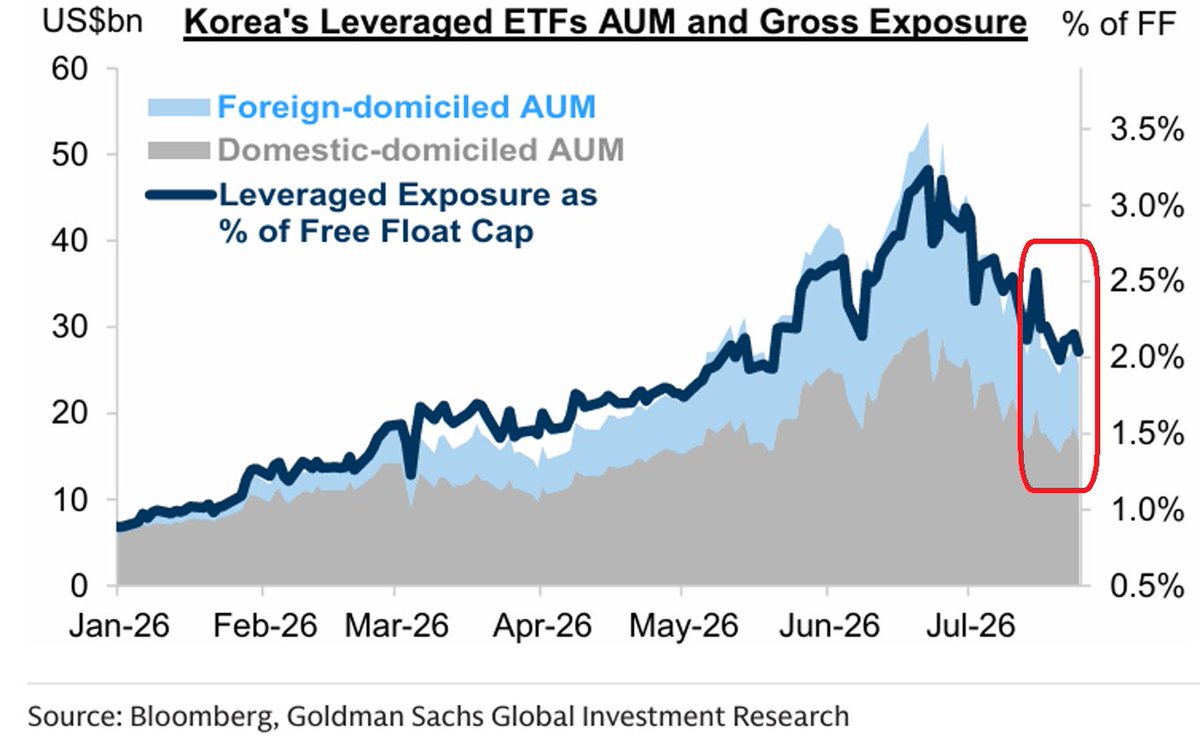
‼️Korea's leveraged ETF mania is unwinding as if there is a Financial Crisis:
Assets under management (AUM) across Korea's leveraged ETF complex have HALVED over the last month, to ~$26.5 billion.
Leveraged exposure relative to Korea's free-float market cap peaked at 3.3% around the same time, and is now down to 2.1%.
Leveraged ETFs must buy and sell stocks every day to maintain their target leverage, meaning large rebalancing trades can amplify market swings.
This comes as daily rebalancing flows in Samsung are down to 15% of its 1-month average daily trading volume, from 40% at the peak.
In SK Hynix, the same measure is down to 14%, from 26%.
Samsung and SK Hynix together account for over 50% of KOSPI's total market cap, so the leveraged ETF unwind has significantly reduced one of the market's largest sources of mechanical buying.
The same leverage that amplified Samsung and SK Hynix's rally is now accelerating the market decline.
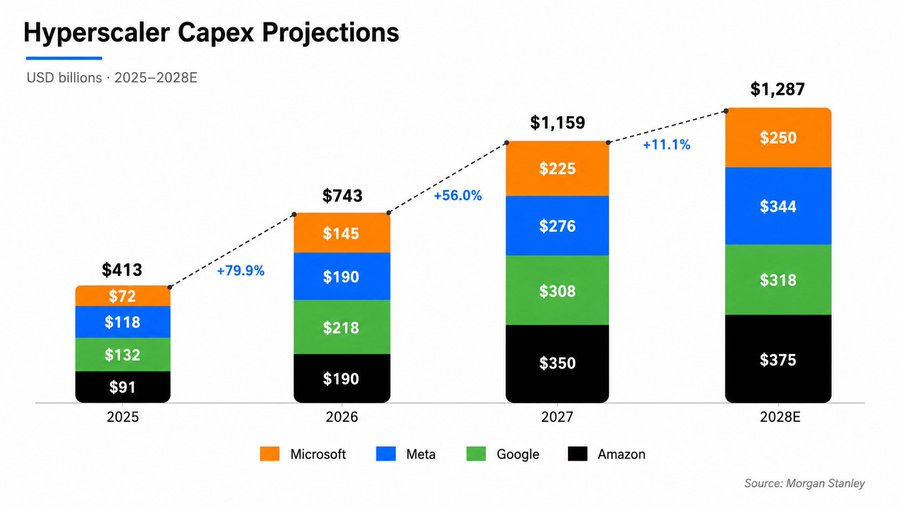
$1.28 trillion is about to pour into data centers but the biggest winners are companies most people have never heard of (Save this).
Microsoft, Meta, Google, and Amazon are set to spend $413 billion in 2025 and blow past $1.28 trillion by 2028, nearly tripling in three years .
Capex jumped 79.9% in 2026 alone and is still climbing 11.1% into 2028, even as the growth rate itself starts to cool .
Roughly 70 to 80 percent of that spending flows straight to public suppliers, which turns $1.28 trillion into real revenue for companies most retail investors couldn't name.
Here are some of the key companies that will benefit from this.
Credo Technology makes the active electrical cables that link AI servers inside a rack together with far less power loss than traditional copper, and it just raised guidance about 20% ahead of earnings purely because hyperscaler demand outran its own forecast.
Powell Industries builds the custom electrical switchgear and distribution equipment that feeds power from the grid into a data center's server floor, sitting inside a power infrastructure trade most ETFs still barely touch.
Hubbell supplies the grid side transformers and electrical components utilities need before they can even deliver enough power to a data center site in the first place.
Fluence Energy builds battery storage systems that let data centers smooth out power draw during peak GPU load, signed fresh supply deals with two hyperscalers, and doubled in a week once short sellers got caught leaning the wrong way.
MACOM Technology Solutions designs the high speed semiconductor chips used inside optical transceivers, the small components that let data flow between servers at the speeds AI training actually requires.
Prysmian, an Italian cable maker most US investors have never traded, produces the fiber optic cable itself that physically wires these data centers together, and just got its price target raised on rising AI driven fiber demand.
None of these are Nvidia sized names, which is exactly why they still fly under the radar, but each one sits at a chokepoint in the buildout where swapping suppliers mid project just isn't realistic.
Bullish on AI infrastructure, make sure to follow @MelvinInvests for more AI investment insights and if you want to see exactly what I'm buying as an analyst at Milk Road Pro, you can join for just $1 using the link below.
Google just reported $99 billion in profits it never actually received.
Alphabet posted net income of $112.1 billion for a single quarter. Earnings per share came in at $9.11 against a Wall Street estimate of $2.87.
That is one of the largest profit quarters any company has ever printed.
Yet the stock fell about 7% the same day.
When people read past the headline and opened the earnings release, they found the reason sitting in one footnote...
$99 billion of that profit came from a line called other income. Alphabet describes it as "primarily the result of net unrealized gains on our equity securities."
So Google did not sell anything. It marked up shares it already owned and ran the increase through its income statement.
That single line added $77.1 billion to net income after tax. It accounted for $6.26 of the $9.11 in earnings per share.
Strip it out and adjusted earnings per share were $2.85. Analysts wanted $2.89. The ACTUAL business missed.
Now here is what makes this insane:
Most of that $99 billion came from two holdings, SpaceX and Anthropic.
SpaceX went public on June 12 at roughly $1.77 trillion, up from about $400 billion a year earlier. Alphabet's stake is worth $94.1 billion, and roughly $80 billion of it sits under sale restrictions.
Anthropic went from a $350 billion valuation to $965 billion inside the same quarter. Alphabet's private company holdings were worth about $124.3 billion on June 30, and the vast majority of that is Anthropic.
Google cannot sell either position right now.
Now trace where that valuation came from:
Google started putting money into Anthropic in 2023. A $300 million bet has grown into a $13.3 billion position with commitments of up to $30 billion more.
Anthropic committed to buying at least five gigawatts of computing capacity from Google Cloud.
Google Cloud revenue then grew 82% to about $24.8 billion, the strongest quarter that business has ever had.
That growth is part of the story the market uses to price both companies.
And when Anthropic's valuation jumped, Google booked the jump as its OWN profit.
Google is the investor, the supplier, and the party deciding what the asset is worth. A tax and accounting consultant named Robert Willens flagged this back in April, pointing out that Alphabet is able to influence the value of one of its own assets.
And Alphabet's free cash flow for the quarter was negative $5.9 billion. That is the first negative quarter since Google went public in August 2004.
Capital spending hit $44.9 billion. Operating cash flow was $39.1 billion. Capex now eats about 37.5% of every dollar of revenue, the highest share in the company's public life.
To fund it, Alphabet has taken on roughly $100 billion of debt this year and raised about $85 billion in a June share sale, its first in more than two decades. This is a company that spent years buying its own stock back.
What happens next:
Alphabet raised 2026 capital spending guidance to between $195 billion and $205 billion, the second raise in three months. The finance chief told analysts 2027 spending will rise significantly.
The company also disclosed $811 billion in contracted future spending commitments as of June, up nearly $500 billion from March.
Those commitments are signed contracts that get paid in cash. The profit is an estimate of what a private company might be worth on a given day.
Estimates move in both directions. If Anthropic or SpaceX gets repriced downward, the same line that produced the biggest quarter in Google's history runs backwards, and this quarter produced no free cash flow to absorb it.
Meta, Microsoft and Amazon are all carrying their own private AI stakes into their own earnings reports.
Watch how much of their profit they actually collected in cash...
There we go: Hyperscaler CDS just hit record wides, led by a disintegrating ORCL and SPCX. And today the "supersafe" names finally ripped.
Bond market is done funding this negative ROI lunacy
BREAKING: Net credit balances fell -$70 billion in June, to a record -$1.06 trillion.
This metric tracks how much margin debt investors carry relative to the cash in their brokerage accounts.
Since the 2022 bear market, this figure has more than quadrupled.
This comes as margin debt has surged +$895 billion over this period, to a record $1.50 trillion.
By comparison, throughout the 2008 Financial Crisis, the net credit balance remained positive, meaning investors held more cash than margin debt amid widespread deleveraging and a flight to safety.
Investor risk appetite is at unprecedented levels.