OCRia-nano-1 is now #1 trending on @huggingface for image-to-text models!
It's an open-weight OCR model with just 8.1M parameters. Parses a page in 426 ms on your CPU, no GPU needed.
Great way to spend the weekend time. Go give it a spin and parse something @llama_index
I married into an Indian family and getting exposed to Maggi Tomato Chili Sauce 🌶️ has been life changing. My sauce game got an upgrade.
I prefer it over Sriracha. It goes amazing with samosas (obvi) and also with karage/fried chicken, burgers, omelettes.
The LlamaIndex team just open-sourced a PDF parser, and it's stupidly fast 😳
LiteParse parses PDFs and office docs locally on your own machine. No LLM, no cloud, no API key.
Text parsing takes about 2-5 milliseconds per page, so your RAG pipeline stops waiting on documents.
The list of what it supports is kind of ridiculous:
PDF
Word, Excel, PowerPoint
Images
Built-in Tesseract OCR
Its own tiny CPU OCR model (8.1M params)
PaddleOCR or EasyOCR via HTTP
Markdown, JSON and plain text output
Bounding boxes for every piece of text
Page screenshots for AI agents
Python, Node.js, Rust and the browser (WASM)
Why is this worth bookmarking?
Most RAG setups send every PDF to a paid parsing API, or use a slow parser that mangles tables and layouts.
LiteParse runs entirely on CPU. It can even check how complex a document is before parsing it, so the hard files can go to heavier tools and the easy ones fly through.
With its optional OCR model, it beats Marker and Indra on ParseBench-2 while handling about 28 pages per second on CPU.
Already at 13.2K stars.
Install is dead simple:
pip install liteparse
Then:
lit parse document.pdf --format markdown -o output.md
If you build RAG, knowledge bases or document AI, bookmark this one.
GitHub:
https://t.co/uWEpN2Kbst
#LiteParse #LlamaIndex #RAG #PDF #OCR #LLM #OpenSource
Today, we’re releasing OCRia-1’s weights on @HuggingFace and @Ollama🦙
Our 4B model for complex tables, charts and difficult scans is now available to download and run on your own infrastructure.
In about a month we shipped:
→ OCRia-1, our first document parsing model
→ OCRia-1.5, in 2B and 4B
→ OCRia-nano-1, our 8.1M-parameter model for local CPU parsing, released with open weights
We’re building OCRia for the full range of document workloads, with open-weight releases to help advance research in document understanding. Grab the weights and show us what you build.
Hugging Face: https://t.co/YLpQmxImHN
Ollama: https://t.co/7MBLI3UFD8
Yesterday we released OCRia-nano-1’s weights. Today, OCRia-1 joins it 🦙
From 8.1M parameters for everyday parsing on your CPU to our 4B model for the hardest documents, we’re building OCRia for the full range of document workloads.
Today we are open-sourcing the weights to OCRia-1, our flagship 4B VLM for document OCR 🔥
This is our SECOND open-weight release in two days (we just launched OCRia-nano-1 yesterday!!).
OCRia-1 is on the pareto curve of accuracy and cost relative to other 4B models on multiple benchmarks: ParseBench, olmOCR-bench (tables), PulseBench-Tab, and fr-bench-pdf2md. It is an extremely general purpose model that can parse even the most complex document types, including complex tables/charts/formatting/layout.
We’re releasing the weights to help advance open research around OCR, on both @huggingface 🤗 and @ollama 🦙
If you want to use it in prod, come talk to us. If you want to use the latest SOTA of the OCRia model family, tuned for production, check out LlamaParse!
Release on @huggingface : https://t.co/h8SMhfRLDo
Release on @ollama: https://t.co/p4B9GtHFfU
LlamaParse: https://t.co/pAJJyXjzVD
My desktop and mac have been running nonstop to train this release 🔥
The fun part about small models is how accessible they are. Anyone can train and run models this size no matter the hardware.
Will a sub 50M paremeter model ever beat our larger OCR models? Stay tuned 😉
Proud of this one 🦙
Fast, accurate document parsing in just 8.1M parameters, running locally on your CPU. The weights are open.
Give OCRia-nano-1 a try on your everyday PDFs. Would love to hear how it does!
In celebration of Jensen Huang's return and his commitment to open-source AI:
Today we’re releasing OCRia-nano-1, an extremely lightweight and open-weight OCR model that is just 8.1M parameters in size and can parse pages at 426 ms per page on your CPU ⚡️ - no GPU required!
OCRia-nano-1 is intended to be the first pass parsing for the billions of pages/petabytes of data that are locked up within any organization and unlock it for all agentic automation. Even at its size, it still has the following properties:
✅ it can parse complex tables and generate bounding boxes
✅ it is natively multilingual and can cover CJK, right-to-left, and other scripts
✅ is more accurate than Marker, PP-OCRv6, Tesseract while being up to 2-5x faster
It is perfect for ‘unlimited’ high-volume ingestion (e.g. indexing a petabyte scale RAG knowledge base) and ad-hoc uploaded files where the agent has additional tools to inspect the file more deeply. You can always use larger VLMs (like OCRia-1.5) for any document that requires higher visual accuracy.
Best of all, it’s a fully open-weight model available through liteparse. If you’re interested in using it for commercial use, come talk to us!
Blog: https://t.co/2woySeAtbz
Install OCRia-nano-1 through liteparse: https://t.co/Z5JFsCA7G3
Weights on @huggingface: https://t.co/1t6EZTO0fq
Full technical report:
Today we’re introducing OCRia-1.5
It’s a new family of document parsing models that push the boundaries of accuracy and cost across multiple document parsing dimensions.
We had just released OCRia-1 a month ago, which set a new SOTA in unified document parsing, but we've only released even more improvements since then.
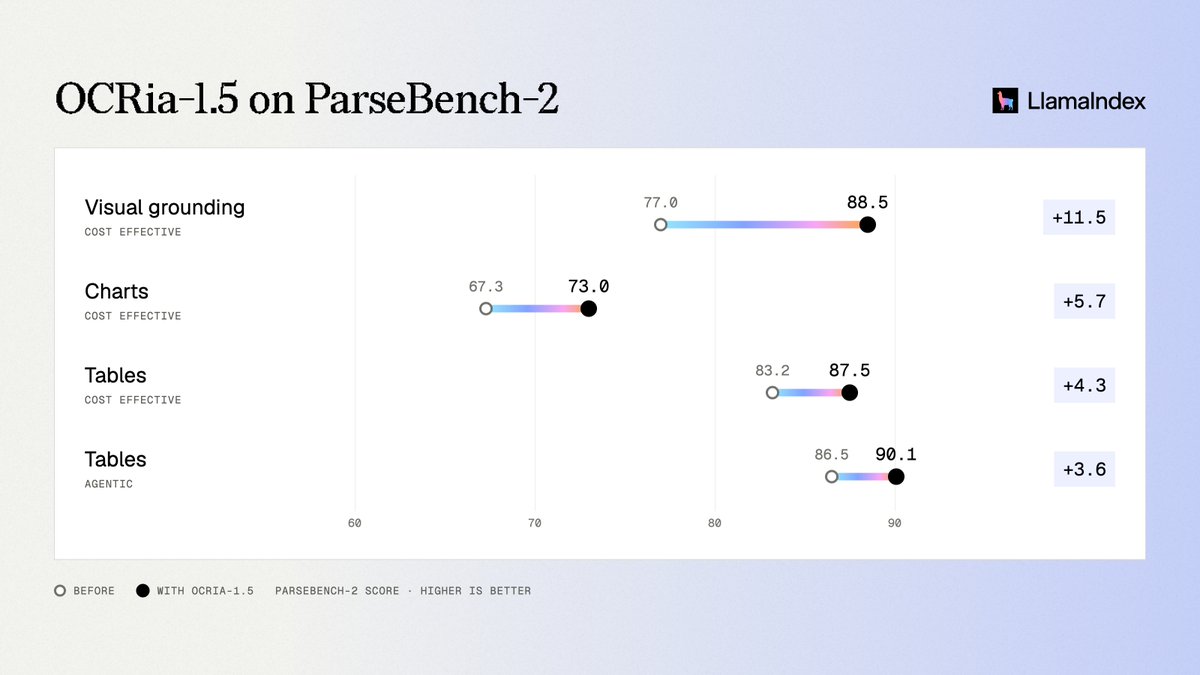
✅ Tables: Table scores rose from 86.5 -> 90.1 on agentic, 83.2 -> 87.5 on cost-effective
✅ Charts: 74.9->76.8 on agentic, 67.3 -> 73.0 on cost-effective
✅ Forms: +2.6 on agentic, +4.2 on cost-effective
✅ Visual Grounding: +4.1 on agentic, and +11 (!!) points on cost-effective
Together, these models set a new Pareto frontier for document parsing. Our cost-effective OCRia-1.5 is the cheapest and most accurate model for parsing all of tables, charts, forms, handwriting, with high-quality layout.
Blog: https://t.co/9NlhPd6E1s
These scores for all our modes (cost-effective, agentic, agentic plus) reflected within ParseBench-2: https://t.co/PWczfhp0OX
Today we’re introducing OCRia-1.5. It is more accurate than OCRia-1 on complex tables, charts and forms, and it places bounding boxes more precisely.
OCRia-1.5 comes in two sizes now:
→ OCRia-1.5-2B runs Cost Effective, built for parsing at scale
→ OCRia-1.5-4B, our upgraded flagship, runs Agentic for the hardest pages
Same tiers, same prices, better models underneath.
Here’s what changed on ParseBench-2 👇️
Today we’re introducing OCRia-1.5
It’s a new family of document parsing models that push the boundaries of accuracy and cost across multiple document parsing dimensions.
We had just released OCRia-1 a month ago, which set a new SOTA in unified document parsing, but we've only released even more improvements since then.
✅ Tables: Table scores rose from 86.5 -> 90.1 on agentic, 83.2 -> 87.5 on cost-effective
✅ Charts: 74.9->76.8 on agentic, 67.3 -> 73.0 on cost-effective
✅ Forms: +2.6 on agentic, +4.2 on cost-effective
✅ Visual Grounding: +4.1 on agentic, and +11 (!!) points on cost-effective
Together, these models set a new Pareto frontier for document parsing. Our cost-effective OCRia-1.5 is the cheapest and most accurate model for parsing all of tables, charts, forms, handwriting, with high-quality layout.
Blog: https://t.co/9NlhPd6E1s
These scores for all our modes (cost-effective, agentic, agentic plus) reflected within ParseBench-2: https://t.co/PWczfhp0OX
I agree with @jerryjliu0's sentiment.
[Rant on]
Some of the reactions to ParseBench 2 from competitors have been pretty disappointing.
We've seen personal attacks, bad-faith interpretations of the benchmark, and criticisms that suggest some people haven't actually taken the time to understand what we built.
One example that stood out:
"Look, there's underlined text in a table cell, and if our parser misses the underline, the benchmark penalizes us. This is scandalous!"
Well... yes? If the dataset evaluates underline preservation, missing underlines gets penalized. That's kind of the point.
Another interesting one: calling for an end to benchmarks, only to release two new closed benchmarks a few days later, while promoting a proprietary "LLM-as-a-judge" evaluation that conveniently ranks your own parser first.
(Surprise: vendor preferences can be embedded in evaluation prompts too!)
There have been dozens of takes like these, often from people who clearly haven't looked into how ParseBench 2 actually works. At times, it's felt more like a coordinated effort to discredit the benchmark than a genuine technical discussion.
[/Rant off]
Here's the thing: every vendor will continue publishing benchmarks. That's how this industry works.
And every benchmark, including ours, will have flaws and biases. We naturally measure the things we care about.
That's fine. It's worth discussing. It doesn't justify personal attacks.
I'll continue taking valid feedback seriously and improving and expanding ParseBench. I genuinely want us to get closer to a fairer, more useful benchmark.
Because ultimately, I care about the quality of what we ship, not winning a marketing argument.
And with ParseBench 2, we actually built some pretty cool things that I think deserve more attention:
1. User-defined evaluation policies
To our knowledge, ParseBench 2 is the first parsing benchmark that lets users define their own penalty policies, instead of blindly accepting the benchmark creator's preferences (including ours).
Try it: https://t.co/aExXILK3xM
We're working on making this easier to use, customize, and export.
2. Metrics designed to reflect what actually matters
We spent a lot of effort making sure different models get a fair evaluation, without unnecessarily penalizing formatting differences or model-specific quirks.
We also developed a technique to better align scoring metrics with the user's chosen evaluation policy.
This means we can distinguish between errors based on their actual severity, rather than relying purely on traditional edit-distance metrics that may treat very different mistakes similarly.
You can explore the metrics, different severity policies, and our analysis of dozens of other benchmarks here:
https://t.co/cNuyoE6RVd
I'm genuinely impressed by the technical work coming out of some of our competitors. Some teams are doing incredible things, and I have a lot of respect for that.
I'd love to see more technical discussions, more reproducible evaluations, and less high-school-level drama.
Anyway, back to building.
Last week we released ParseBench-2, our most comprehensive effort to benchmark various document OCR tools.
It drew quite a bit of ire among our peer document OCR vendors, who offered their own reactions:
---- “This is marketing slop” - vendor 1 who immediately goes and publishes lower-effort marketing slop (*cough benchbench cough*)
---- “everybody is number 1 on their benchmark” - vendor 2 who immediately shows their own benchmark where they’re #1
(also we’re not even #1 on some dimensions! No one actually cared about our efforts to be more fair)
there was some constructive feedback which we’re taking into account and iterating on a new release. But it was mostly masked by some (pretty funny) noise and posturing.
Unlike other vendors, our evals are completely open - no hidden judge prompt, no hidden test dataset, and we actively update the leaderboard from Github/Hugging Face submissions.
If you’re in the market for document OCR, I think ParseBench-2 is probably the most comprehensive resource for comparing different solutions. Even if you completely ignore our parsing solutions or overall score, there’s value in understanding the detailed taxonomy we’ve created over different failure types.
Come check it out! https://t.co/PWczfhp0OX
Also our tech report is extremely detailed and the result of incredible effort from our research team. Come check it out: https://t.co/qNlc5r0mss