.@llama_index just launched OCRia-1, a 4B document-parsing language model based on Qwen.
It's made to process images and turn it into markdown with tables and charts.
Get started with the model:
ollama pull llamaindex/ocria-1:bf16 https://t.co/tBkfFNxmma
Today we are open-sourcing the weights to OCRia-1, our flagship 4B VLM for document OCR 🔥
This is our SECOND open-weight release in two days (we just launched OCRia-nano-1 yesterday!!).
OCRia-1 is on the pareto curve of accuracy and cost relative to other 4B models on multiple benchmarks: ParseBench, olmOCR-bench (tables), PulseBench-Tab, and fr-bench-pdf2md. It is an extremely general purpose model that can parse even the most complex document types, including complex tables/charts/formatting/layout.
We’re releasing the weights to help advance open research around OCR, on both @huggingface 🤗 and @ollama 🦙
If you want to use it in prod, come talk to us. If you want to use the latest SOTA of the OCRia model family, tuned for production, check out LlamaParse!
Release on @huggingface : https://t.co/h8SMhfRLDo
Release on @ollama: https://t.co/p4B9GtHFfU
LlamaParse: https://t.co/pAJJyXjzVD
OCRia-1.5 is one of the most accurate models for parsing your most complex tables within your PDFs
- dense, long tables
- merged columns/rows
- scanned tables
It both converts these elements into clean html/markdown, and also draws precise bounding boxes annotating every element on the page.
It outperforms some of the most advanced frontier models while being extremely price efficient. OCRia-1.5 sets a new pareto frontier in cost and accuracy on ParseBench-2, where we've benchmarked 60+ other OCR tools, frontier models, open-weight models. They have the highest accuracy relative to their price points compared to other models.
OCRia-1.5 blog: https://t.co/8y12TrAEYn
ParseBench-2: https://t.co/PWczfhp0OX
Come check it out in LlamaParse! https://t.co/XYZmx5TFz8
i'm a really big fan of interactive maps. one i've been using is this old site called https://t.co/VSYtec4mZ7
if you moved to SF and miss your hometown radio, give this site a go
ParseBench has been cited by NVIDIA, Cohere and Perplexity. It still isn’t a perfect benchmark.
Part of getting closer meant owning where ParseBench-1 got things wrong. On one McDonald’s financial statement, it scored a parser that broke a dollar amount above one that got every number right.
So for ParseBench-2, we changed how we build the metric. We decide how much each kind of error should matter first, then test and tune the scoring until it agrees.
→ 330 perturbation types to check that scores move by the right amount
→ 4,317 pages across six dimensions, now including forms
→ Full reference tables for all 1,025 charts
→ A Metric Lab to set scoring priorities for your own workload
There’s still more to do, and we wanted to be open about that too.
Read more about how we’re building toward a perfect document parsing benchmark in the reply below.
Today we’re introducing OCRia-1.5
It’s a new family of document parsing models that push the boundaries of accuracy and cost across multiple document parsing dimensions.
We had just released OCRia-1 a month ago, which set a new SOTA in unified document parsing, but we've only released even more improvements since then.
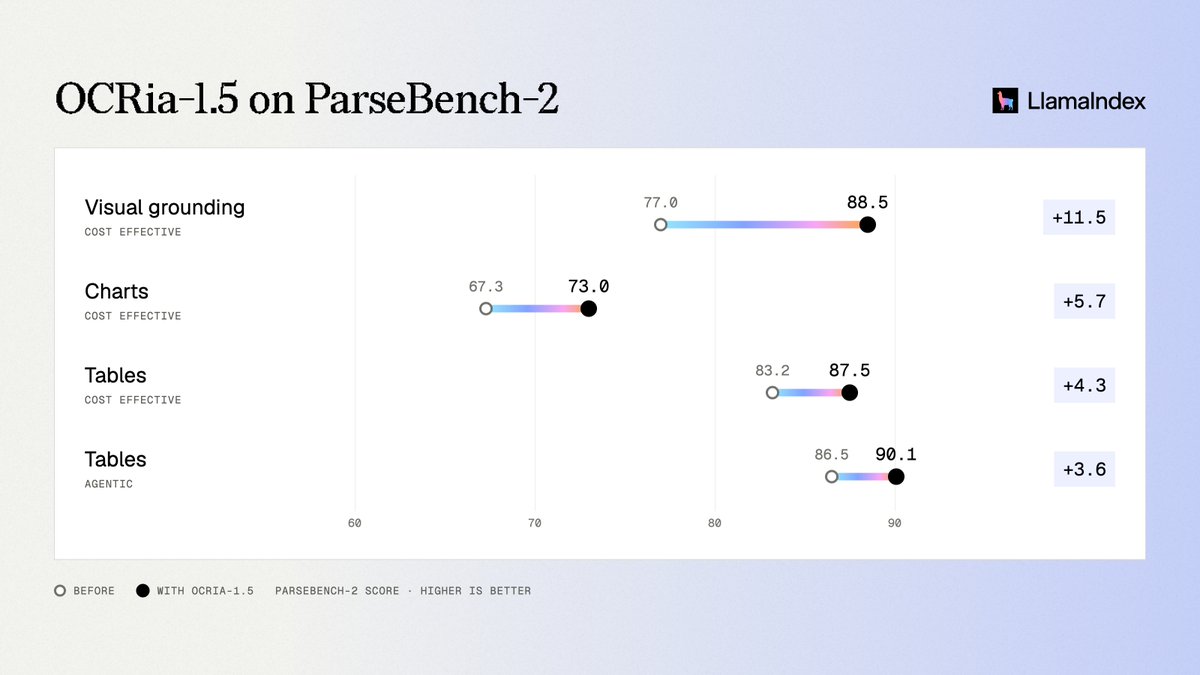
✅ Tables: Table scores rose from 86.5 -> 90.1 on agentic, 83.2 -> 87.5 on cost-effective
✅ Charts: 74.9->76.8 on agentic, 67.3 -> 73.0 on cost-effective
✅ Forms: +2.6 on agentic, +4.2 on cost-effective
✅ Visual Grounding: +4.1 on agentic, and +11 (!!) points on cost-effective
Together, these models set a new Pareto frontier for document parsing. Our cost-effective OCRia-1.5 is the cheapest and most accurate model for parsing all of tables, charts, forms, handwriting, with high-quality layout.
Blog: https://t.co/9NlhPd6E1s
These scores for all our modes (cost-effective, agentic, agentic plus) reflected within ParseBench-2: https://t.co/PWczfhp0OX
Today we’re introducing OCRia-1.5. It is more accurate than OCRia-1 on complex tables, charts and forms, and it places bounding boxes more precisely.
OCRia-1.5 comes in two sizes now:
→ OCRia-1.5-2B runs Cost Effective, built for parsing at scale
→ OCRia-1.5-4B, our upgraded flagship, runs Agentic for the hardest pages
Same tiers, same prices, better models underneath.
Here’s what changed on ParseBench-2 👇️
Today we’re introducing ParseBench-2 - our most ambitious document parsing benchmark to date.
It is the only benchmark that provides both extreme granularity into every single type of production parsing error, while also making sure that metric scores are highly aligned with human judgment. We do this by painstakingly assigning severity scores to 330+ error types, and tuning each metric to match the severity scores.
Existing benchmarks either use brittle deterministic metrics (e.g. OmniDocBench) or LLM-as-a-judge (ParseArena), which can help recognize equivalent representations but are coarse/stochastic/subject to bias by the prompt+model.
ParseBench-2 also contains:
✅ 4.3k+ document pages (double from ParseBench-1).
✅ An extra dimension (forms)
✅ Much better ground-truth across all dimensions compared to ParseBench-1.
This is the next evolution of ParseBench, our hugely popular benchmark that has 50k+ monthly downloads, over 150+ OCR solutions benchmarked, and has been adopted by companies like NVIDIA, Cohere, Aleph Alpha, Perplexity, and others.
Alongside ParseBench-2, we are also releasing OCRia-1.5 - a new family of document parsing models that powers all our modes in LlamaParse. They represent a massive step up in capabilities from our latest release, and are state of the art in parsing complex tables, forms, charts, formatting, and assigning bounding boxes to complex layouts.
Come check out our blog post, technical report, and website.
Blog: https://t.co/TKbfCyTjht
Technical Report: https://t.co/eAu0s6ttA1
Website: https://t.co/PWczfhp0OX
If you’re interested in trying out our OCRia-1.5 capabilities, come sign up for LlamaParse: https://t.co/XYZmx5TFz8
Last Thursday we hosted a private dinner for AI leaders in insurance at Niku Steakhouse.
The discussion was so good we forgot to take a photo :) We created a photorealistic rendering of what the conversation looked like below.
We live in a world where frontier models are exponentially improving every month. This raises many interesting questions around the opportunity for agentic automation, both within the external products that folks are building (e.g. automating claims, underwriting), and within internal organization and engineering processes.
We opened with two questions:
1. How much of your work is AI actually automating today?
2. In an industry this regulated, where does a human stay in the loop?
Human in the loop will always be needed for verification and legal purposes in highly regulated environments. But it is fascinating to see that most builders have evolved from building small deterministic workflows into agents that can deliver e2e outcomes. They're also able to build product with a team that's leaner than ever and still multiples more productive than the same time last year.
Big thanks to @imaanxsultan for organizing!
This is the first dinner for Marginalia, a private dinner series that gathers AI leaders one industry at a time. Thanks to everyone for a great discussion, and we’re hoping to host the next one soon!
Today we’re releasing OCRia-1, a frontier VLM for document parsing that sets a new SOTA in accuracy, cost, and latency.
It not only sets a new high score on ParseBench (87.4), but also leads in three 3rd-party benchmarks: olmOCR-bench* (83.5 overall, 92.9 on tables!), PulseBench-Tab (84.1), and fr-bench-pdf2md (72.1).
OCRia-1 is really, really good at parsing complex tables: nested headers, merged cells, irregular grids, scanned tables, and more. It is also fantastic at parsing complex unlabeled charts (line, bar, pie, technical diagrams), and preserving complex formatting. Most real-world enterprise documents contain at least one of the these, whether it’s a big tax withholding table or a public economic report.
It is a 4B model and outperforms all other models within a similar parameter class: LightOnOCR-3, Chandra-OCR 2, Mistral OCR 4.1, and more. It is also extremely fast.
All credit goes to our research team, who spent countless hours on curating a diverse dataset, tuning our training pipeline, and squeezing every last drop out of model optimization so that it can process billions of pages at scale.
OCRia-1 as a base is powering all of our modes within LlamaParse (cost-effective, agentic, agentic plus), so you can access its capabilities today!
If you’re processing millions/billions of documents at scale, we’re offering enterprises that book a demo up to $3k in credits for a guided evaluation.**
*olmOCR-bench scores are adjusted based on unifying rendering at 1,288px for all models
**enterprise POC credits apply to eligible organizations that book a demo
Send me the page that breaks your parser.
Merged-cell tables, 30 year old scans, handwritten claims forms, engineering drawings you name it, we want the worst of the worst and the ones that cause the most pain today.
I'll run it through LlamaParse and post the output. No pitch, no form. Just reply or DM.
Does paying 5x more per page actually get you better document extraction? We ran the data to find out.
We evaluated 14 frontier systems across 370 enterprise documents, then plotted their accuracy against cost per page. The biggest takeaway? Higher cost does not equal better extraction.
• Agentic Plus hit the highest accuracy overall at <1/3 the cost of the runner-up.
• Agentic & Cost Effective routinely beat systems costing several times more per page.
More expensive doesn’t necessarily mean more accurate. Now we have the data to show it.
Try Extract on your own documents with 10,000 free credits when you sign up for LlamaParse → https://t.co/eDIakWBZHy