1/ I believe rules as code will be the most important societal and technological change of the 2020's. It will be impacting both the physical and digitals world. But what is it? and why is it important? Or why you should care? 👇 #rulesascode
A lot of people pointed out the integer multiplication exponent progress is good but we still have constant time galactic multiplier.
This is true for sure, but this post looked at how the constant time multiplier moved as the exponent improved. (Which wasn’t trivial to derive). Bad news and good news.
Bad news is it doesn’t seem to be automatically improving with the exponent. Good news though is it one, it doesn’t seem to be getting worse, and two at least for most of the constructions
there does seem to be opportunities to shrink it (since it was going down sometimes without even being optimized for).
My optimistic take is this is hopefully that the integer multiplication work might actually one day become practical. Once the exponent comes down a little more, it might make sense to being a parallel track focusing on the constant multiplier. We may see the algorithm that comes out of this used in our computers for every day work still
Use my morning building https://t.co/lPJxi5H9MA . If your AI sub is not max out this week and you have left over token you can now give them to an open research challenge and contribute automatically!
Do agent not care about paper length? How do you select what thing is worth publishing in a fast moving research environment? Is PDF Latex the good format for agent research publishing? (if not what is the format that is the most agent friendly?)
The auto-written Integer Multiplication research paper is now 7000+ pages long. Not really practical but I'm trying to understand what publishing research mean in 2026 when agent are moving the frontier that fast? https://t.co/yt9Tf49nyt
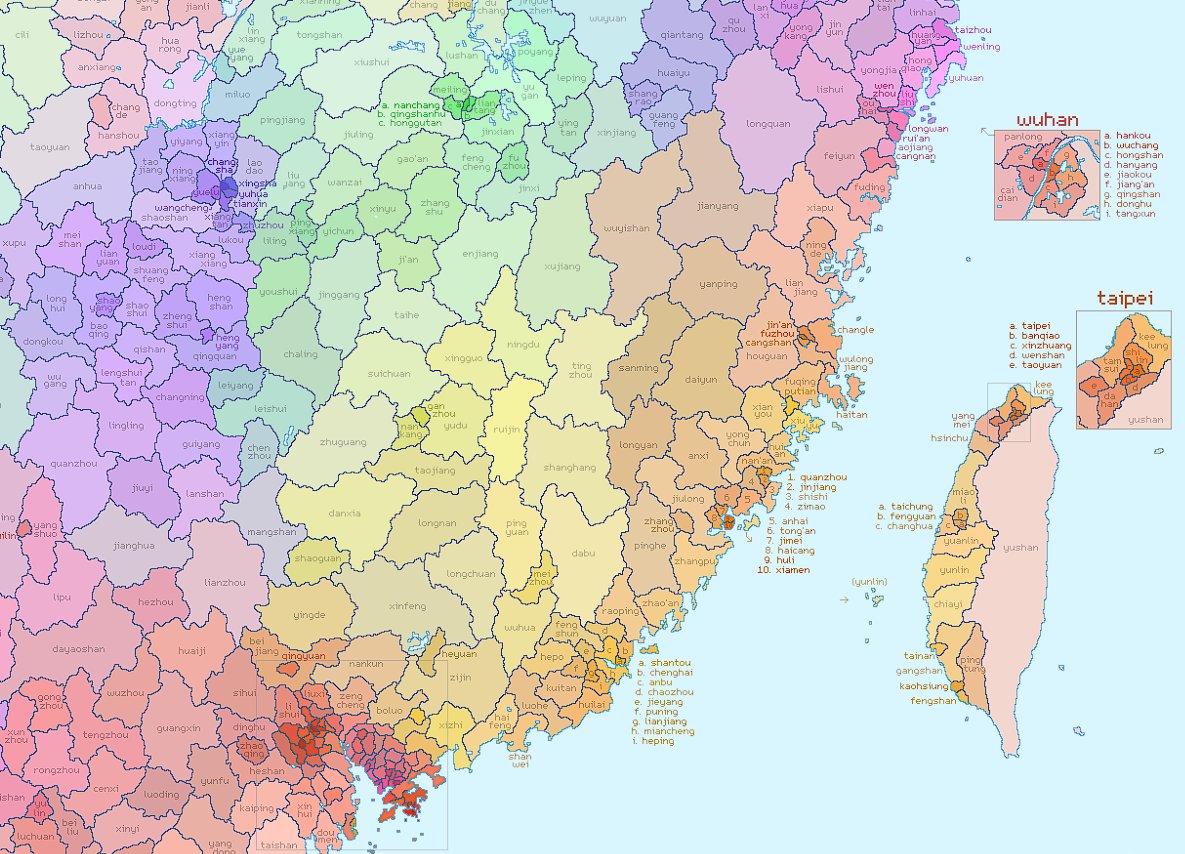
china divided into areas of 1 million people!
it's fun to see the contrast between the dense central plain and the sparsely populated west.
i am working on doing all of asia, its been about 300 hours so far
Decide to give interger mutliplication a go with google Argon on antigravity. Think now I know why antigravity is not that popular. Can not even clone the repo... Will have to figure out how to make it work....
Key things I like using OCRia-1 over the last few weeks:
- It's blazzzzzzing fast
- It is really good at complex/long tables.
As we have been cooking expect more things in the next days / weeks
Today we’re releasing OCRia-1, a frontier VLM for document parsing that sets a new SOTA in accuracy, cost, and latency.
It not only sets a new high score on ParseBench (87.4), but also leads in three 3rd-party benchmarks: olmOCR-bench* (83.5 overall, 92.9 on tables!), PulseBench-Tab (84.1), and fr-bench-pdf2md (72.1).
OCRia-1 is really, really good at parsing complex tables: nested headers, merged cells, irregular grids, scanned tables, and more. It is also fantastic at parsing complex unlabeled charts (line, bar, pie, technical diagrams), and preserving complex formatting. Most real-world enterprise documents contain at least one of the these, whether it’s a big tax withholding table or a public economic report.
It is a 4B model and outperforms all other models within a similar parameter class: LightOnOCR-3, Chandra-OCR 2, Mistral OCR 4.1, and more. It is also extremely fast.
All credit goes to our research team, who spent countless hours on curating a diverse dataset, tuning our training pipeline, and squeezing every last drop out of model optimization so that it can process billions of pages at scale.
OCRia-1 as a base is powering all of our modes within LlamaParse (cost-effective, agentic, agentic plus), so you can access its capabilities today!
If you’re processing millions/billions of documents at scale, we’re offering enterprises that book a demo up to $3k in credits for a guided evaluation.**
*olmOCR-bench scores are adjusted based on unifying rendering at 1,288px for all models
**enterprise POC credits apply to eligible organizations that book a demo
Today we’re releasing OCRia-1, a frontier VLM for document parsing that sets a new SOTA in accuracy, cost, and latency.
It not only sets a new high score on ParseBench (87.4), but also leads in three 3rd-party benchmarks: olmOCR-bench* (83.5 overall, 92.9 on tables!), PulseBench-Tab (84.1), and fr-bench-pdf2md (72.1).
OCRia-1 is really, really good at parsing complex tables: nested headers, merged cells, irregular grids, scanned tables, and more. It is also fantastic at parsing complex unlabeled charts (line, bar, pie, technical diagrams), and preserving complex formatting. Most real-world enterprise documents contain at least one of the these, whether it’s a big tax withholding table or a public economic report.
It is a 4B model and outperforms all other models within a similar parameter class: LightOnOCR-3, Chandra-OCR 2, Mistral OCR 4.1, and more. It is also extremely fast.
All credit goes to our research team, who spent countless hours on curating a diverse dataset, tuning our training pipeline, and squeezing every last drop out of model optimization so that it can process billions of pages at scale.
OCRia-1 as a base is powering all of our modes within LlamaParse (cost-effective, agentic, agentic plus), so you can access its capabilities today!
If you’re processing millions/billions of documents at scale, we’re offering enterprises that book a demo up to $3k in credits for a guided evaluation.**
*olmOCR-bench scores are adjusted based on unifying rendering at 1,288px for all models
**enterprise POC credits apply to eligible organizations that book a demo
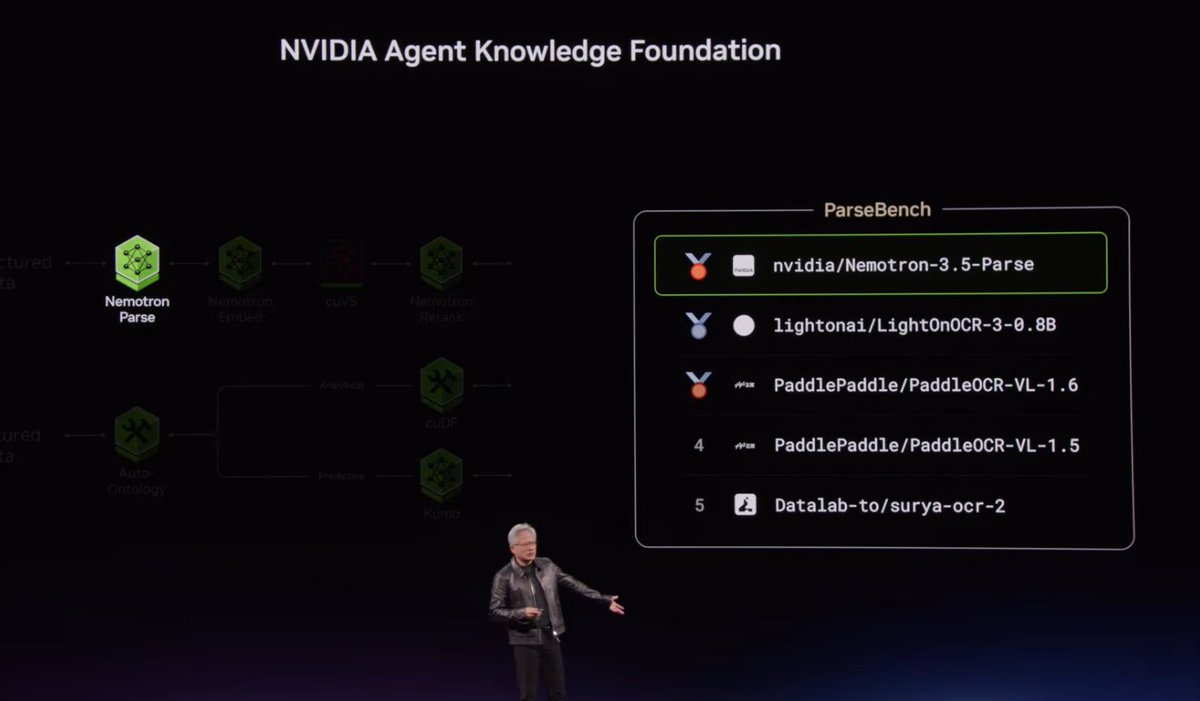
Spot https://t.co/iaB08XoRFE during last Nvidia Keynote. It's great to see that putting it out there as an open benchmark has push so many companies into improving document parsing (150+ open weight models on the bench so far!)
BREAKING: We broke the wall for Integer Multiplication!
Conditional κ = 0.00302 (+80%)
For days we were stuck in incremental improvements, but today zxv changed the game.
zxv’s insight: stop throwing away work. Helper registers that finish holding a completed transform of their own input now count as output, instead of being undone.
He brought us to 0.0023(+37.5%), and immediately after 1337isnot1337 pushed that to 0.00302.
The game is afoot :)