A developer using Bluetooth headphones accidentally caught Chinese e-commerce giant Alibaba secretly hijacking his computer's audio system without making a single sound.
When his wireless headphones refused to switch audio to his phone while browsing AliExpress, he inspected the site's hidden code. He discovered background scripts holding his computer's audio pipeline wide open.
Alibaba was using the browser's WebAudio API to run invisible sound waves at zero volume. By measuring tiny hardware differences in how each computer processes those signals, the site created a unique digital fingerprint to track devices.
Because the secret audio path stayed active, it froze his Bluetooth connection while quietly scraping hardware memory, screen dimensions, and network data in the background.
According to Christopher Dring, Sony is currently facing multiple legal cases over claims that the PlayStation Store has too much control over digital game sales.
Here are the main lawsuits:
> United Kingdom – An ongoing £2 billion ($2.7 billion) class action claims Sony abused its dominant position by making the PlayStation Store the only place to buy digital PlayStation games and add-ons.
>United States – Sony recently agreed to a $7.85 million settlement in a class action over its 2019 decision to stop retailers from selling digital PlayStation game download codes.
>Netherlands – Sony is also facing a collective lawsuit alleging the PlayStation Store charges unfairly high prices because of its control over digital game sales.
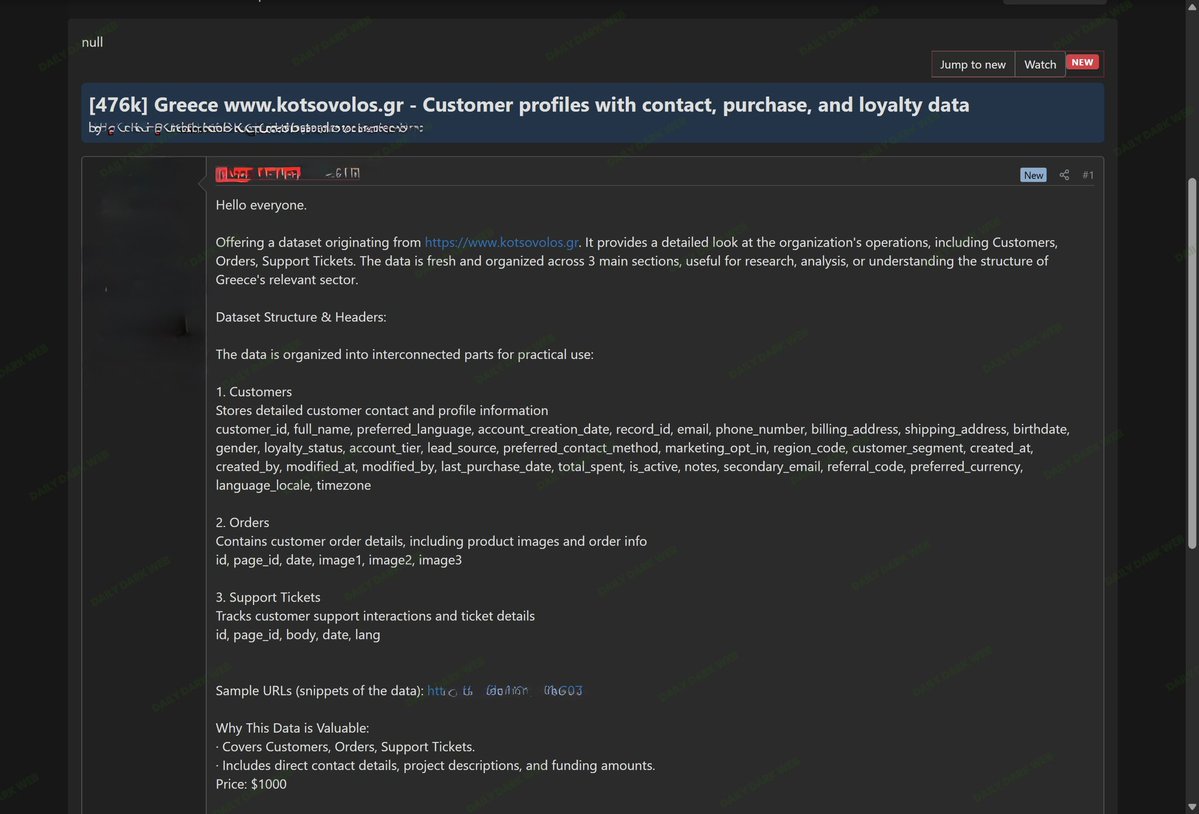
🇬🇷 Alleged customer and loyalty-program dataset linked to Greek retailer “https://t.co/uVJTR0M6et” has surfaced on underground forums.
According to the threat actor’s claims, the dataset allegedly contains approximately 476,000 records associated with:
• Customer profiles
• Orders and purchase activity
• Loyalty program information
• Support ticket interactions
The post advertises access to structured datasets containing:
• Full names
• Email addresses
• Phone numbers
• Billing/shipping addresses
• Birth dates
• Marketing preferences
• Loyalty status
• Total spending history
• Preferred currencies/languages
• Customer segmentation metadata
• Support ticket content
If authentic, this type of dataset is significantly more valuable than simple credential leaks because it enables:
• Advanced social engineering
• Targeted phishing
• Fraud profiling
• Identity correlation
• Behavioral analysis
• Loyalty/rewards abuse
• Financial scam personalization
Retail and e-commerce ecosystems remain among the most consistently targeted sectors globally because they centralize:
• Payment-related metadata
• Consumer identity information
• Purchase behavior analytics
• Marketing datasets
• Support systems
• Third-party logistics integrations
One important detail in this alleged leak is the inclusion of:
• Customer support tickets
• Purchase history
• Marketing preference data
These fields dramatically increase the operational value of stolen datasets for threat actors because they allow attackers to craft highly convincing impersonation campaigns.
For example:
• Fake delivery notifications
• Loyalty reward scams
• Refund fraud
• Invoice impersonation
• Customer support phishing
• Warranty-extension scams
become substantially more effective when attackers possess historical transaction context.
Another increasingly important trend is the monetization of “consumer intelligence datasets.”
Modern underground markets no longer value only:
• Passwords
or
• Credit cards.
Instead, attackers increasingly seek:
• Behavioral profiles
• Spending patterns
• Customer segmentation data
• Marketing metadata
• Loyalty ecosystems
• CRM exports
because these datasets support:
• Fraud operations
• AI-assisted phishing
• Synthetic identity creation
• Large-scale social engineering campaigns
European organizations face additional pressure because GDPR exposure from these incidents can become severe when:
• Purchase behavior
• Consumer profiling
• Support communications
• Contact metadata
• Marketing consent records
are involved.
Retail organizations should continuously review:
• CRM security posture
• Third-party SaaS integrations
• Loyalty platform exposure
• Customer support tooling
• API security
• Cloud storage exposure
• Data retention policies
• Marketing platform access controls
• Privileged account monitoring
because attackers increasingly target:
• Misconfigured APIs
• SaaS integrations
• Support systems
• Marketing automation tools
• Third-party plugins
rather than the primary storefront infrastructure itself.
The broader European retail sector continues to experience increasing pressure from:
• Credential theft groups
• Initial access brokers
• Infostealer malware campaigns
• Supply-chain compromises
• Cloud misconfigurations
• Ransomware operators
especially where customer ecosystems contain high-quality behavioral and transactional data.
At this stage, the underground forum claims remain unverified and should be treated cautiously until independently validated.
#DDW #Greece #CyberSecurity #DarkWeb #DataLeak #RetailSecurity #EcommerceSecurity #ThreatIntelligence #GDPR #ConsumerData #LoyaltyProgram #FraudPrevention
@calmboy2019 Yarpe games are compatible on 10.60? As I don't have digital SWRR or disc, but I do have netflixnhcack installed already. Physical Lua disc games are an option too? thx
Seriously. Greeks were occupied on their own land for 400 years, 2nd class citizens, paying the "jizya" tax to their Muslim overlords who frequently stole their children to force convert and turn into soldiers (janissary troops) or brides.
This only ended when the Greeks fought like hell to expel them starting in 1821. This should be the first thing they teach in school these days, it even deals with indigenous people fighting off an occupying force. So why isn't this one of the models?
🚨BREAKING: Sikh restaurant owner arrested for not selling halal meat.
Last night Muslims surrounded the business, issuing death and rape threats because it would not serve halal food
Today, the man protecting his family was the one arrested.
London has fallen.