| Tech, markets, history, MMA
| COO at @Yumagroup; opinions my own
| Founded + sold fintech businesses to @DCGCo + @LSEplc
| Life is too short for lazy workouts
@WSquires I love this for Bittensor, but frankly the advancements here are bigger than Bittensor as well
Seriously impressive stuff. Highly encourage folks to take a close look at what was achieved here.
Three of the leading companies in the Bittensor ecosystem collaborated to develop an impact analysis on the proposed Conviction updates
If you hold $TAO or are building in the space, you should give this a read and check out the podcast discussion
High-density info throughout
5/5) Why it matters
The limiting factor for frontier model training has generally been access to dedicated clusters
If pipeline-parallel training over distributed hardware scales further, Bittensor becomes a credible compute layer for foundation model pretraining, not just inference.
Ultimately, the scale of a single datacenter will also be a limiting factor for any commercial entity or frontier training run. Logic would follow that decentralized training is critical for advancement in the field generally, even beyond Bittensor.
Given all of the above, this run appears to be an incremental but very real step in that direction and (in my opinion) worthy of the attention it's receiving.
I've been digging into the @MacrocosmosAI@IOTA_SN9 100B parameter pretraining run to understand what it is (or isn't) and potential implications.
My honest assessment below in case its helpful for others:
4/5) These were A100 professional GPUs, not consumer cards that IOTA is best known for using
It was also not broadly decentralized. These were 16 hand-selected A100 nodes in a controlled run.
Their substack notes it was achieved "a fraction as much" as equivalent datacenter setups. I assume the cost advantage over datacenter they mentioned comes from distributed spot/underutilized capacity pricing, not cheap hardware, but admittedly that's not clear to me either way.
Macrocosmos is explicit that this is stage 1: future stages target heterogeneous hardware, interruptible nodes, and eventually consumer-class GPUs. The current run proves the architecture works at scale; the cost story likely gets more compelling as the hardware constraints relax
Since the initial Conviction update, Bittensor has seen ~17.7M alpha locked
Equivalent to 199K $TAO or $49M; 4.6% of total subnet market cap
Just over half of the locked stake thus far is from a single address
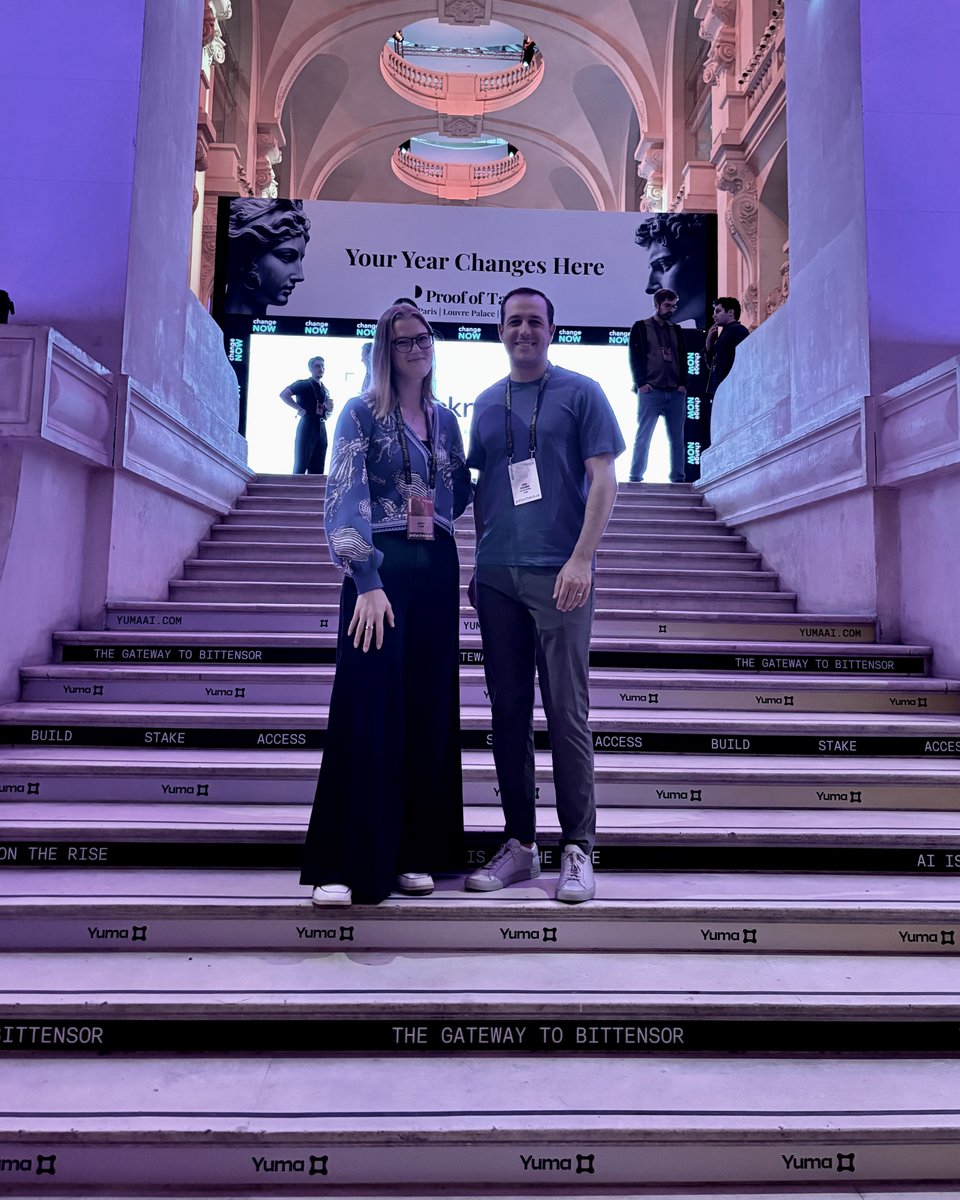
Greetings from @proofoftalk 2026 in Paris!
Make sure to see our CRO @EvanMalanga speaking this afternoon at 5:35pm, and say hello at the official Bittensor Track happy hour afterward.
Or reach out to Evan, @LindsMikeStone or @JourdanYuma to meet.
Over the last couple weeks, we worked with @TAO_dot_com and @UnsupervisedCap on an impact analysis related to the proposed Conviction updates
This podcast reviews that report in a data-driven discussion on the potential implications of locking and subnet takeover
Worth a watch
Our objective is to be the go-to entry point for builders and investors in decentralized AI.
Yuma CRO @EvanMalanga lays the vision out with @LexSokolin earlier this month for @finblueprint
The price at which Bittensor subnets get deregistered has been quietly rising since October.
Up ~2x in both TAO and USD terms.
As it rises, the weakest link in the network continues to strengthen.
“Agents can launch tokens. Agents can have businesses. Agents can pay for their own compute.”
@adamsternbach , VP of Legal @YumaGroup, joins us on today's Block & Order. Watch now: https://t.co/0wFP92EfOF
Subnets are the intelligence engines of Bittensor, but still remain largely inaccessible to the general public.
Today we took a big step towards addressing that by making access to them available to customers of one of the world’s leading crypto platforms.
App, custody, and institutional users on @cryptocom can now stake both $TAO and subnet tokens through Yuma's validators, enabling access to @bittensor ecosystem yield for the trading platform's 150M+ global audience.
Would add that @_redteam_ seems to have been programmatically buying their alpha consistently for three months.
They're staking rather than burning, but it's still providing equivalent economic support to their alpha price, driving miner and validator incentives.
Only 2 productive bittensor subnets are consistently manually burning their alpha daily (not miner burns, these are buyback+burns).
@lium_io leads with ~87 TAO worth of their alpha burnt per day (in the last 30 days). This insane amount is partially due to buyback+burns, but also because @fish_datura is insane and is burning a lot of his subnet owner emissions.
@chutes_ai boughtback+burnt an average of ~28 TAO worth of their alpha per day (in the last 30 days).
Honorable mentions @sportstensor (almanac) and @VantaSN8 both were burning for several days in a row earlier in the month, but have now stopped.
This will be clearly visible publicly on https://t.co/M7cIsu0exk soon.
Agentic iteration on specialized models for Bittensor subnets accelerates intelligence production at a cadence exceeding Big AI.
Yuma COO Greg Schvey breaks down the massive opportunity around AI‑driven progress from the stage at #Consensus2026. Full video: https://t.co/HFQOr8r3fn