Agentic RL environments are becoming critical. We integrated OpenReward (https://t.co/PGK3Ilhj1C) into Alibaba’s ROLE (https://t.co/3SkXlH5hRZ).
Details: https://t.co/BWR9lZ0dcJ
On the back of our ICML workshop on Protocol Learning, our official workshop proposal has been accepted at NeurIPS, titled "Open, Collaborative, and Decentralized Training of Foundation Models". There is an exceptional set of speakers, and the call for papers is coming soon!
In collaboration with @benjamintherien, @Ana_koloskova, @ebelilov, @niclane, #kaja, #Aakanksha, @Pluralis
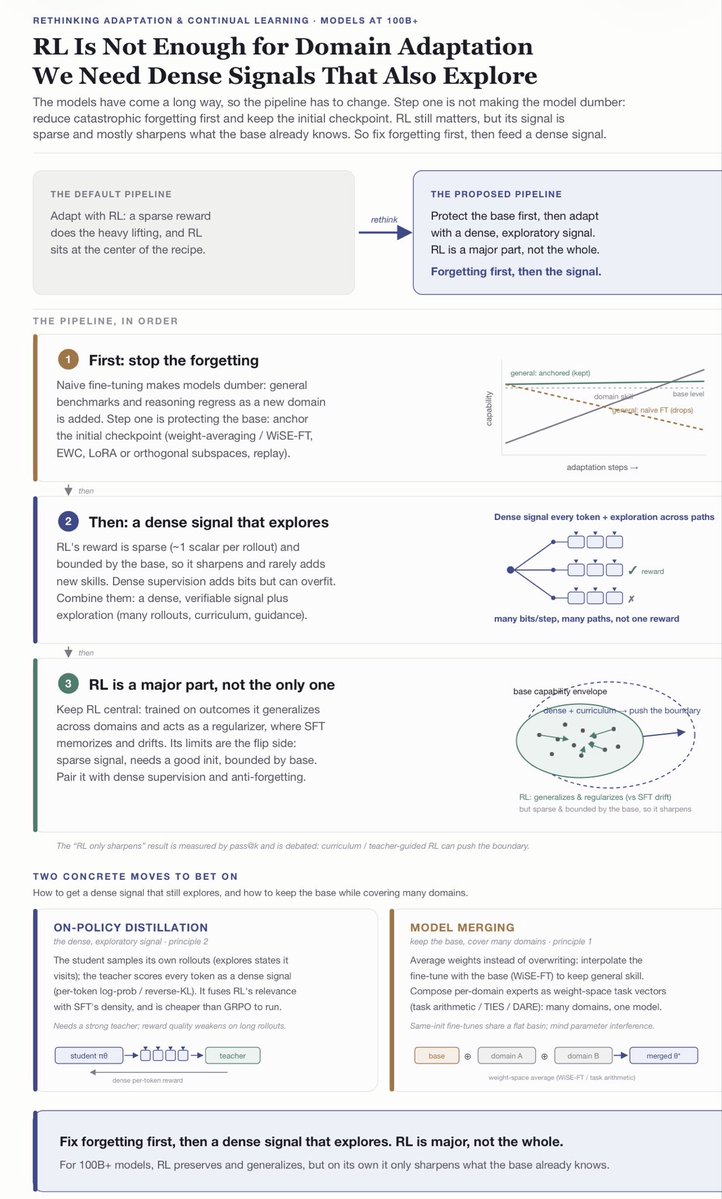
What we actually need: dense signals with built-in exploration. Enough bits per step to learn, enough exploration to reach past the base, without erasing what's already there.
Really bullish on on-policy distillation when you have a powerful model, and of course model merging.
RL still has a major part: trained on outcomes it generalizes and regularizes, where SFT tends to memorize and drift. But it's sparse and mostly sharpens what the base already knows.
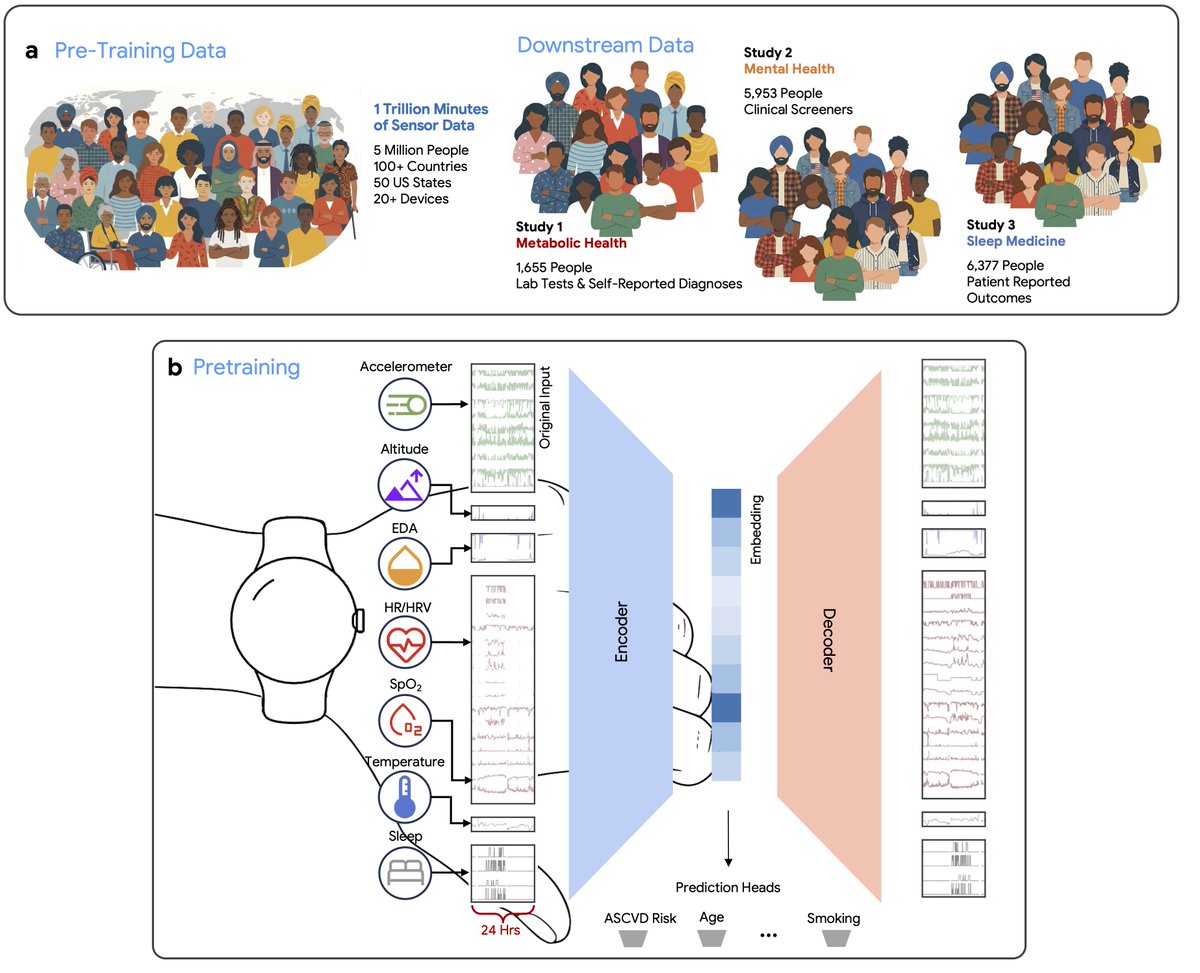
Introducing SensorFM, a large-scale Sensor Foundation Model that learns from 1 trillion-minutes of unlabeled wearable data drawn from five million consented participants.
SensorFM learns a single, reusable representation of sensed human physiology that transfers across cardiovascular, metabolic, sleep, and mental health, as well as lifestyle and demographic factors.
More →https://t.co/lbi1DG0zAW
Similar line of paper, but claims RLVR raw weights move in a curve , but it only has a rank 1 dominant direction and it moves pretty linearly.
https://t.co/NHAVkqwXYP
Been reading a lovely paper, "Linear Dynamics in the RLVR Training of LLMs" (Wang et al.): during RL, model weights move almost in a straight line over training.
We got curious how this looks on a weaker, different base model. A short exploration. ��
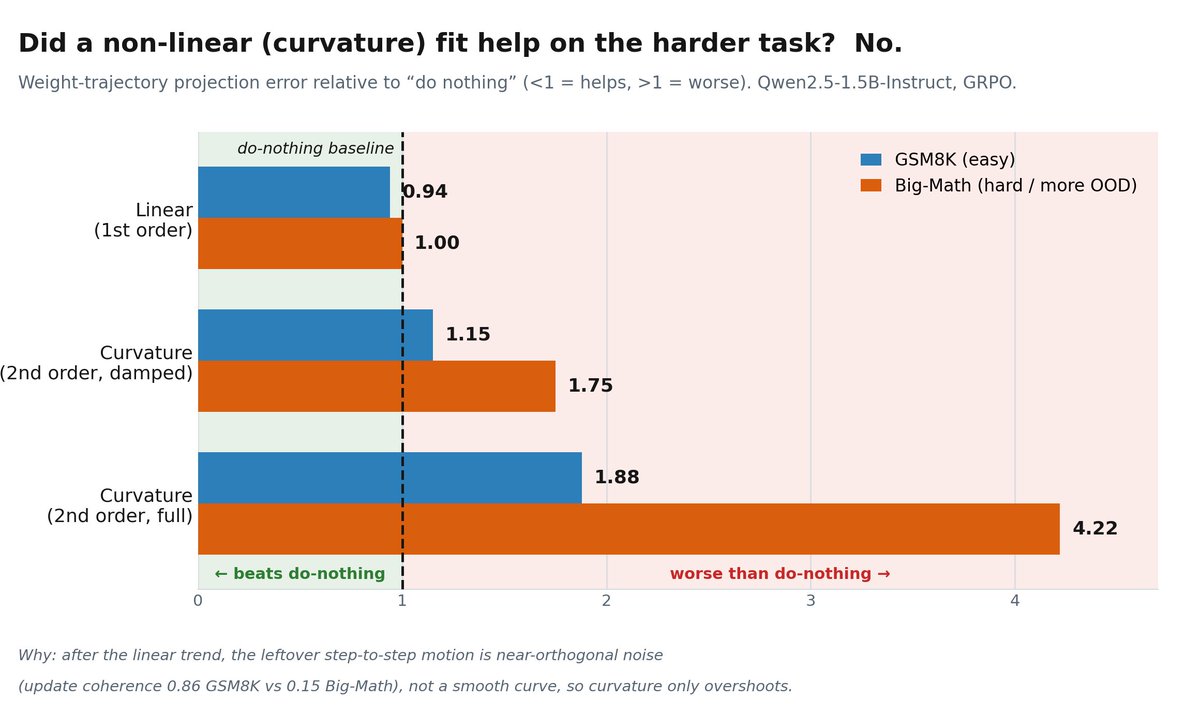
@michael_jupp4 we did try second-order curvature fits, both fixed and adaptively refit. They did worse, not better, and when free to choose, the fit just zeroed the curvature term.
Been reading a lovely paper, "Linear Dynamics in the RLVR Training of LLMs" (Wang et al.): during RL, model weights move almost in a straight line over training.
We got curious how this looks on a weaker, different base model. A short exploration. 🧵
Takeaway: the linear regime is real, and its strength tracks base-model capability vs task.
Modern pipelines distil + SFT first, then RL, which keeps the model capable and its RL weights linear. Exactly where these extrapolation / compression ideas should pay off. Summary 👇
Nicely, this matches the paper's own intuition: they anticipate piecewise linearity under distribution shift, and expect their lazy-training view to hold while the model stays near its starting region.
A weaker model on harder math just sits closer to that edge.