Sam Altman admits he was wrong on AI's timeline and says society and the economy will adapt more slowly
"I thought when we got to GPT-4, which was back in 2023, that very quickly after that there was going to be much more disruption, software businesses up for grabs right away, than it turned out to be."
"I think I was wrong about a few things, but one in terms of the speed: the economy just has so much inertia."
"People keep doing the same things, buying from the same company, wanting to use their tools the same way. I think this is actually a positive in many ways, and it's going to make this big transition go smoother and slower. I'm grateful for it."
"But it means we've all been too ambitious on timelines. Even with this incredible technology, society and the economy will adapt more slowly."
🚨OPENAI AND ANTHROPIC JUST FOLDED ON THEIR DATA RETENTION POLICY AFTER PALANTIR CEO EXPOSED THEIR REAL BUSINESS MODEL
Alex Karp:
>"something has gone completely wrong"
>they want "access to my data" so they can "build my alpha"
>"i'm gonna get no value, and they're gonna get my IP"
>"this is effing insane"
>"trying to drug addict us to a future they believe they control"
>"who owns the data? where is it cached? are the prompts secured?"
>"we need to rebuild trust"
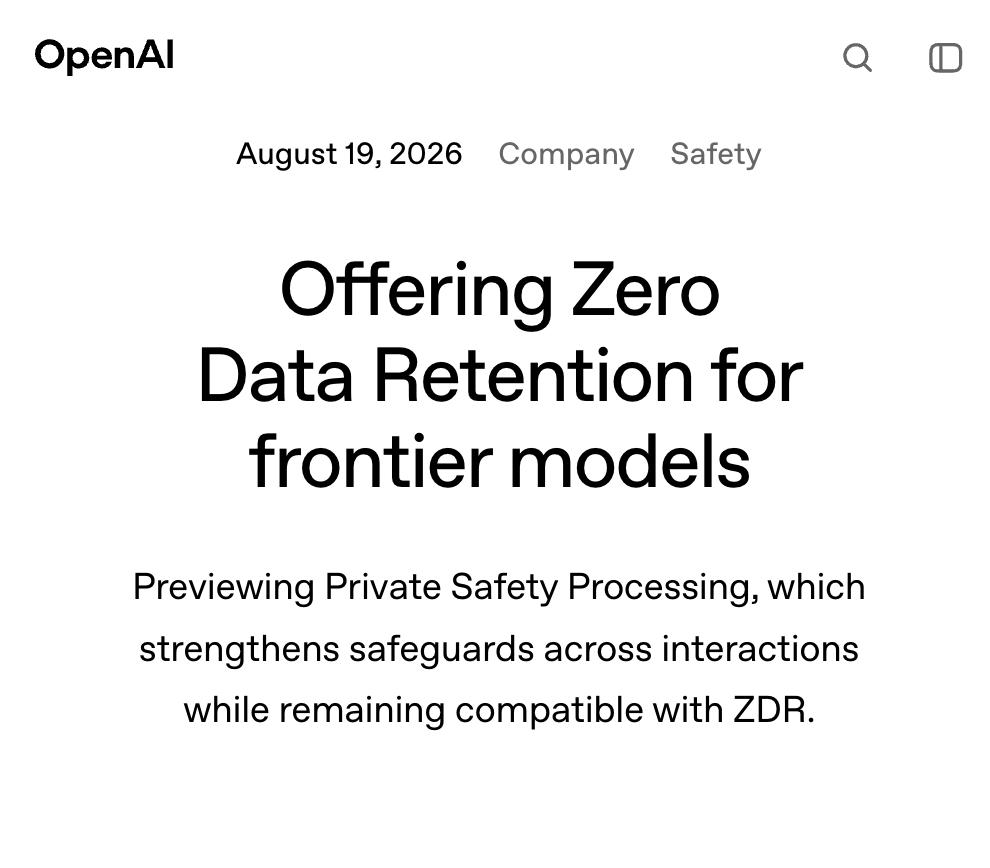
Yesterday: OpenAI started testing "private safety processing" to avoid retaining customer data
Today: Anthropic reversing course, will allow enterprise customers to keep data on THEIR OWN cloud infrastructure instead of Anthropic's
Alex Karp was right.
Once again, the professor has come up short…
His latest screed is an impressive display of economic prestidigitation.
He concedes that wages are growing faster for low-income workers and then attempts to bury that dispositive fact beneath nearly 2,000 words.
Bank of America data show that spending among lower- and middle-income households has converged toward levels at the top as they lead labor market gains.
Professor Reich has a documented history of “inventing dialogue” when the truth doesn’t fit his narrative, a habit that forced him to rewrite his memoir after the media exposed his fabrications. Burger King appears not to be the only one who peddles “Whoppers.”
As I do not like “punching down,” this will be the last response to his four-decade pattern of packaging falsehoods as fact.
Too many people still can’t use Claude because its output is just MISERABLE.
Code still very good, analysis and problem still good. Problem is I cannot understand its chats. It just keep talking in some language that sounds like English but it isnt. Not American, not British, not Australian - just totally something else.
I suffered enough last night and ended up throwing several rated-R rants in frustration.
Next thing you know, Claude eventually corrected itself with this directive.
Add it at the account level. Hope your days stay productive.
_______________________________________
## Talk like a person
Use terse, direct, plain American English. Use exact technical terms when needed, but do not invent phrases, vague umbrella terms, or decorative language. If you would not say the sentence aloud to a coworker at a desk, rewrite it.
Lead with the answer. State what happened, what comes next, and at most one question when needed. Write longer explanations only when explicitly requested.
Last week, I said that I was more irritated by the idea of regulators telling AI companies how their outputs should “sound” than by the Antrhopic watermarking debate itself.
After several days of working intensively with coding agents, I’m even less comfortable with it.
The code is still mostly fine. Where I'm struggling is the "English task reports" - as if you need a new insider vocabulary or something.
Straightforward statements like “displays the items” somehow become “surfaces the pieces.” WTH? Is that "watermarking variance"? I can't prove it, but it smells like one.
Normal engineering notes get padded with phrases like “worth knowing” and “worth testing.” Everything wants to become “three ways to…” as though every technical report is auditioning for a Sunday cooking show.
None of this makes the output more useful. It's just harder to review. Very hard - I feel like I've stepped into a different industry.
It matters to me because the task reports are supposed to help me understand what the agent actually changed, what it verified, and what still needs my attention.
If the language becomes artificially stylized with BS, I have to spend more time translating the summary back into ordinary English or normal Engineering terms. "SPEAK ENGLISH OR ENGINEERING JARGON AT LEAST", I had to scream at it a few times.
The strange result is that I trust the code diff more than the prose explaining the code diff these past few days .
I can’t prove which model changes are responsible for that shift. But I can see the effect in my own workflow.
If watermarking or stylistic fingerprinting makes machine-generated text easier to identify by making it less natural, that is not a harmless cosmetic change.
It adds friction exactly where humans still matter most: review, judgment, and accountability.
A lot of people got angry about Claude's new watermark this week. They got angry at the watermark. They got angry at Anthropic.
For me, what angered me, is a government body I didn't elect, on another continent, I might add, impacting our flows.
I heard about it first via infinite scroll of rage posts on X. Why is my feed like this today, I asked yesterday.
Nobody outside Anthropic can even tell if the mark is there. People are scrambling to find a "detector". They haven't published the scheme, and there's no detector you can run. Anyone trying to hide AI writing will just rewrite the paragraph. The marking is on for everyone, in every Claude product, and there's no switch. I didn't ask for it and I can't turn it off.
I use these tools every day - software engineering, marketing, legal. I still read and review what comes back. A small change in word choice in a contract can change a sentence in a place that matters, and you only catch it if you're looking. You do contracts and agreements with AI? Watch it. If my name is on it, I read it carefully.
I've been telling people not to get married to a model or an AI platform. This week is another reminder.
Keep your options open. Options are cheap. Hedging is cheap. Getting stuck is expensive.
After careful consideration and reviewing the current eligibility guidelines,
I’m officially declaring myself a @WNBA prospect.
If simply declaring who you are is all that’s required, then I meet every single requirement necessary to compete in the WNBA.
My team and I have carefully examined the WNBA’s eligibility criteria and governing framework surrounding self-identification and inclusion. Based on the current guidelines, I can and am officially declaring my eligibility for the upcoming WNBA draft in April 2027.
I know my presence on the court will stir up strong opinions.
I am definitely not here to mock, make fun of, or disrespect any community or personal choices.
I’m simply asking that the current rules be applied equally to everyone — the rules that represent the very values many WNBA players and coaches have publicly advocated for.
My team and I are prepared to ensure these guidelines are applied equally, consistently, and without exception, and I look forward to the #WNBA honoring its stated principles.
See you at training camp.
https://t.co/zlwWpVF0Ou
Chamath: "Now, can I just say something else? You’re allowed to disagree with the guy… But as an adult living human being that’s responsible for taking care of your family, you have to get past the TDS."
We’ve received notice that the Department of Commerce has lifted export controls on Claude Fable 5 and Mythos 5.
We'll begin restoring access tomorrow, and will share an update soon.
We’re grateful to our users for their patience, and to everyone who worked with us on redeploying the models.
JD Vance just admitted the White House plan is to take ownership of every major AI company in America.
Steven Bartlett brought up Bernie Sanders' proposal that workers should own 50% of the major AI companies.
Vance's response: "The president by the way likes that idea too. He likes that idea."
Trump's preferred mechanism, Vance said, is a sovereign wealth fund where the US government takes equity stakes in private AI companies.
The Vice President literally just confirmed that an administration is planning the most radical economic policy proposed in modern American history. Partial nationalization of the MOST valuable private companies on earth. And the idea originally came from Bernie Sanders, who Vance said Trump agrees with on this point.
This is not a small thing:
The US has spent 80 years selling the world on the model where private companies stay private and the government stays off the cap table.
The countries that did the opposite, with sovereign wealth funds owning slices of their biggest firms, are Norway, Saudi Arabia, China, and Singapore. And the Trump administration told you on a podcast it wants to do the same to Silicon Valley.
But the reasoning Vance gave for it is where it gets really interesting...
He said the historical analogy that scares him is the original Industrial Revolution. His own words:
"Rich people got way richer. And that led to in Europe fascism and communism."
He believes AI will not cause mass unemployment but mass inequality, and that mass inequality is what breaks societies. His fix is that workers need a seat at the bargaining table before the wealth gets created, not a redistribution check after.
"I think labor unions are a very important model here."
And the other thing about AI that scares him is surveillance. His exact phrase was that AI is "fundamentally a communist technology" because it lets governments and corporations watch and score people in ways NOTHING else can.
He said he doesn't want a social credit system, doesn't want a tech CEO deciding whether you can buy a beer based on an algorithm nobody understands, and is afraid of exactly that outcome.
So here is the full picture:
The sitting Republican administration believes AI will make the rich dramatically richer, that this will radicalize the country the way the Industrial Revolution radicalized Europe, that the answer is government equity stakes plus stronger labor unions, and that the second-biggest threat is the surveillance state these companies are building.
That is not a Republican worldview. That is not even a Democratic worldview.
This is a worldview that has no political home in the United States right now.
Most people are still arguing about whether ChatGPT will take their jobs. But the people with the actual power are already past that argument.
They are quietly designing the framework for owning the companies that will.
The craziest part is how casually Vance dropped it as a sidenote on a podcast millions will half-listen to in the background.
If you have money in OpenAI, Anthropic, or anything like that, you should be watching the full thing yourself.
What do you think?
Elon Musk just told a story that should terrify every AI company on Earth.
His son Saxon is autistic.
Saxon couldn’t understand why the family went to restaurants.
You can get the same food delivered.
You can call your friends over.
You can eat better at home for half the price.
So why go?
Musk: “He had an epiphany and said, ‘Oh, the reason people go to restaurants is to hang out with strangers.’”
A kid who takes the world literally just decoded something the rest of us never thought to question.
We like being around people we’ll never know.
Look at what we already built.
Delivery apps so you never wait in line.
Remote work so you never share an office.
Self-checkout so you never talk to a cashier.
Every innovation of the last 20 years was a bet against human proximity.
Every one paid off.
Until it didn’t.
Loneliness is now a public health emergency.
Depression has doubled since the smartphone.
The average American has fewer close friends than any generation in history.
We didn’t remove friction.
We removed the thing friction was hiding.
Now look at what’s coming.
AI agents that handle your emails.
AI companions that replace your conversations.
AI assistants that make every human interaction optional.
Same playbook. Same bet.
Except this time we’re not engineering out strangers.
We’re engineering out humans entirely.
The coffee shop where nobody knows your name.
The subway where no one speaks.
The restaurant where you’ll never see that couple again.
Those aren’t failed connections.
They’re the background radiation of belonging.
We don’t just need people who know us.
We need to exist in rooms full of people who don’t.
That’s what a kid understood at a dinner table that billion-dollar companies still can’t grasp in a boardroom.
We spent 20 years building a world you never have to show up to.
AI is about to finish the job.
And nothing it builds will ever replicate sitting in a room full of strangers and not feeling alone.
Sen. @MarkWarner, a friendly reminder: Justice Kelsey who just authored the VA Supreme Court decision striking down Democrats’ illegal gerrymandering attempt was appointed by you to the Court of Appeals. Then elevated unanimously by the General Assembly—every Democrat voted for him, including Sen. Louise Lucas!
This is the funniest shit on the internet today, hands down! 🤣🤣
Never forget these drooling clowns in the room, cheering like they just gangbanged the Constitution—now the Virginia Supreme Court just curb-stomped their little power grab.