Here’s my take on how F1 will change this season.
A deep dive into the new power unit rules, energy flow and performance trade-offs.
Months spent in the rulebook and hundreds of calculations later — this is where I landed.
Leclerc’s mistake: a bigger throttle lift into Turn 2 (15 km/h slower), then more throttle through Turn 3 for extra momentum.
The lower speed meant less downforce, while the more aggressive throttle application sent even more torque to the rear tyres on worn rubber - game over.
Great article by The Race yesterday - here’s a small refinement. Leclerc’s deployment didn’t disappear, it just changed form. The energy usage was different, but there was no laptime loss when comparing these two laps. You can see it on the data - all in all a 0,03 gain!
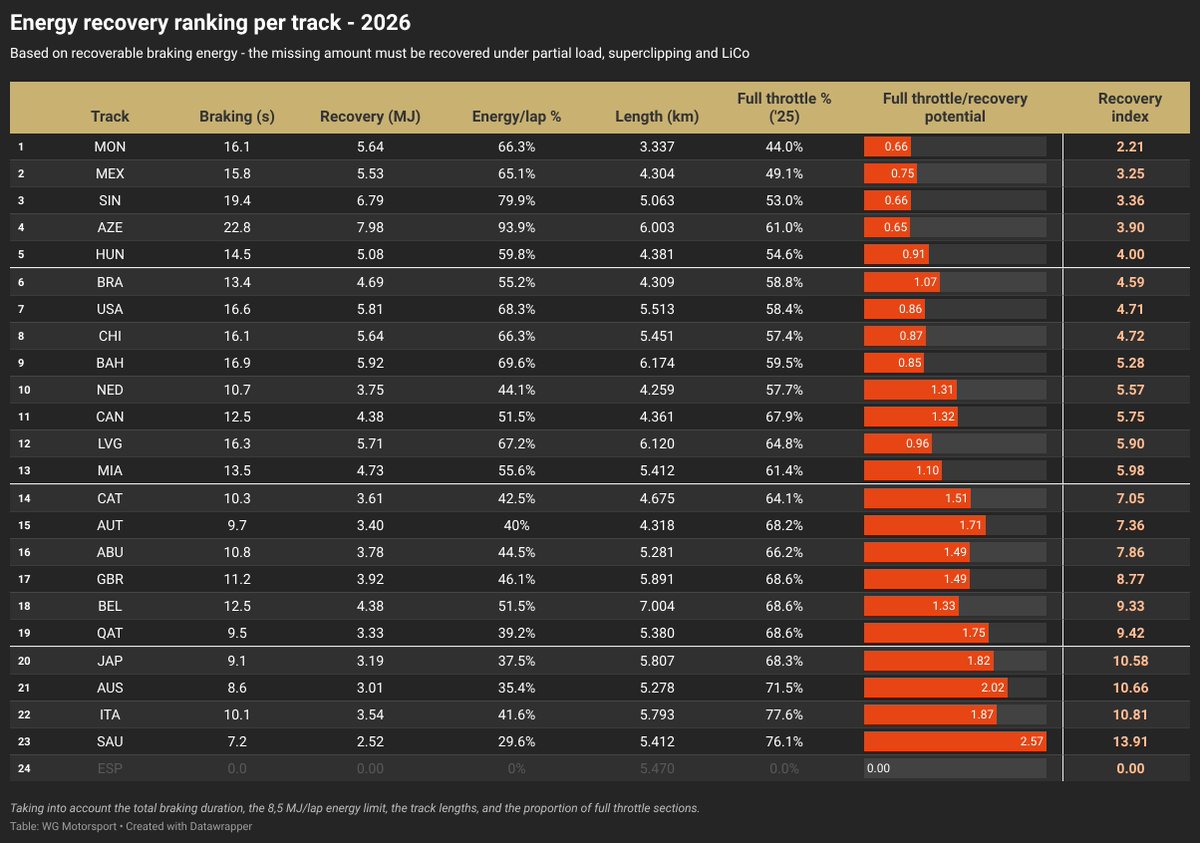
@redhammer786@FDataAnalysis Yes, that's right. I wanted to show the "natural" recovery possibilities. But beware, these are maxed out numbers without losses. It's really just a barometer between tracks, exact numbers will vary depending on many factors.
Here’s how the '26 F1 calendar stacks up in terms of energy recovery potential. Melbourne was one of the most challenging venues in this respect, but this weekend we're heading to Shanghai, which ranks in the top third — despite having a longer than average straight. Let's see.
@cbwin3@PenteanoO@FDataAnalysis No one says you’ll be faster, I was telling you they wouldn’t get much slower. If you compare it to F3 and think that would mean constant -100 kW, you clearly don’t understand the regs. Energy per lap wouldn’t change — only the rate you use it.
@etorphine101@FDataAnalysis It’s not an overnight solution, rather a complicated one, not really feasible on short term. Regarding your original idea the cars qualified in Overtake mode, meaning no longer capped at 290 km/h — the ramp down (in theory) started at 337.5 km/h.
@etorphine101@FDataAnalysis Banning the ramp down would make it even worse, everyone would use even more power early and then superclip. Front axle regen would add another 40-45 kg of weight and complexity and would mean a complete redesign chassis and system wise too.
@cbwin3@FDataAnalysis Not by much, but on the other side would make the energy usage a lot more sustainable with less agony on the 2nd part of the straights. I don’t really care about losing another 5 tenth or a second if makes it more flowing and natural.
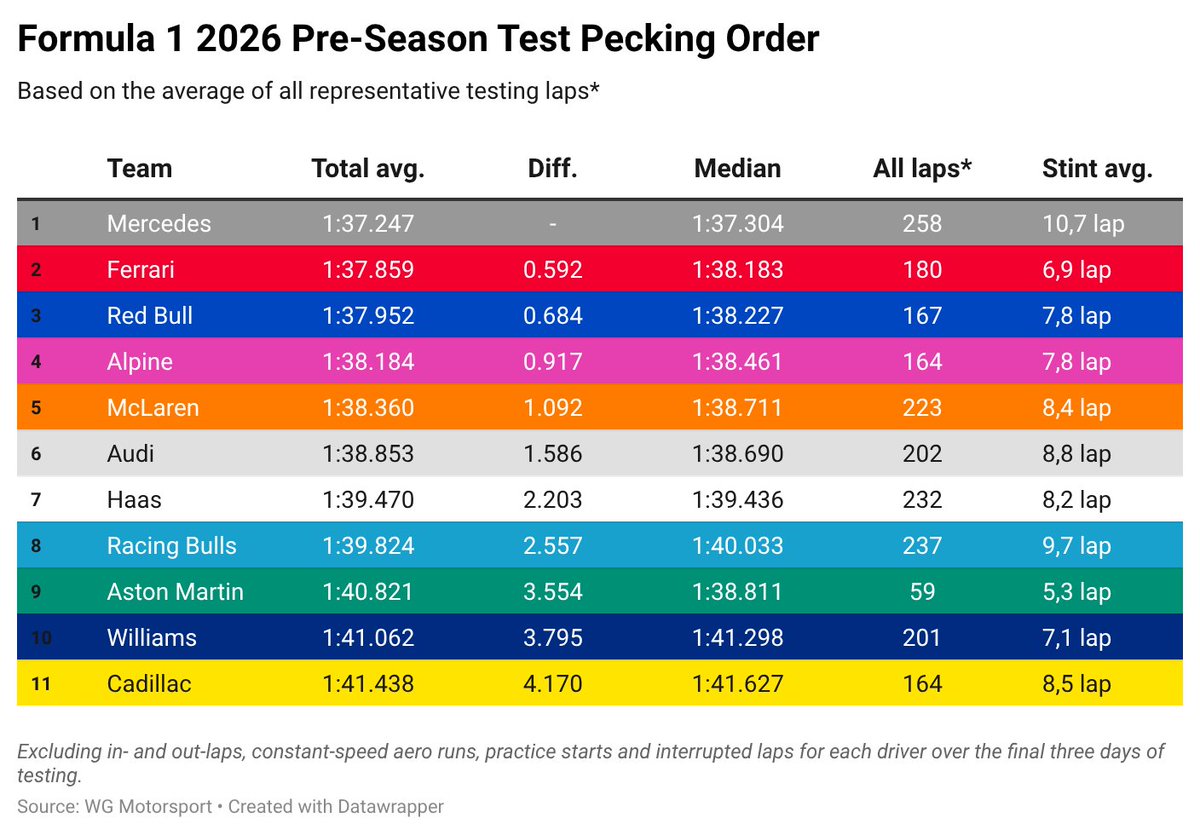
Here’s what the numbers say after the final test week — based purely on objective data. We won���t have to wait much longer to see how it plays out in reality.
Here are the estimated gaps between the '26 compounds after 3 weeks of testing data. It will vary of course depending on layout, weather, setup and unique characteristics of each car. Let's set it aside and look at it later.
@cytrusf1 You clearly missing the point here: there is no full throttle mid corner, that would be traction control in disguise. You can only harvest what the driver doesn’t demand with the throttle pedal.