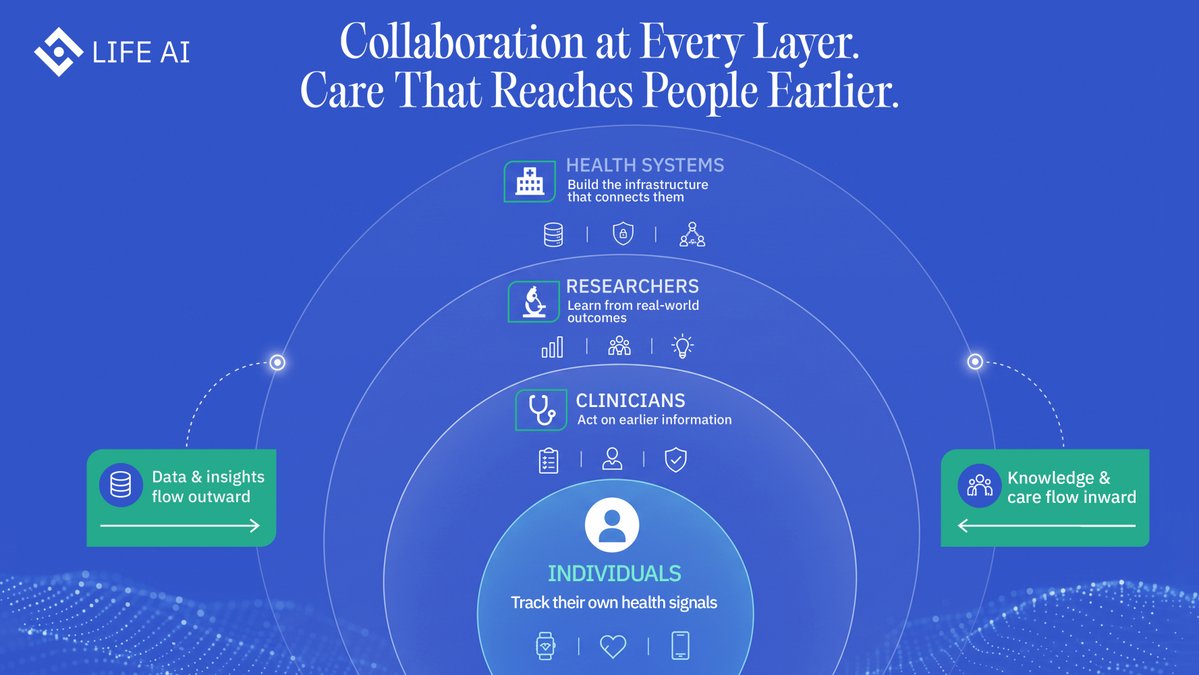
Earlier detection is only useful if healthcare can act on the signal.
Chronic disease develops over time, leaving measurable signals across biomarkers, clinical history, behavior, and longitudinal health data.
AI can analyze these signals at scale, identify emerging patterns, and surface potential risks earlier.
But detection is only one layer of the healthcare workflow.
An identified risk still needs to move through:
Detection → Clinical Assessment → Evidence → Intervention → Monitoring
Each stage introduces different requirements for clinical expertise, evidence, workflow integration, and continuous feedback.
This is where the next challenge for Healthcare AI emerges.
AI can increase the speed and scale of detection. The healthcare system must be able to process what that detection produces.
The objective is not simply to identify risk earlier.
It is to establish a continuous pathway from:
Signal → Evidence → Decision → Intervention → Outcome
That is what turns AI assisted detection into measurable clinical impact.
Delivering effective preventive health requires collaboration between:
— individuals tracking their own health signals,
— clinicians acting on earlier information,
— researchers learning from real-world outcomes, and
— health systems building the infrastructure that connects them.
Together, we can build care that reaches people before they need it.
@LifeNetwork_AI Epigenetic research shows lifestyle choices actively influence gene expression, meaning today’s movement and rest can redirect biological trajectories for years.
GLife. Your health builds over a lifetime.
How you move, eat, sleep, and manage stress shapes where your biology is heading.
It's never too early to start.
Shiv Shankar Bholenath,
Your damru plays upon the mountains.
O
M
N
A
M
A
H
S
H
I
V
A
Y
Om Namah Shivay🪔
O
M
N
A
M
A
H
S
H
I
V
A
Y
Om Namah Shivay🙏
O
M
N
A
M
A
H
S
H
I
V
A
Y
The divine play of your damru is unique and wondrous. @grok
3/
A bolt-on mindset produces bolt-on results.
AI that drafts appeal letters. AI that generates summaries. AI that flags codes.
Each useful in isolation. None of them connected. None of them compounding.
The constraint was never the model. It was the operating model underneath it.
2/
The diagnosis is clear.
Most organizations approached AI with a bolt-on mindset, deploying point solutions on top of existing workflows rather than rethinking the workflows themselves.
The result: a proliferation of pilots without the integration or scale required to create enterprise value.