I've never been a fan of the American Heart Association's version of the diet-heart hypothesis.
But what if they're right?
Shouldn't we all work diligently to lower our LDL by diet?
Let's work through the numbers and see what we have to gain.
If you're curious about how a public health campaign acknowledging "negligible benefit" for most of us became the foundational proposition of our dietary wisdom, read on...
Lowering LDL: Surely, a “Heart-Healthy” Diet is Worth the Effort. Isn’t it? https://t.co/4kyTTE26Il
We recently hosted a Capitol Hill briefing on how nutrition can address chronic disease, improve health outcomes, and reduce healthcare costs in the era of GLP-1s.
Watch highlights featuring @RepDavids, Dr. Maya Maroto, @bschermd, @DoctorTro, and Dr. Caroline Roberts.
Question of the day: Why would you ever eat a fad diet?
1. Because you’re a frivolous person, and this is the kind of thing frivolous people do.
2. Because you lack the critical skills necessary to understand why our nutrition authorities don’t take such a diet seriously?
3. Because you’ve been living with an intractable diet-related health issue for far too long, and the conventional dietary approaches have failed you.
4. Because a relative, friend, co-worker, TikTok influencer, or maybe even (heaven forbid) your doctor suggested it might cure what ails you, and so, what the hell? Why not?
NY Times writers will invariably suggest 1 or 2. Maybe because I think conventional diets are doomed to fail, and I eat a fad diet, I’m going with 3 and 4.
Now RKF Jr and his Republican colleagues (or cronies, depending on your political affiliation) are eating a meat-and-sauerkraut diet.
Why would they do such a thing? And how do you think the Times reported it? How about the WSJ?
Blah Health Journalism: Meat, Sauerkraut and Politics Edition. https://t.co/HqCbQF7DNJ
And please listen to this, too.
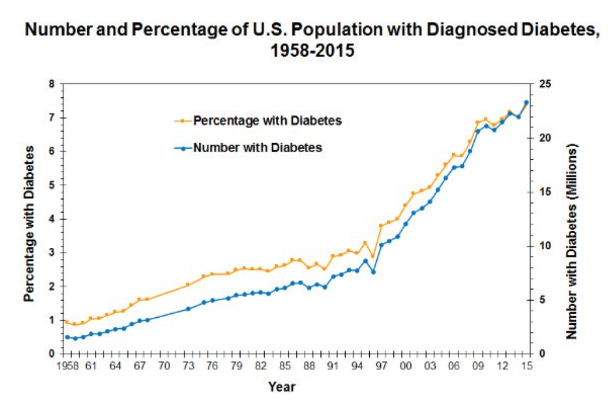
We tend to forget that treating the symptoms of obesity and diabetes does precious little or nothing to prevent their appearance.
At our congressional briefing, @RepDavids explains why the U.S. healthcare system must do more to prevent chronic disease before people get sick.
Watch to learn about bipartisan efforts to expand Americans' access to fresh produce, nutrition counseling, and more.
We recently hosted a Capitol Hill briefing on how nutrition can address chronic disease and reduce U.S. healthcare costs.
Watch our executive director, Dr. Maya Maroto, explain how evidence-based nutrition approaches can improve Americans' health and complement GLP-1 treatment:
Oh, we're back to that issue.
As I said then, repeatedly, I am acknowledging that GLP-1s suppress appetite. That's an observation that is unambiguous.
The question is: how do they do it? And what's the relationship between the appetite suppression and the weight loss (which they also clearly do)?
You're attacking a straw dog here.
If you "can't tell at this late date" whether I actually believe my commentary, it's because you can't seem to understand the very basics of it.
Try harder.
Obesity researchers believe the brain defends body weight by regulating how many calories we consume and expend. It monitors our fat stores, turning hunger up or down as necessary to keep them stable.
Decades ago, though, researchers in the field of physiological psychology, who actually study the physiological basis of hunger, reached a very different conclusion.
They concluded that the brain doesn't care about how fat we are, or how much we’ve just eaten, but is monitoring the energy status of our cells—whether they are producing energy or depleting it.
Remember ATP from high school biology? The “molecular unit of currency” for moving energy around the body? Unlike fats and carbohydrates, ATP cannot be stored. An animal deprived of food survives for days or longer; an animal whose ATP production is shut down by a toxin survives for seconds.
Both theory and evidence were compelling, but the obesity researchers knew nothing about it, and they still don’t. (They didn’t read the physiology journals, and the physiological psychologists—PhDs, not MDs—weren’t presenting at obesity conferences.)
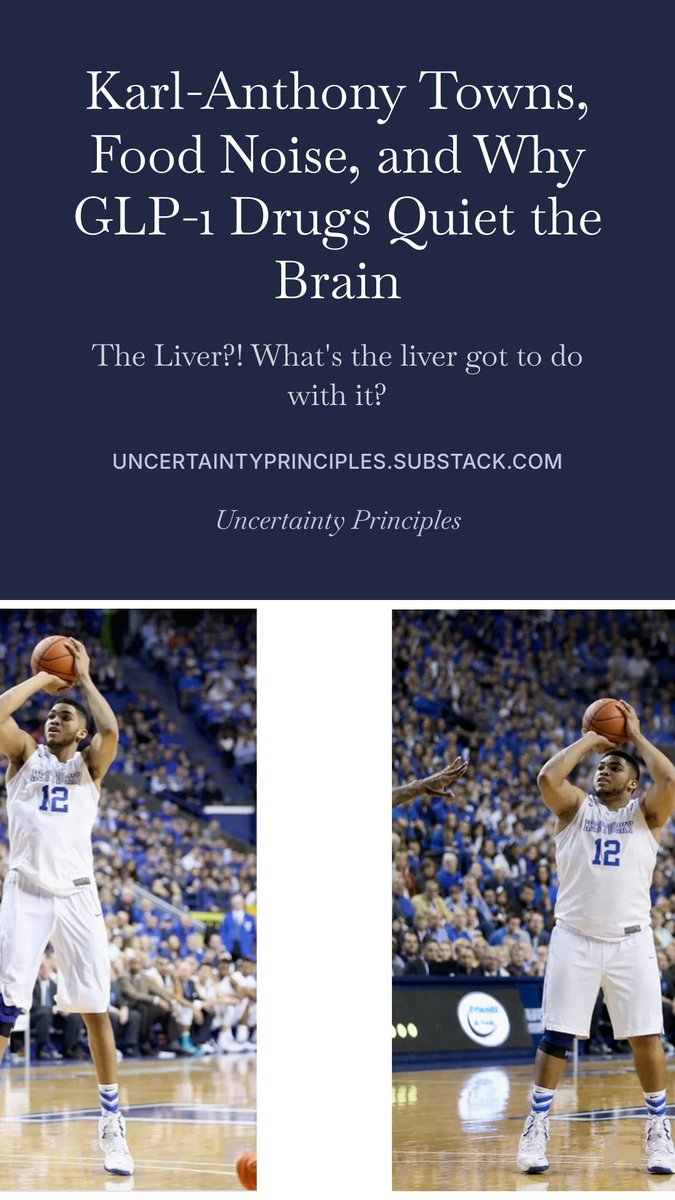
If it’s true, though, it changes radically how we think about obesity, hunger, and, yes, food noise—and why the GLP-1 drugs so famously shut that down. It puts our livers at the center of the metabolic universe, not our brains.
(And even Karl-Anthony Towns comes into this story.)
Karl-Anthony Towns, Food Noise, and Why GLP-1 Drugs Quiet the Brain https://t.co/wldVhLHoB0
I've tried the flavored ones, and they're sweet and definitely a problem. I begin to crave them in a way I don't the unflavored "originals" which are tasteless if not distasteful.
Over the years, I've quit them on occasions in between having to get books written--while doing the research--but I go back when I have to write. Now that I'm writing a Substack, I always have to write and so I've stopped trying to cut back. Someday..., I tell myself...
GLP-1 stimulates insulin secretion from beta cells in vitro. But there's a lot more they do. E.g., GLP-1 also suppresses glucagon--a response to the insulin secreted by the beta cells--lowering hepatic glucose output, which reduces the glucose the system has to deal with.
In vivo, per Astrup's diagrams, the drugs resolve insulin resistance, which is why they are so effective for T2D. Circulating insulin levels drop because less insulin is needed to control blood sugar.
That's what those figures are documenting.
How do GLP-1 drugs cause weight loss?
If they work by suppressing appetite or increasing satiety (which I don't buy), the notion that they accomplish that by delaying gastric emptying doesn’t stand up to scrutiny.
At least not in the first actual test of the assumption.
https://t.co/povnIwW5JE
From Arne Astrup's 2024 EJCN article. Arne did some of the seminal work on GLP-1s:
"GLP-1 therapy reduces insulin secretion and levels, which have implications for the understanding of the mechanisms behind its effect on weight loss."
Here's the paper, available for free. https://t.co/mbO9F90ss0
Mental health and metabolic health are deeply interconnected, and the science is advancing rapidly.
Join us virtually for this Harvard Medical School-accredited CME/CE course September 16–19, 2026.
We'll explore the latest research and practical clinical applications related to mental health, metabolism, nutrition, lifestyle interventions, and integrated care models.
Only 9 days left to take advantage of the early registration discount.
I hope you'll join us!
https://t.co/gdb39PPyI2
The ideological capture is always an interesting issue.
We're all ideologically captured. It's only a bad thing if our ideology is demonstrably wrong. The CIM may be incorrect. But energy balance thinking certainly is.
So what do I do about that (ideologically captured, as I am)?
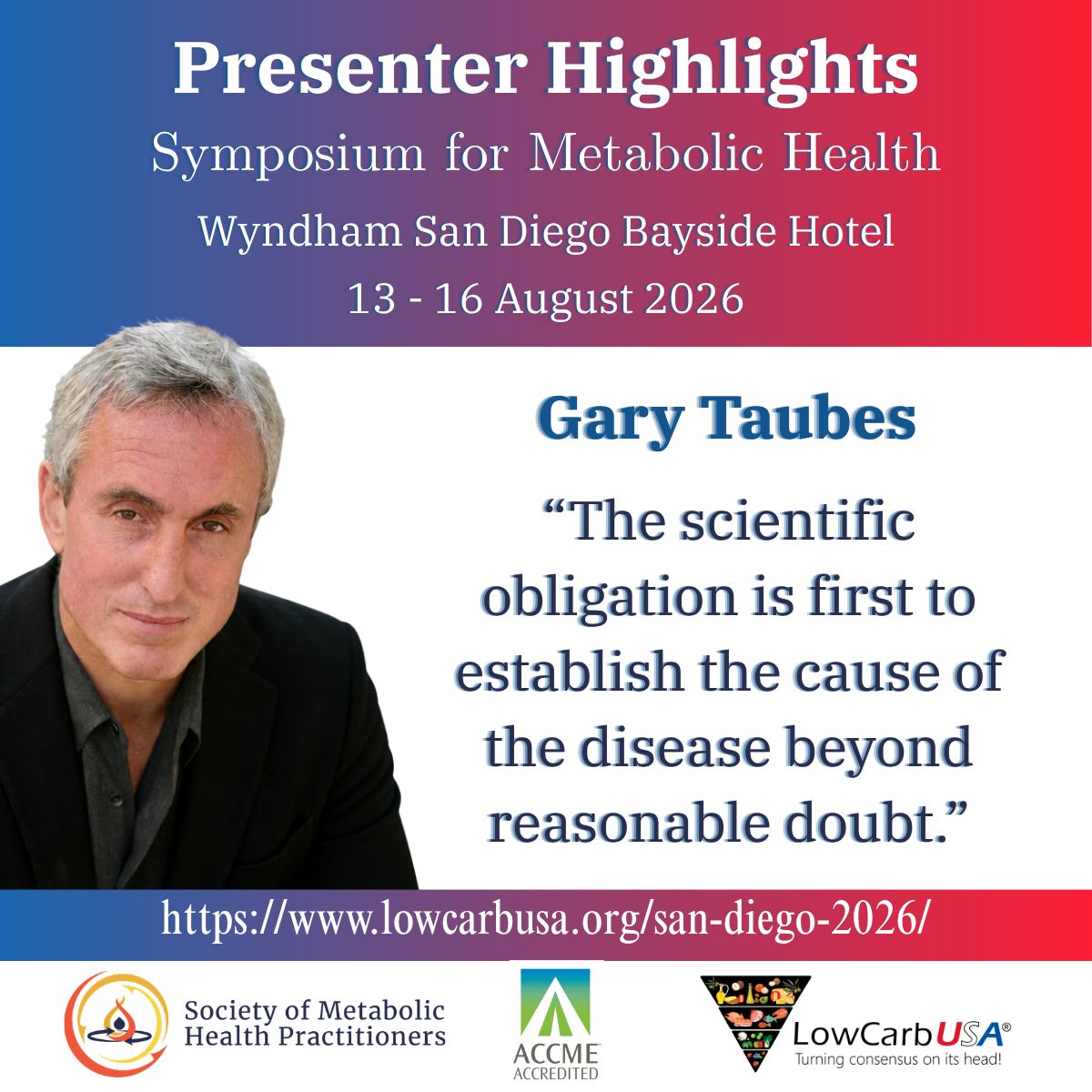
I'm looking forward to LowCarbUSA in San Diego next month.
This year I'll be talking about why anyone would do a diet as extreme as keto or carnivore if it wasn't necessary.
The new code is 'JulySavings'.
Should be fun and informative, as always.
There's a moment, for a lot of people, when the story they've been told about food, weight, and metabolic health stops making sense…
For many in this community, Gary Taubes is the person who lit the match.
The science journalist behind Good Calories, Bad Calories; Why We Get Fat; The Case Against Sugar; The Case for Keto; and Rethinking Diabetes has been part of LowCarbUSA from the very first San Diego event 11 years ago.
This August, he returns to the stage.
That shift — from a dozen physicians a quarter century ago to tens of thousands today — didn't happen because the theoretical debate was won.
It happened because clinicians and patients witnessed what changed:
- weight loss
- falling A1C
- lower blood pressure
- reduced hunger
In San Diego, Taubes is weighing two talks: the lost history of obesity science, or the clinical case for ketogenic diets — and why the popular "ultra‑processed" label may be too broad to explain what foods actually do to blood sugar, insulin, hunger, and fat storage.
Read the full story and join the movement.
https://t.co/A2VwpscUBC
2026 Symposium for Metabolic Health
📍 Wyndham San Diego Bayside
🗓️ August 13–16
Final days — use code SummerSavings for 10% off your full registration, only through July 4.
https://t.co/uA4EGX3Ze8
#TheSMHP #MetabolicHealth #MHP #NeverStopLearning #SymposiumForMetabolicHealth #GaryTaubes #EvidenceBasedMedicine #TCR
Proud to share a study lead by PI Judy Ford which I was a co-investigator at @UCSF on: the first randomized controlled trial of ketogenic therapy in schizophrenia-spectrum and bipolar disorders, out now in Schizophrenia Bulletin.
Key results: keto was feasible, metabolic markers improved significantly at 1 month, and the 4-month extension showed significant psychiatric symptom reduction and better cognition.
58 participants at UCSF. 1-month RCT + optional 4-month keto extension.
Early evidence — but a real step toward metabolic treatments for serious mental illness.
Paper: https://t.co/REIr9fDcxO
Does this make any sense to you? Evolution (or your deity of choice) goes through all that trouble to induce us to procreate and assure the survival of our genes and our species, and then it makes the actual act of giving birth so painful, prolonged, and dangerous that it can kill or disable both mother and child just for going through with it.
Now that a new study may have killed the conventional explanation of the Obstetrical Dilemma, maybe we should consider the unconventional. Dare we suggest diet matters?
Shouldn’t Giving Birth Be (Reasonably) Easy? https://t.co/wPCKHmmLap