@RakeshP38298981 Son and his wife work hard to recover their life. Manage to marry off their daughter this year. Mother does not attend any function. This person's mother is still his mother. Please do not say anything negative to any mother. All types of people exist. n/n
@RakeshP38298981 Mother starts telling son, his wife and now 21 year old daughter that she has enough money to buy 5-6 sons. Soon Covid strikes and son's business goes into a huge loss. Mother asks son to leave. Son and family leave, with very little money in their personal possession. 7/n
Please note @RepRileyMoore
1. That St. Thomas the Apostle you speak of is a myth.
No local inscriptions, coinage, or independent historical documents from 1st century CE south India record St. Thomas the apostle’s ministry or martyrdom.
2. Organized south Indian Christian communities developed later via Syriac merchant migrations, such as those led by Knai Thoma (Thomas of Cana) in the 4th century CE, whose identity was likely merged with the apostolic legend over time, to fool Indians into believing that Christianity was present in India from beginning of the Common Era.
3. Since you are so concerned about India's implementation of the amended FCRA 2026, here’s a puzzle for you ~
Why does America have a FCRA type law, the Foreign Agents Registration Act (FARA) that was passed by the Congress in 1938 ? The law just like our FCRA aims at curbing foreign influence and propaganda money coming from foreign countries.
You want America to remain a Christian nation with a FARA in place to keep Christianity safe there; but you want a Hindu majority India to not implement the FARA type FCRA that aims to keep Hinduism safe in India.
Nice try hypocrite!
The Brahmin’s Prediction: How India Tracked Uranus Before the West
By @shreehistory
On the night of March 13, 1781, the German-born British astronomer William Herschel stood in the garden of his home at 19 New King Street in Bath, England, and pointed his telescope toward the constellation Gemini. He spotted an unfamiliar, slightly diffuse disc. He reported it to the Royal Society as a "comet." Within two years, the scientific community realized it was not a comet at all, but a new planet. History canonized this moment as the first time a planet was discovered in recorded history, and William Herschel was enshrined as the sole visionary who expanded the boundaries of our solar system.
But what if the object Herschel encountered had already been tracked, classified, and predicted by practitioners of the Indian astronomical tradition long before his telescope was ever built?
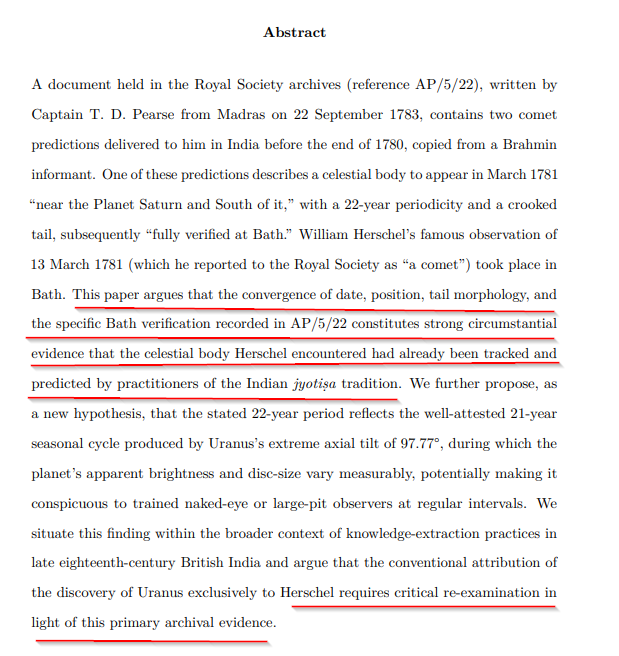
Deep within the archives of the Royal Society itself, filed away and forgotten for over two centuries, lies a document that profoundly disrupts the conventional narrative of European scientific supremacy. The document is reference AP/5/22, a letter written by Captain T. D. Pearse from Madras on September 22, 1783. Filed under the mundane category of "Unpublished Letters," it contains explosive primary evidence that the celestial body we now call Uranus was under systematic surveillance by Indian astronomers long before the West claimed it. It lay hidden, till @shreehistory downloaded it OCRed it for cursive font and extracted the text and then connected the dots.
The Letter from Madras
Captain Pearse was a British officer stationed in India, deeply engaged in studying local culture. In his letter to the Royal Society, he transcribed two comet predictions that had been delivered to him by a "learned Brahmin" in or around 1780. Pearse explicitly stated that he had transcribed these predictions "before the End of 1780." This timestamp is the crux of the historical intervention. The predictions predate Herschel's observation by at least three months.
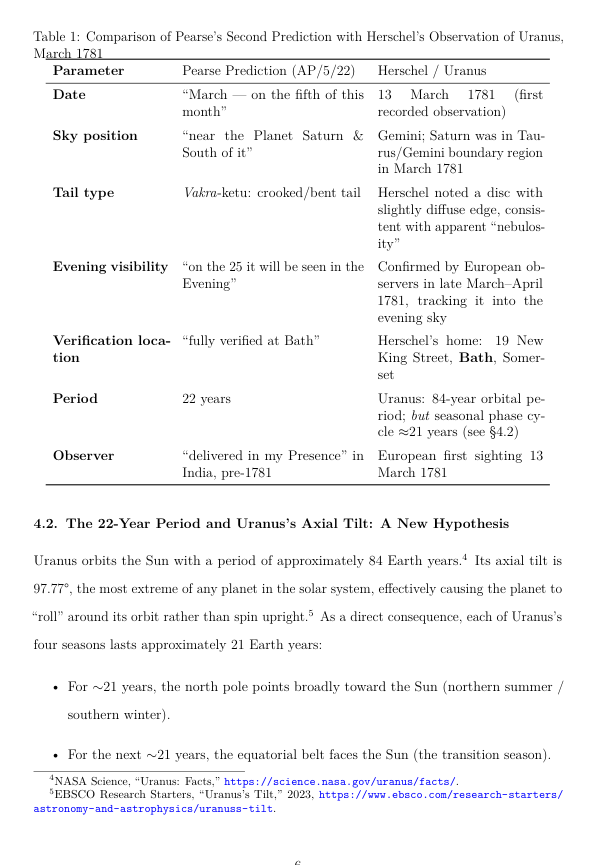
The second of the Brahmin's predictions read: "March, on the fifth of this month another Comet will appear of the kind called Wuckier or crooked from the Form of its Tail. It will appear six Ghurrees before Sun-rise, near the Planet Saturn and South of it. On the 25 it will be seen in the Evening. Its Period is twenty two years."
Later in the letter, Pearse casually notes the fate of this prediction: "I send you the copies of the other two predictions, one of which was fully verified at Bath."
The convergence of data is staggering. The prediction specifies the month of March, the exact proximity to Saturn, the evening visibility by the 25th, a crooked tail, and the specific verification location of Bath. This was not a lucky guess. The probability that a prediction composed in India before 1781 would correctly specify Bath, the month of March, the proximity to Saturn, and a 22-year period for an unknown celestial object, and that Herschel would then observe exactly such an object from Bath in March 1781 by pure chance, is vanishingly small.
The Sanskrit Taxonomy and the 108 Comets
The terms used by the Brahmin were not arbitrary. "Wuckier" is a direct transliteration of the Sanskrit word Vakra, meaning curved or crooked. In the Indian astronomical tradition of jyotisa, this refers to a specific class of comet known as Vakra-ketu, documented extensively in Varahamihira's Brhat-samhita from around 550 CE. The other prediction mentioned a "Dwudge" or flag-shaped comet, directly mapping to the Sanskrit Dhvaja-ketu.
The Indian system was not merely a collection of naked-eye myths. It was a highly sophisticated taxonomic project. Elsewhere in AP/5/22, Pearse records the Brahmin's promise to provide him with the tables of 108 distinct comets. This number is historically consistent with the ancient comet catalogues of Parashara, which classified celestial transients by tail morphology, rising direction, and crucially, periodicity.
The Brahmin informed Pearse that this catalogue was ancient received knowledge, written in the epoch preceding the current one. This implies a tradition of sustained, systematic tracking across many centuries, perhaps millennia. European astronomers like John Flamsteed and Pierre Charles Le Monnier had actually sighted Uranus before Herschel, but they catalogued it merely as a fixed star. They lacked the epistemological framework to recognize it as a moving body. The Indian tradition, by contrast, placed it within a named typology, assigned it a periodicity, and predicted its next appearance relative to Saturn.
The Secret of the 22-Year Cycle
Perhaps the most scientifically profound aspect of the Brahmin's prediction is the stated 22-year periodicity. Uranus has an orbital period of 84 Earth years. If the Indian astronomers were merely tracking the orbit, they would have recorded an 84-year cycle. Why 22 years?
The answer lies in the unique axial tilt of Uranus. The planet is tilted at a staggering 97.77 degrees, effectively causing it to roll around its orbit on its side. This produces four distinct seasons, each lasting approximately 21 Earth years. During these seasonal transitions, the geometry of the planet shifts from pointing its pole toward the Sun to pointing its equator toward the Sun. Modern science confirms that this transition causes measurable changes in the planet's atmospheric band structures, cloud features, and overall brightness.
The 22-year period recorded by Pearse was not an error. It reflects a new hypothesis: the Indian astronomical tradition was tracking the seasonal conspicuousness cycle of Uranus. They were observing a faint, slow-moving object that became notably brighter and more active in the sky roughly every 21 to 22 years. This requires a level of naked-eye observational discipline and data retention over centuries that the West has historically refused to imagine was possible in the Global South.
The Colonial Archive and the Erasure of Knowledge
The Royal Society received this letter in 1783. It was never read to the Society. It was never published in the Philosophical Transactions. It was filed away in the archive, buried in the vaults of the very institution that was simultaneously celebrating William Herschel's "discovery."
This archival suppression is emblematic of the broader history of colonial knowledge extraction. As historians of colonial science have documented, British intermediaries systematically collected indigenous technical knowledge, transformed it into European frameworks, and failed to credit the original sources. The year 1783, the date of the Pearse letter, marks the exact opening of the era where British scientific institutions in India began actively incorporating native knowledge into the matrix of imperial power without granting authorship.
Herschel himself wished to name the planet Georgium Sidus after the British monarch, King George III. It was a cosmic naming ceremony that mirrored the British assertion of hegemony over the Indian subcontinent. The Brahmin tradition, which had tracked this object within its own sophisticated taxonomy, received no acknowledgement then and has received none in two centuries of historiography.
Reclaiming the Cosmic Ledger
The paper authored by @shreehistory, drawing upon this buried primary evidence, does not seek to erase Herschel's telescopic achievement. It seeks to contextualize it. The history of astronomy owes a reckoning with the contributions of the Indian jyotisa tradition.
The conventional Eurocentric discovery narrative is historiographically incomplete. The object known as Uranus had been engaged with, tracked, and predicted by South Asian practitioners long before a European telescope was trained on Gemini. The truth of this history, preserved for over 240 years in the Royal Society's own archives, demands a critical re-examination of how we assign credit for human discovery.
The era of relying solely on the colonial archive to define the limits of indigenous knowledge is over. The time has come to read the Brahmin's predictions not as exotic curiosities, but as the rigorous scientific records they truly are.
All rights reserved. You must get written permission if you want to republish. Twitter users can share, repost, like, comment but please provide attribution to @shreehistory who did all this research.
Paper is in preprint and can be accessed from my site.
https://t.co/WpJ7h9EK6U
As I dwell deeper into Vedic and pre-Kaliyuga texts, it becomes evident that taking Panini Vyakaran as a rule-engine instead of a cluster of prevailing conventions of his era is unscientific.
The grammar driven approach to Sanskrit makes one of the most intuitive Bhasha of world the most intimidating.
I experimented with root-based immersive learning, and found that Veda Samhitas and Brahmans (the oldest Sanskrit texts available today) are far easy, intuitive and scientific than Kalidas or Banabhatt. More useful also.
These pre-Kaliyuga texts (and even Panini himself) liberally flout rules of Panini Vyakaran. So much so that Panini had to say "Bahulam Chhandansi" (in Vedic texts, rules have wide exceptions).
The impact on overall mental acuity has been astounding, even in grasping other domains.
In fact, to me medieval drama is abject decay of a Deva Bhasha designed to uplift cognition.
And unless Sanskrit is reclaimed linguistically by redirecting it towards Veda Mantras (through route of Brahmans, Upanishads, Darshans, Nirukta, Ramayan, Mahabharat), it will remain the university course where people take admission because they scored low in class 12, or want to be teachers in colleges later.
Sanskrit is language of Sanatan. Vedic Sanskrit is the source of Sanskrit. Veda Samhitas are the source of Sanatan.
Due to Veda Samhitas, our way of life is called Sanatan.
Unless we pursue Veda Samhitas in Sanatan Yogic ways, as Manu Smriti suggest, we are simply wasting our time pretending to be sadhaks.
Your great-great-grandfather didn't have a surname.
He had a gotra. A kula. A title earned or inherited. A village name. A trade.
Then the British census arrived. 1871–1881.
Suddenly, administration needed fixed surnames. Standardized. Permanent. Inheritable only through patrilineal descent.
Surname took birth in addition to "son of / daughter of / wife of"
🧵
@mariawirth1 I disgree. If westerners cannot differentiate between two words, it would only indicate that they are stupid. Why should we change names, new or old, to cater to their stupidity?
If Chanakya were here, Devdutt’s fantasies would last about as long as the kūśa grass he ripped out when he vowed to destroy the Nandas. Devdutt’s entire thesis rests on one illusion: if he can confuse you with multiple names, shout “interpolation!” a few times, and wrap it in modern caste-politics, maybe just maybe, he can make 1,000 years of evidence of Chanakya’s existence disappear. But the moment you actually look at the sources, his narrative collapses flat.
Let’s start with where he doesn’t want you to look: the Arthaśāstra itself. In multiple verses it explicitly names Viśnugupta Kautilya as its author:
“विष्णुगुप्तेन आर्यकौटिल्येन च सम्पादितम्” (“Compiled by Viśnugupta the noble Kautilya”)
“समाप्तं कौटिलीयम् अर्थशास्त्रम्” (“Here ends the Arthaśāstra of Kautilya”).
Devdutt’s primary deception rests on creating two doubts in the reader's mind: first, that since the Arthaśāstra names “Kautilya,” Chanakya must be fictional; second, that if he can push the Arthaśāstra to a later date, then Chanakya couldn’t have existed in Mauryan times or guided Chandragupta.
But the moment you place the Arthaśāstra’s author in time, things get murky for Devdutt. Ashoka’s edicts (3rd c. BCE) describe an administrative system of mahāmātras, welfare officers, anti-animal-slaughter days, judicial ethics - all straight out of the Arthaśāstra. The Mauryan empire cannot be founded on a Kautilyan framework if the text didn’t exist until 500 CE. The empire itself proves Kautilya predates Ashoka to at least 4th c. BCE as tradition says.
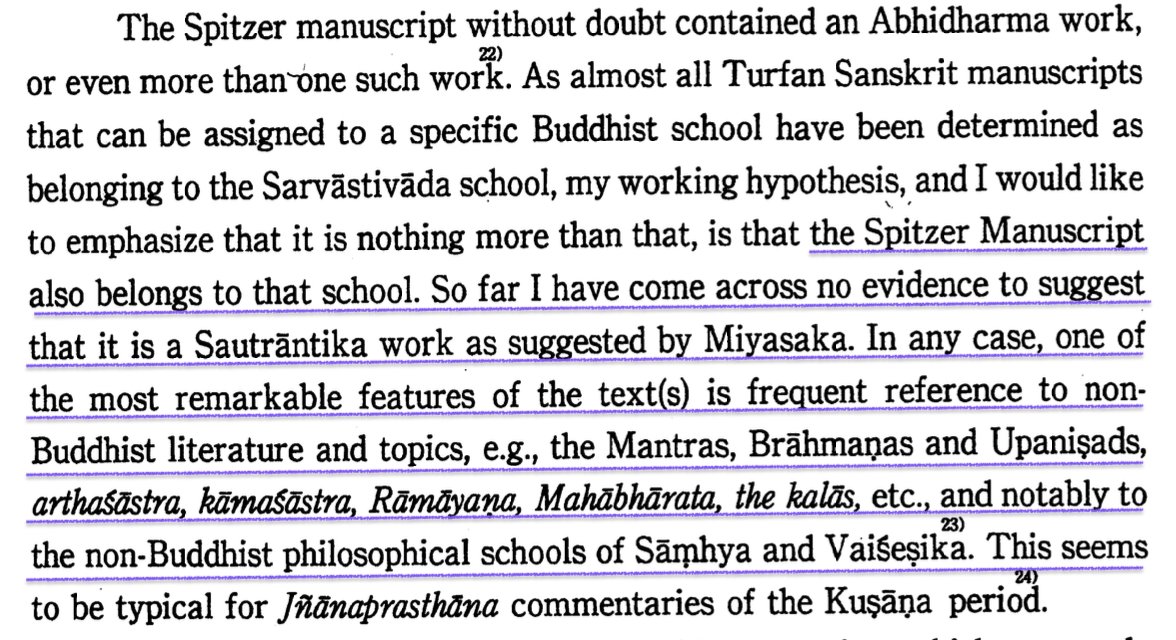
Then comes the Spitzer Manuscript, the oldest Sanskrit manuscript found so far (1st–2nd c. CE), which contains unmistakable references to the Arthaśāstra. And where was it found? A Buddhist monastery in Kizil, Xinjiang - 1000s of miles away from any “Brahmin power structure.” This alone demolishes Devdutt’s claims. Buddhists were studying Kautilya centuries before his imaginary “500 CE Brahmin invention.” Why would Buddhists preserve such “Brahminical propaganda”? They preserved it because it was already an established, authoritative, valuable text.
Next comes the knockout punch: the Kāmāndakīya Nītiśāra (4th c. CE) is a political treatise in the nīti-śāstra tradition, written by Buddhist scholar Kāmāndaki (कामान्दकि). He explicitly & admiringly states that the great Viśnugupta/Kautilya who authored the Arthaśāstra was the exact same strategist who overthrew the Nandas and guided Chandragupta Maurya to victory. This is the same storyline attributed to Chanakya in later literature. Why would a Buddhist writer like Kāmāndaki, with zero incentive to glorify a Brahmin minister, directly attribute Kautilya with the same glorious achievements as those of Chanakya the revolutionary? Because they were the same person. The Kāmāndakīya Nītiśāra text is the bridge which conclusively links : Arthaśāstra's Viśnugupta = Kautilya = Chanakya (in later Buddhist/Jain/Hindu sources)
Several other Buddhist sources specifically identify Viśnugupta/Kautilya as Chandragupta’s kingmaker. Jain sources like the Nisītha Cūrṇi and Hemacandra’s Pariśiṣṭaparvan identify Chanakya as the very same kingmaker overthrowing the same Nandas for the same Chandragupta. Gupta-era dramas like Mudrārākṣasa assume everyone already knows Kautilya as Chanakya. Kashmir’s Tantrākhyāyikā tradition immortalizes “Chanakya” as the archetype of political strategy. Across all traditions - Buddhist, Jain, Hindu, Kashmiri, Gupta - it is the same man performing the same deeds under different names.That is not myth-making. That is historical convergence, the strongest form of evidence when history spans 1000s of years.
As for the multiple names? In ancient worlds, it was perfectly normal. Confucius was also called Kong Qiu, Kongzi, Zhongni. In India: Viśnugupta is the personal name, Kautilya the gotra/scholarly name, & Chanakya the patronymic. One man. Many names. Total consistency. Pretending these names represent three different people is like claiming “Zhongni disproves Confucius.”
Devdutt also relies on the mention of “China” and “Roman coins” to push the Arthaśāstra centuries forward. But historian K. P. Jayaswal has already demonstrated that “Cina” here refers to the Śina/Shina Himalayan region of Gilgit, not Han China, which is why the Arthaśāstra uses kauseya and chinapatta, neither of which are Chinese words. And yes, references to Roman dīnāra are probably later interpolations - just like the many interpolations in Homer, the Pentateuch, or Euclid. No scholar ever claimed that these interpolations proved the authors never existed. Devdutt deploys this strategy only because he needs the text to look late, so that he can detach it from Chanakya and declare him a “Brahmin myth.”
Then comes the collapse of Devdutt's obsessive caste narrative. The earliest sources calling Chanakya a Brahmin are Buddhist and Jain works not Hindu ones - traditions which historically resisted Brahmin power. The Mahāvaṃsa (Buddhist), the Divyāvadāna (Buddhist), the Nisītha Cūrṇi (Jain), and Hemacandra’s Pariśiṣṭaparvan (Jain) all identify him as a Brahmin minister centuries before Hindu traditions elaborated the narrative. If “Brahmins invented Chanakya,” why do rival traditions repeat the same identity independently? Because they were recounting historical memory, not mythic propaganda.
So to make it crystal clear: Chanakya, Kautilya, and Viśnugupta are not three different people - they are simply three traditional names for a single historical strategist. This is exactly how ancient India named its great thinkers: a personal name (Viśnugupta), a gotra or scholastic name (Kauṭilya), and a patronymic (Chanakya). Tradition even preserves additional variants like Dramila, Draumina, Vishamashila & Anśula. Every independent source - Buddhist, Jain, Hindu, Gupta-era, Kashmiri all uses these names interchangeably for the same individual performing the same political revolution. This is not ambiguity; this is unanimity. One mind. One statesman. One architect of empire. Three names, one genius - exactly as ancient Bharat preserved its greatest figures.
Bottom line: three competing religious traditions which often competed as rivals, sometimes even hostile to each other - all remembering the same brilliant strategic genius of Magadha, overthrowing the same Nanda for the same Chandragupta Maurya in the same century CANNOT be coincidence. Devdutt winning the lottery while filming a TikTok and getting struck by lightning inside a volcanic eruption is statistically more likely. There is no “Brahmin propaganda.” There's only history refusing to bow to Devdutt's nauseating political biases and casteist agenda.
When such an overwhelming number of Bharatiya traditions, texts, chronicles, and political manuals over 2000 years point to the same genius - Chanakya/Kautilya/ Viśnugupta with the same narrative, then you don’t get to call him a myth and get away with it!
Devdutt’s article isn’t researched scholarship; it’s the same old casteist provocation wrapped in pseudo-history which crumbles instantly like a soggy biscuit in hot tea - the moment primary sources are allowed to speak.
A woman who has single-handedly waged an unyielding crusade against the Leftist–Communist intellectual syndicate for decades.
Her command of history and her ferocity of argument are so overwhelming that a single podcast from her can intellectually pulverise an entire battalion of Romila Thapars.
Repost if you agree with me