Everyone knows the approaching crises! And yet many choose to close their eyes. Many others choose inaction. Let us do our bit to avert the looming disaster. Spread the word 👉 #SaveSoil. Let us bring more people on board.
@cpsavesoil#SadhguruJV
No greater calamity we can walk into as a generation as heartbreaking and excruciating as famine. We cannot allow defenseless suffering to ravish our planet. This is a disaster we can and we must prevent. #SaveSoil. Let us make it happen. -Sg @antonioguterres@UNCCD@WFP
@binarybodhi Even when you insist that you are not comparing their enlightenment, this categorisation and ranking spiritual masters is a mistake in itself. Who are we to judge or measure whose work had what impact? Who are we to determine their philosophical depth?
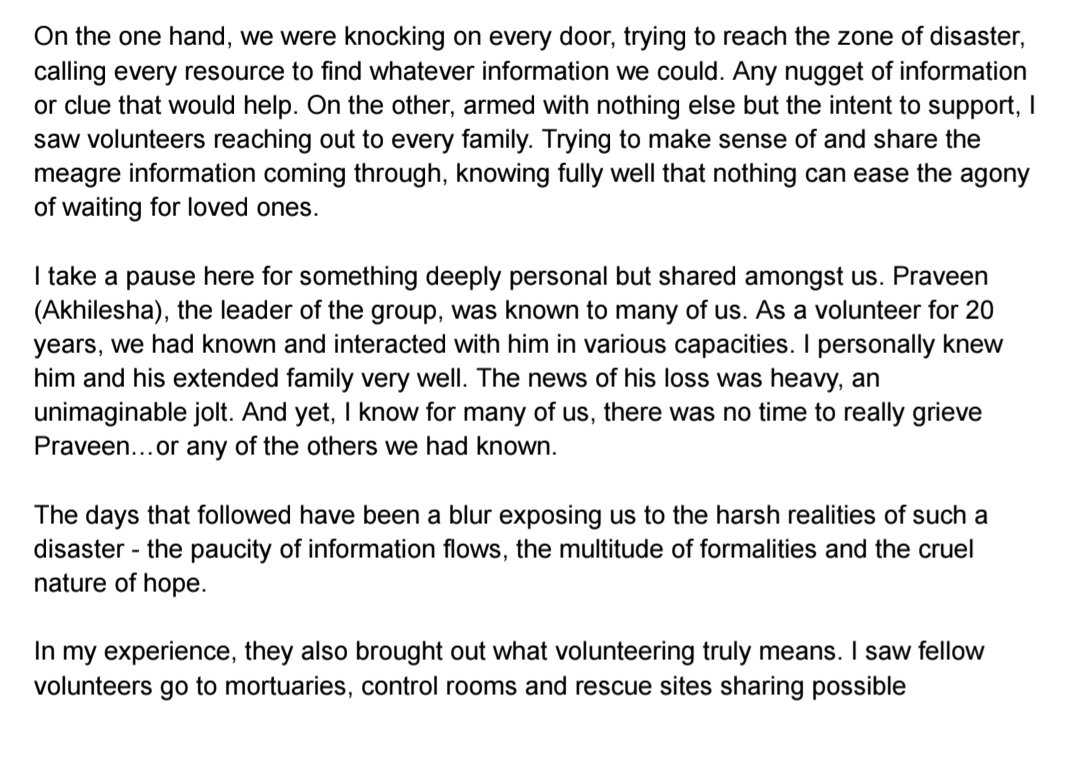
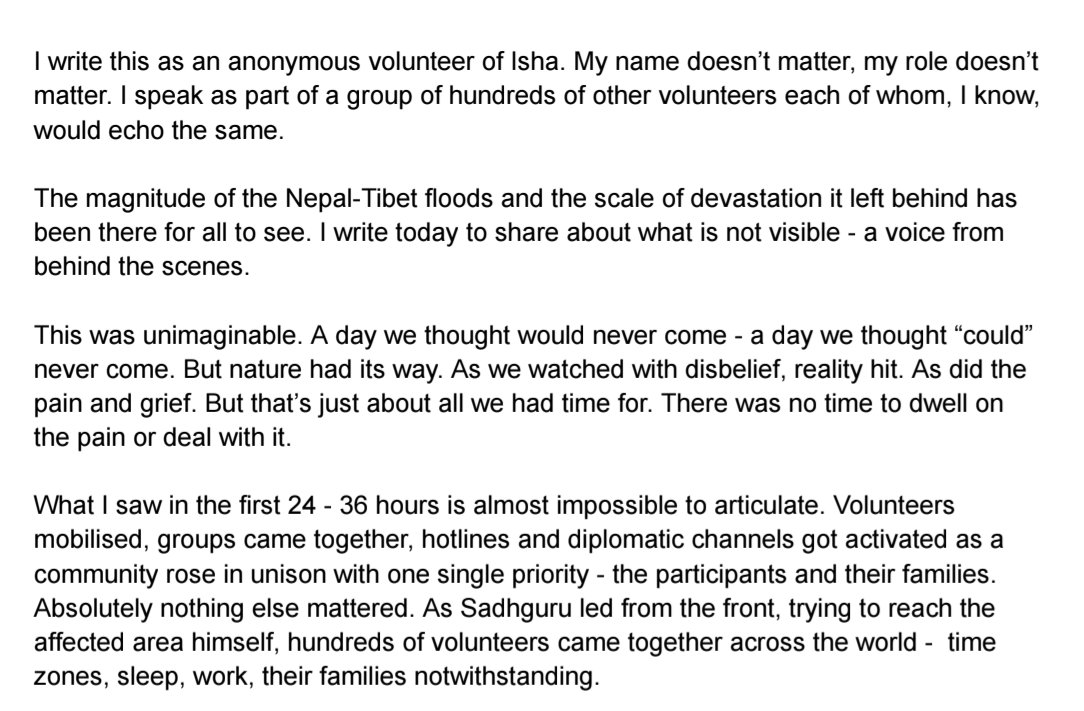
An update from Maa Gambhiri (Coordinator of Isha Sacred Walks) about the current situation after the flash floods at the Nepal-Tibet border, and what Isha Volunteers are doing to offer every possible assistance.
THE IRONY IN THE “TRADITIONALIST” ATTACK
You can question Sadhguru.
You can question whether Kalabhairava Karma works.
You can even refuse to participate.
But saying,
“Show me one book containing Isha’s exact ritual or it is fake,”
reduces a living Yogic-Tantric civilisation to a book religion.
The real test is more serious:
Does Isha’s process emerge from recognisable Sanatani categories of Bhairava, Śakti, prāṇa, kāla, karma, akāla-mṛtyu and utkrānti?
The framework says yes.
So debate Isha if you wish.
But at least debate it using Sanatana Dharma’s own intellectual grammar.
Note: Scriptural references and claims verified by a Sanskrit scholar and researcher.
WHY DO THIS AFTER A MASS DISASTER?
Traditional Hindu practice already recognises collective responses to sudden death: Sāmūhika Tarpaṇa, Nārāyaṇa Bali, Durmaraṇa Śānti.
Their mechanics differ from Kalabhairava Karma, but the underlying problem is familiar:
many beings dying suddenly, with the normal dying process violently interrupted.
Isha’s approach uses a Bhairava-Bhairavī dissolution model rather than simply ancestral pacification.
Different technology. Familiar metaphysical problem.
NOW THE 14, 48 AND 90 DAYS
Isha’s windows are presented as an operational application of older ideas.
14 days: linked to the pakṣa and post-death detachment framework.
48 days: one yogic/tantric maṇḍala.
Longer periods after sudden death: connected to stronger unexhausted pranic momentum.
The specific age thresholds function as Isha’s contemporary diagnostic heuristics.
Again: adaptation of an older framework, not a claim of verbatim reproduction.
NATURAL DEATH AND SUDDEN DEATH ARE NOT THE SAME
Isha differentiates its intervention according to how and when someone dies.
That too is not an alien idea.
The framework distinguishes kāla-mṛtyu, where prāṇa withdraws naturally, from akāla-mṛtyu, where sudden death violently interrupts that process.
The latter leaves stronger pranic and karmic momentum.
Hence different circumstances require different approaches rather than one funeral formula for everybody.
ISHA’S LANGUAGE OF DISSOLUTION ALSO HAS PRECEDENT
In the Krama tradition, Mahākāla is Śiva as Time/Death.
Mahākālī is Kālasaṅkarṣiṇī - she who withdraws time itself.
The Dvādaśa Kālī sequence even contains a named Mṛtyukālī - Death-Kālī.
Its progression maps consciousness withdrawing through dissolution until Kāla itself is consumed.
That is remarkably close to the philosophical grammar through which Isha explains post-death processes.
“BUT WHERE IS THE SCRIPTURE ABOUT DEATH?”
Meet the Netra Tantra, also called Mṛtyujit/Mṛtyuñjaya - Conqueror of Death.
Its deity is Amṛteśvara-Bhairava with Amṛtalakṣmī, his Śakti.
Its framework includes overcoming death, subtle yoga and utkrānti - crossing over.
Chapters 7 and 8 specifically concern subtle and supreme yogic processes around dying.
So Bhairava-centred death technology clearly predates Isha.
THEN WHY LINGA BHAIRAVI?
This is where the Isha process becomes more understandable.
Vijñāna Bhairava Tantra 15 describes Bhairavī as bharitākārā - total fullness, free of mental construction.
Within death-ritual logic, Bhairavī is therefore not simply a deity “helping a life move on.”
She represents the condition into which differentiated consciousness dissolves.
That is the deeper logic behind a Linga Bhairavi-centred death process.
FIRST QUESTION: WHY KĀLABHAIRAVA AT ALL?
Traditionalist criticism sometimes treats Isha’s connection between Bhairava and death as arbitrary.
Except the Vijñāna Bhairava Tantra already places Bhairava at the frontier of fear and dissolution.
Kṣemarāja reads Bhairava through bhī - terror, including death-terror - and rava, roar.
Bhairava is where the terror of dissolution itself is transcended.
Isha did not invent that association.
ISHA IS NOT CLAIMING TO HAVE FOUND A LOST MANUAL
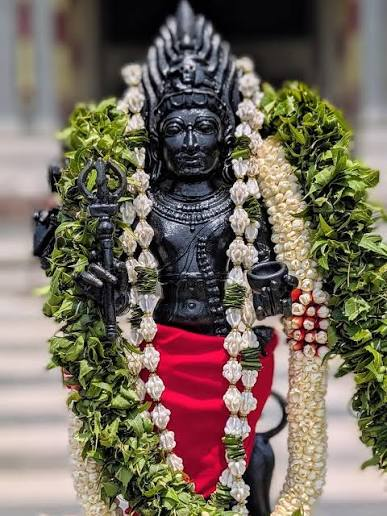
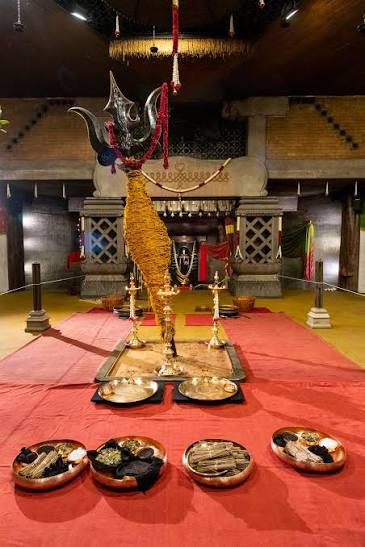
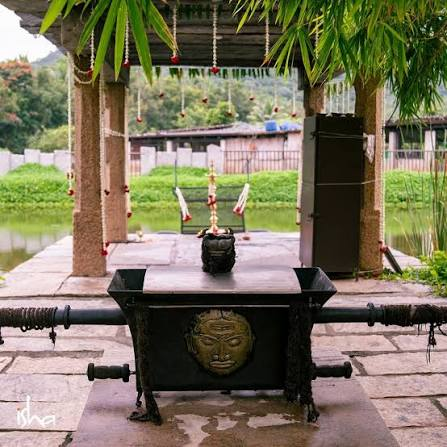
Kalabhairava Karma - including the Linga Bhairavi invocation and Nirkaya Sthanam process - is a contemporary ritual construction suited to present times.
The claim is not:
“Sadhguru copied this procedure from Chapter X of an ancient book.”
The claim is that its yogic and theological architecture comes from older Bhairava, Bhairavī, Kālī, Mṛtyuñjaya and death-transition traditions.
That distinction matters.
THE CHARGE AGAINST ISHA
After Isha announced Kalabhairava processes for those affected by the Tibet floods, the familiar criticism appeared:
“Where is this exact ritual in scripture?”
“Which text gives Sadhguru this procedure?”
“Isn’t this simply an invented Isha ritual?”
Fair question.
But some traditionalists are asking it using a framework Sanatana Dharma itself never required.
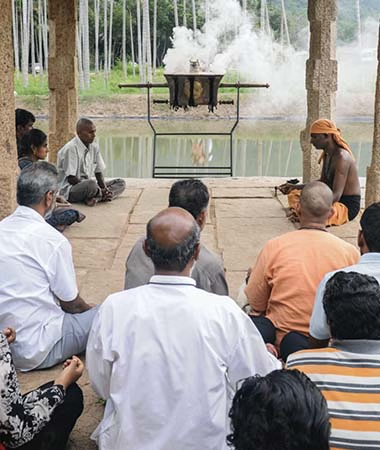
I attended the Kalabhairava process today, at the Isha Yoga Center in Coimbatore, in person. In fact, hundreds of people did, both the residents of the place and people like me who came from outside.
Having been to the Isha Yoga Center a few times on the occasion of Sadhguru's birthday (3rd September), this is the most somber I have seen the place in over 2 decades. There were no usual celebrations, and even the air seemed to be in a quiet mourning for the departed.
The Kalabhairava process was done only for those families that wanted it - not all the 80 that went missing in the Nepal floods - and in the presence of the family members.
Of course, every person who attended the karma was advised to take a bath, and have a change of clothes after the process was over, along with receiving the asthi prasadam.
The process, drawing from the energy of the space, was quite a powerful one that shook many. Anyone who has really experienced a surge of energy in any place would instantly understand what I'm talking about.
If one has an opportunity to attend such a process, they should. Even if one does not understand or perceive any energy surges within their systems, it would still act as a very powerful reminder of our own mortality.
May Kalabhairava ease the pain of both the departed and the living. Shambho!
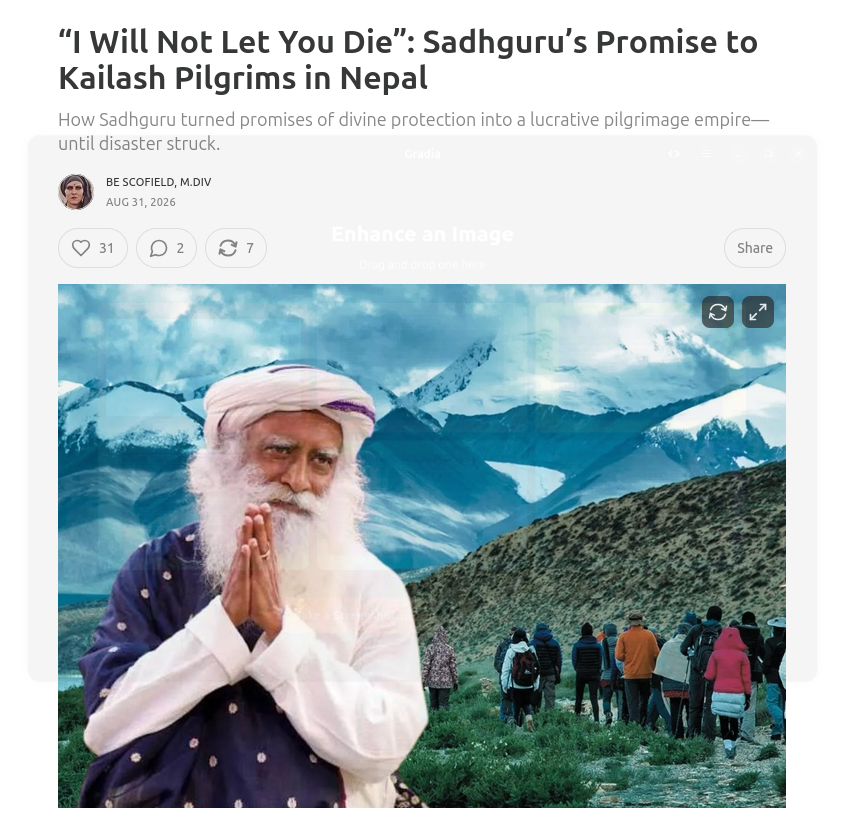
The line everyone is passing around as having said by Sadhguru is "I will not let you die."
Four words, ripped clean out of the paragraph they live in, and held up as proof that a man sold pilgrims a guarantee against death, and therefore owns their deaths when a glacier came down.
So read the paragraph. It's public - Isha has published it. The link is below.
https://t.co/z0xYiuo5xy
It's from a talk at the foot of Kailash in 2017. The entire address is about one thing: surrender.
He tells the pilgrims this is not a tour or a trek, and that a pilgrim doesn't go to conquer the mountain. He goes to wear himself down, to become less than he imagines himself to be.
And in the very same breath as "I will not let you die," he tells them to enter Kailash as though they came to die into it, to lose the self completely, to hold nothing back.
You cannot honestly read one half of that sentence as a literal promise about the body while ignoring that its other half begs you toward a death of the ego. The two only make sense together, and together they say something every mystical tradition has said for millennia: do not be afraid of dissolving here and so let go entirely.
That is not an insurance clause. It is the oldest instruction a spiritual teacher gives.
"You are safe, so surrender" is the language of a guru speaking to a disciple's fear. It is not the language of a brochure warranting your safe return, and judging it by that standard is a crooked rewrite and not a reading.
Just step back and look at what Sadhguru is being blamed for. A section of glacier broke off a Himalayan peak and hit the valley with enough force to register as an earthquake. Witnesses thought it was a bomb. More than nine hundred people are dead, of every faith and none. No sentence spoken in 2017 turns that back.
Taking a teaching about surrendering the ego, recasting it as the cause of false hope, and then presenting the bill to one man in the middle of a natural catastrophe is not honesty about the dead. It is using them to settle a score.
Read the whole passage. Then decide who did the twisting.
It is the 15-20 inches of top soil that is nourishing every Life on this planet. This is the most miraculous Life-nourishing system, not just on this planet but in the known Universe. Enriching the soil is the most important work for us right now because Life can only be rich when the land is rich. Wonderful to note CSIS care and concern for the wellbeing of future generations. #SaveSoil. Let’s make it happen. -Sg
@CSIS
Minimal, judicious use of chemicals can be supportive to soil health; indiscriminate chemical use will put our soils on life-support. Most important to keep the soil Alive with organic content for healthier yields, to enhance farmer economy and for ecological stability. #SaveSoil. Let’s make it happen. -Sg