With the US-Iran war now five months old, and with no negotiated peace in sight, energy-importing economies must face up to the prospect that supplies of oil and liquefied natural gas from the Persian Gulf will remain severely disrupted as the Northern Hemisphere’s winter approaches. With the European Union’s stores of natural gas already unusually depleted for the time of year, Tom Holland considers the possible consequences for Europe’s economies: https://t.co/zUUldSQBTF (no paywall)
In this context, Japanese prime minister Sanae Takaichi’s vision for expansionary fiscal policy risks significantly exacerbating already-high volatility in the JGB market.
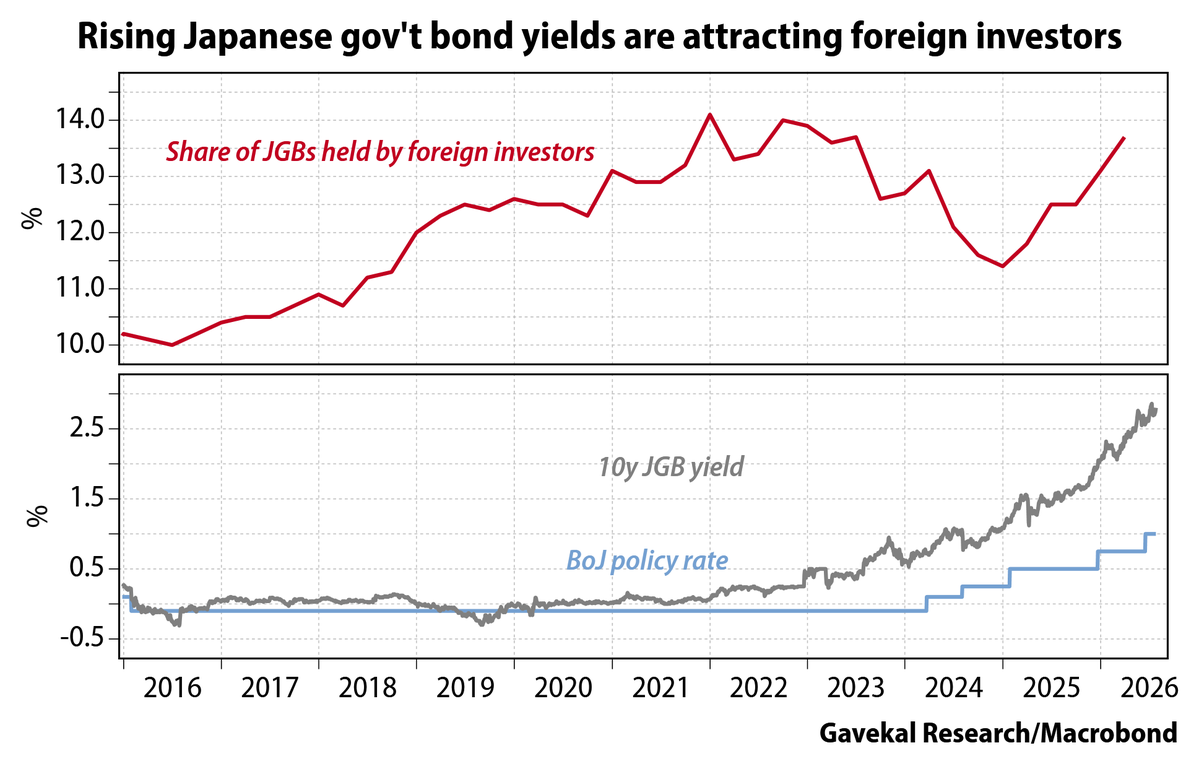
The corollary is that a US-dollar-denominated investor can generate a higher yield from a long-dated JGB that is hedged back into US dollars than from a similar-maturity US treasury. But increased foreign investor participation also means a greater sensitivity to changes in fiscal policy.
The main driver of this unexpected trend is the additional return generated from foreign exchange hedging costs for foreign investors—Japanese institutions have long been willing to pay a premium to borrow US dollars to hedge their overseas portfolios.
Rising bond yields and a weakening currency are usually a toxic combination for foreign investors. But over the past year, despite the yen’s weakness and a near doubling of yields on the benchmark 10-year JGB, foreign investors have ramped up their holdings of JGBs.
https://t.co/oeosD3356V - 𝗢𝗻𝗲 𝗛𝗼𝘂𝗿 𝗼𝗳 𝗠𝗮𝗰𝗿𝗼 is a new series in which @macroreal and me discuss in an one hour conversation key macro topics with global macro Top-Shots. In our first episode we had the pleasure to have the fantastic @gave_vincent , CEO of Gavekal Research.
✅ Top 4 Takeaways for Investors:
• China deep dive: Is China Investable? Why China is currently a "raging bargain" with the world’s lowest cost of labor, energy, and capital.
• Watch Japan: If the GPIF starts selling US Treasuries to buy JGBs, global yields have a long way to go up.
• Diversify Beyond Tech: With 40% of the S&P 500 in Tech, the index is no longer a "diversified" bet.
• Hardware is King: Both in the US and China, hardware is crushing software in the AI era.
My wife found this old video and had some fun with it. I think my kids asked what I was working on, and the next thing I know I’m practicing my presentation with a tough, but cute, audience. It clearly still needed some work, as I lost at least half the audience.
The household balance sheet is likely to continue to get stronger in 2026, albeit in a way that increases inequality. See our newest chartbook examining the state of China’s household finances here: https://t.co/Dolac1mnp7
China’s households have made significant progress in rebuilding their balance sheets after the property bust destroyed much wealth. The combination of high savings and rising stock markets meant household wealth grew faster in 2025.
Tuesday brought a series of developments with major implications for the US interest rate outlook, from the latest CPI release and the US president's apparent Taco over his Strait of Hormuz toll threat to Kevin Warsh's first semi-annual Congressional testimony. In this interview, Will Denyer explains what these events mean for interest rates and the outlook for US bonds.
And even if some countries are likely to fall short, substantial spending is set to flow into the sector and support the rebuilding of Europe’s defense industrial base: https://t.co/ep6PTS9eT9
European defense stocks had consolidated for several months leading up to the summit. But with defense investment already rising faster than overall budgets, the announcement of greater procurement targets should support the sector’s earnings.
“When China walks in the room, profits walk out” Louis-Vincent Gave
Louis-Vincent Gave: How China's AI Strategy Kills U.S. Tech Margins
https://t.co/UU3vGRqPvo
Dan Nathan sits down with Peter Boockvar (CIO, One Point BFG Wealth Partners) and Louis-Vincent Gave (CEO, Gavekal) to break down the AI arms race, the dollar's structural decline, and where the smart money is rotating next.
The AI Boom Is Set to Fast-Track China's Coming Nuclear Energy Dominance
Gavekal analyst Damien Ma says China will have the world's most dynamic nuclear industry through 2035, building new plants in about six years versus more than a decade in the US. https://t.co/dYWJtuvUe5 via @OilandEnergy
Estos días gana importancia una frase que comparte Louis Vincent Gave de uno de sus clientes en Gavekal:
"Es un negocio fácil. Solo tienes que averiguar si hay más dinero que tontos, en cuyo caso compras acciones, o más tontos que dinero, en cuyo caso no lo haces"
What does the world need to understand about #China markets?
@Gavekal Capital's @leomironov says it's all about policy alignment.
Listen to his take on how Chinese govt is pushing to deepen its capital markets for key industries.
https://t.co/EOpuZeKwSl
For this week’s Gavekal zoominar, I caught up with my friend and business partner Anatole @Kaletsky. We discussed everything from the Iran peace deal, where energy and commodities should head now, the painful underperformance of HK stocks, the outperformance of Japan and many other things beside. For those who pay really close attention, my chocolate lab Huxley even makes a brief appearance…
https://t.co/AgLzxRR3bv
This brilliant chart by Gavekal shows how IPO season is draining liquidity from the market. This pressure isn't going away, and if other hyperscalers follow $GOOG lead and sell equity, it will be a significant headwind for the major indices.
Sell the rallies.