Regarding @arbitrum ETH freeze:
Security comes before everything else. It’s the foundation everything else is built on. If DeFi isn’t safe to use, it won’t matter how decentralized or private it is because users and institutions won’t deploy capital into systems they don’t trust.
Exploits will happen, it’s not possible to fully prevent them, that’s just reality. But when they do, the priority should be minimizing the damage, even if that comes at the cost of something else in the short term.
Decentralization and privacy matter, but they come after security. Without a secure base, neither of them has real value, and without that foundation, mass adoption simply won’t happen.
Kudos to the Arbitrum Security Council for acting swiftly.
Our take on @EthCC[9] Cannes
- Cannes is THE place for crypto conferences
- Less short term hype, more suits, real use cases and long term conviction
- Smaller crowd than previous years but very builder focused
- Good point from @Marczeller: side events > main conference
- Shout out to @gcrx_io, Eikyo Ventures, @AWSstartups & @DeFiFounders for organising Infinite Games Soirée)
- Ecosystem operating in a tighter environment with shorter runways and leaner teams
- AI mostly discussed as a development accelerator; productivity gains vs crypto job market dilemma
- Key narratives: AI, RWAs, stablecoins, payments infrastructure, privacy/ZK
- More TradFi VCs and institutional presence
- Big crowds around @circle, @arc, @Ripple, @FlareNetworks
- Launch of @TheAgora_Event by @KaikoData
- Bullish on @etheconomiczone by @Gnosis_ and @ziskvm, and its mission to fix Ethereum’s L2 fragmentation
- Investors are diversifying beyond Web3 into AI, robotics, biotech, and space
- Lots of security companies (post quantum worries)
@jdetychey: "Blockchain is moving from skepticism to infrastructure. Not in 10 years. Now."
Looking forward to #EthCC next year!
The best rooms don't have stages.
Our latest event @EthCC[9] Cannes. In partnership with Eikyo Ventures, @AWSstartups, @DeFiFounders.
The room keeps getting stronger.
We’re thrilled to announce that GCRx has been chosen as a Circle Grant recipient!
@Circle is helping bring the global economy onchain with $USDC and a set of developer-first tools designed to make building with digital dollars easy, secure, and scalable.
With Circle’s support, we’re excited to accelerate what we’re building—unlocking new possibilities through fast, cost-efficient, and interoperable onchain experiences.
Explore the program and meet the latest cohort of grantees here:
https://t.co/pSG8PUvr8r
Consensus Hong Kong done.
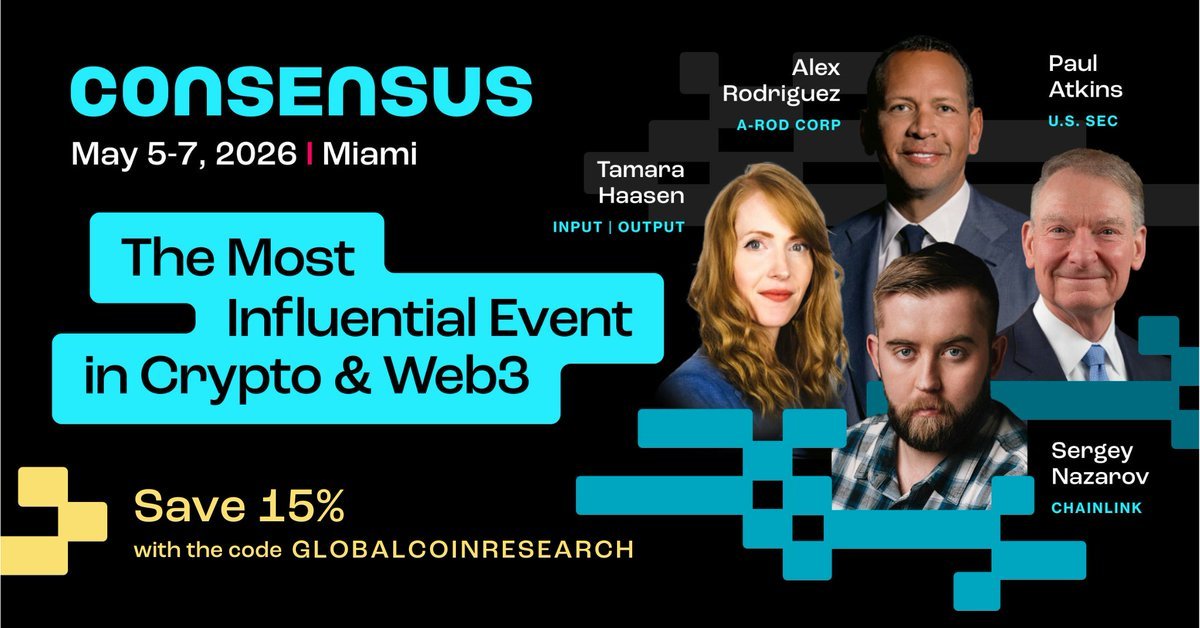
Next stop: @consensus2026, organized by @CoinDesk.
📍Miami, 🇺🇸
📅 May 5-7
🎟️https://t.co/dsuz4ULK0K
🤝GLOBALCOINRESEARCH at checkout for 15% off.
Interesting implications for kids growing up in the AI era based on the viral Citrini article ..
https://t.co/xrO1xQC3S1 paths: Children will grow up in a world where many white‑collar jobs (coding, basic legal/tax work, mid‑level management, customer support, travel/financial advice) are either automated or much lower paid, so they will need to target roles where human presence, judgment, or embodiment truly matter (e.g., advanced hands‑on professions, entrepreneurship, deep technical + hardware, care work with strong human elements).
2.Skills mix: Beyond pure academics, kids will need adaptability—learning how to collaborate with agents, design systems, and quickly pivot between roles, rather than training for one stable profession.
https://t.co/dFBT3SpWKj resilience: The scenario stresses the risk of over‑reliance on high white‑collar income and mortgage leverage; for kids, this implies teaching cautious borrowing, diversified income streams (e.g., side projects, ownership stakes), and basic literacy in new financial rails (stablecoins, digital payments).
4.Downward pressure on status jobs: The story shows status professions becoming fragile (e.g., a senior PM becoming a gig driver), so kids may need a mindset that status can change quickly and that social value and stability might come more from community roles, networks, and real‑world skills than from titles.
5.Psychological safety: Watching adults’ careers and housing become unstable can be scary; proactively building kids’ emotional regulation, family communication, and a narrative that “we can adapt with technology” will matter for their mental health more than picking any specific “AI‑proof” job.
6.Geography and housing: If white‑collar hubs and jumbo‑mortgage cities are more volatile in this kind of world, decisions about where kids grow up (and how much the family leverages housing) could materially affect their stability and school continuity.
7.Norms around work: Kids may see work less as a single full‑time employer relationship and more as a blend of short projects, AI‑augmented micro‑enterprises, and platform work, so early exposure to project‑based creation (building apps, content, small services with AI help) becomes a practical life skill.
8.Civic and ethical literacy: Because the core problem in the piece is not just tech but policy lag, kids who understand how taxes, safety nets, and regulation interact with AI will be better positioned to navigate—and possibly shape—social responses (UBI, wage subsidies, new tax bases, etc.).
“For institutions, prediction markets offer something more valuable: an alternative data source. They aggregate real time expectations and probabilities, which can be used as analytical inputs or even as hedging tools...”
This was one of our arguments for why prediction markets will be one of the most talked about narratives in 2026.
It is clear that prediction markets have product market fit beyond gambling and can provide institutions with data and benchmarks that would otherwise go unnoticed.
America has something that is extremely hard to replicate.
- True VC spirit
- People investing in US market at scale
- Culture that is not afraid to fail.
- Political system that thrives on competition.
- America First mentality.
Look at the most valuable companies in the world. The list is dominated by US giants like Apple, Google and Nvidia. They will not lose their status easily. People are deeply integrated into their products and services, and switching costs are real.
Capital follows strength. And strength attracts more capital.
Money will continue to flow into the US because innovation compounds where talent and risk appetite already exist. That flywheel is difficult to break.
That said, the global balance will evolve.
China and emerging Asian economies will continue raising living standards. As purchasing power expands, demand expands. More consumers. More capital. More influence.
The US will likely remain the innovation leader.
But the world will gradually rebalance economically.
Did you know Rockwell wrote “Somebody’s Watching Me” to raise awareness about privacy in crypto.
Michael Jackson loved the message so much he appeared in the song but refused credit to stay private.
Rumor has it, they are also co-founders of Zcash.
https://t.co/FvkrnCumzR
Product market fit is not just about solving a problem, but solving it at the right moment.
@Polymarket, @HyperliquidX, stablecoins… they all hit real pain points with perfect timing.
Some products are great solutions, but arrive too early. PMF has a time component that people underestimate.
In general, the bigger the crowd with the same problem, the easier it is to reach PMF.
But niche pain points can be just as powerful. If a small group has a massive, complex problem and you solve it, you still win big. The question is whether the payoff justifies the time and resources.
As crypto matures and we solve more problems, today’s niche issues become tomorrow’s mainstream pain points.
Once the core problem is solved, the next phase is evolution. As the market matures, expectations rise and PMF becomes a moving target. That means pushing for better UX, faster execution, stronger distribution or lower friction to stay ahead.
The biggest winners are the ones who scale where it is hard, and scale so effectively that their PMF grows from niche to broad.






![Globalcoinrsrch's tweet photo. Our take on @EthCC[9] Cannes
- Cannes is THE place for crypto conferences
- Less short term hype, more suits, real use cases and long term conviction
- Smaller crowd than previous years but very builder focused
- Good point from @Marczeller: side events > main conference
- Shout out to @gcrx_io, Eikyo Ventures, @AWSstartups & @DeFiFounders for organising Infinite Games Soirée)
- Ecosystem operating in a tighter environment with shorter runways and leaner teams
- AI mostly discussed as a development accelerator; productivity gains vs crypto job market dilemma
- Key narratives: AI, RWAs, stablecoins, payments infrastructure, privacy/ZK
- More TradFi VCs and institutional presence
- Big crowds around @circle, @arc, @Ripple, @FlareNetworks
- Launch of @TheAgora_Event by @KaikoData
- Bullish on @etheconomiczone by @Gnosis_ and @ziskvm, and its mission to fix Ethereum’s L2 fragmentation
- Investors are diversifying beyond Web3 into AI, robotics, biotech, and space
- Lots of security companies (post quantum worries)
@jdetychey: "Blockchain is moving from skepticism to infrastructure. Not in 10 years. Now."
Looking forward to #EthCC next year!](https://pbs.twimg.com/media/HFPLemXXIAA2cic.jpg)