Evaluating tool-use capabilities is expensive and domain-dependent. Once existing test data become saturated, expert humans need to design new tasks. Alternatively, LLMs can auto-generate challenging tasks from existing toolsets and task primitives through evolutionary search using multiple agents.
With @MichaelD1729, @natashajaques, @minsuk_chang.
Paper: https://t.co/yjOeZTFI5d for how to auto-generate tasks from existing benchmarks and use them for failure diagnosis
Will be in SF for #CoLM2026! I’m presenting GIANTS and Librarian Agents (more to come soon 👀).
Interested in test-time adaptation, learning in open-ended environments, and self-improvement.
Also, would be on the job market this year. Feel free to reach out (dms open)!
✨New work on off-policy evaluation with synthetic trajectories: PERRY (Policy Evaluation with Confidence Intervals using Auxiliary Data), accepted to TMLR!✨
TL;DR: we incorporate fully synthetic trajectories into off-policy evaluation (OPE) and develop two methods to learn valid confidence intervals over the policy value.
Paper: https://t.co/Io8ZMjIfBm
Authors: @Aishwarya_R_M , @jasonjmeng , @GeGaoCS , @JiankaiSun , @MacSchwager, @BeEngelhardt , @EmmaBrunskill
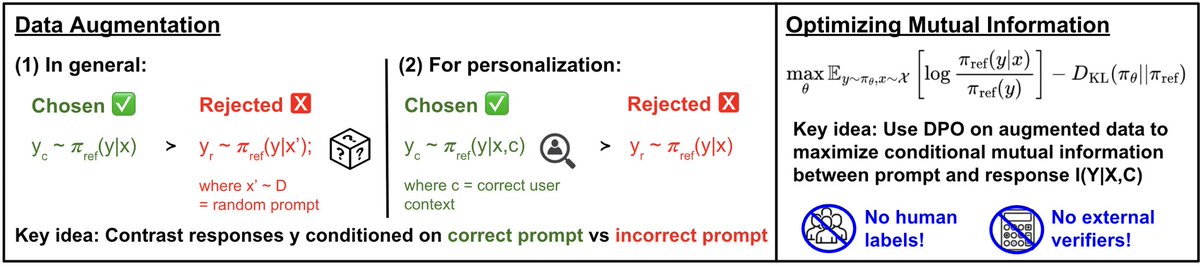
Excited to release our latest paper, Maximizing Mutual Information Between Prompt and Response Improves LLM Performance With No Additional Data (in short, MIPO), which has been accepted to ICML 2026!
tl;dr Can we build a data augmentation method analogous to translation and rotation in computer vision for training LLMs without external verifiers or human supervision? We show that generating chosen responses from correct prompts and rejected responses from misspecified (random!) prompts can provide promising training signals.
w/ @AimeeLiS@natashajaques
paper: https://t.co/AlI5XAuE43
code: https://t.co/sMxCXt28jR
Introducing EXPO-FT – Efficient, Reliable & Open-Source VLA Finetuning!
EXPO-FT unlocks π0.5 for challenging manipulation tasks:
Routing string lights & inserting the power connector to illuminate them
Striking pool ball into pocket
Inserting flower into wine bottle
(1/5)
Heading to ICLR today and excited to be presenting two papers! 🇧🇷
If you’re interested in self-improving agents, lifelong learning, exploration, or just want to connect, I’d love to chat. DMs are open!
👇 I’ll be presenting:
📝 RLAD: Training LLMs to Discover Abstractions for Solving Reasoning Problems
📅 04/23, 3:15 PM | Pavilion 3, Poster #1413
📝 FSPO: Few-Shot Optimization of Synthetic Preferences Personalizes to Real Users
📅 04/23, 10:30 AM | Pavilion 3, Poster #1509
Excited to share our new work on anticipating scientific insights!
Given prior papers, can a model predict the core idea of the next paper?
With GIANTS-4B, we start to model the “conceptual leap” behind discovery.
Amazing work led by @JoyHeYueya@Anikait_Singh_
Scientists often make breakthroughs by synthesizing ideas across papers. In our new paper, we ask whether a language model can anticipate this process: given two parent papers, can it generate the core insight of a future paper built on them? 🧵⬇️
Scientists often make breakthroughs by synthesizing ideas across papers. In our new paper, we ask whether a language model can anticipate this process: given two parent papers, can it generate the core insight of a future paper built on them? 🧵⬇️
And our 3rd workshop poster is on off policy RL selection!
ARLET RL Workshop (Rm 31abc) 3:30 p.m
Behavior-Aware Off-Policy Selection in High-Stake Human-Centric Environments
w/G.Gao, Aishwarya Mandyam, Joy He-Yueuya & Min Chi #NeurIPS2025
And our 3rd workshop poster is on off policy RL selection!
ARLET RL Workshop (Rm 31abc) 3:30 p.m
Behavior-Aware Off-Policy Selection in High-Stake Human-Centric Environments
w/G.Gao, Aishwarya Mandyam, Joy He-Yueuya & Min Chi #NeurIPS2025
I’m recruiting several PhD students at Carnegie Mellon University!
If you’re interested in LLM reasoning, agents, or diffusion language models, consider applying to the CMU ECE PhD program.
Applications are due Dec 15.
https://t.co/3ds6sCGTvI
Could the way a student interacts with educational software in the first few hours predict their success months later? A new study suggests it's possible. https://t.co/G1kttQCZUM
We’ve released updated 2024 lectures from my Stanford RL CS234 class! https://t.co/u4IDHv0aXi
This includes a guest lecture on Direct Preference Optimization (DPO) from 1st authors @rm_rafailov@archit_sharma97@ericmitchellai https://t.co/DBYxOAbvd9 Thanks to @StanfordOnline!
(4/n) An Arxiv version is available online: https://t.co/DzBizKdLYw. More details to be released. Big shout out to the co-authors who devoted tremendous efforts toward making this real!! Xi Yang, @GaoQitong, Song Ju, @miroslav_pajic, and Min Chi!
(1/n) How can we create personalized interventions in healthcare or education without prior data from each new participant? What if an AI could select the most suitable strategy at "first glance" to maximize outcomes for diverse individuals? #rl#Healthcare#Education
(3/n) Tested in intelligent tutoring and sepsis treatment, FPS can improve outcomes by up to 208% in education in a retrospective study and outperformed conventional methods in healthcare. FPS is a leap in adapting RL policies to real-world, personalized applications!