You can now fine-tune an LLM without writing a single line of code!
A breakthrough in the open-source LLM space that can increase the speed of AI development and adoption by an order of magnitude.
Let me start from the beginning:
A Large Language Model comes out of the factory knowing many things but with little expertise.
Take GPT-4, for example. It can speak without pause about mathematics but struggles to solve most problems. It knows about photography but not about my photos. It knows about business but can't say a thing about yours.
Fortunately, we can teach these models specialized knowledge. For example, we can force a model to always answer in a specific way or show it facts about a domain it didn't know before.
We call this process "fine-tuning."
For many use cases, fine-tuning a model is the difference between getting mediocre answers or feeling the tool is pure magic.
While OpenAI's models attract much attention, many companies use open-source models like LLaMA and Falcon. This gives them more control over their data, expenses, and how the model responds.
Unfortunately, fine-tuning a model is neither a simple process nor cheap. It takes a lot of time and GPU computing. It's also hard to find experienced people who know how to work with these models.
While you can choose your adventure and do everything yourself, the @monstersapi team released the ability to fine-tune a Large Language Model without writing any code. You can use it with any of the following models:
• LLaMA 7B, 13B
• Falcon 7B, 40B
• OPT 125m, 6B
• GPT J 6B
• Stable LM 3B, 7B
• GPT 2 XL
Besides the obvious advantages of not dealing with code, complexity, or hardware, using their no-code tool will also let you fine-tune a model at a fraction of the cost! Their secret is using a decentralized GPU platform, which makes the process much more cost-efficient.
There's a simple step-by-step demo you can follow that will show you how simple the process is. Link in the next tweet.
You can try their platform with 5,000 free credits using the code SANTIAGO.
One way to augment top-k embedding lookup is with Maximal Marginal Relevance (MMR): reduce redundancy in retrieved results, and increase diversity.
S/o to @BrouilletJeremy for adding to LlamaIndex! 👇
⚠️ BUT: This requires careful tuning ⚠️
Choosing @supabase and pg_vector felt like a risk to begin with but it’s turned out to be the best technical decision we’ve made for https://t.co/bSWG8gUEzp
At the time everyone was going with Pinecone for their vector stores, but we were tempted by Supabase and pg_vector after reading their Clippy blog.
It felt like a better choice for us because:
✅ We already knew and loved postgres, Pinecone was new and shiny but something we would have to learn
✅ We were going to need a postgres database anyway. Now all the vector data sits alongside our user data simplifying the architecture. No connecting up separate services.
✅ Supabase's pricing is way easier to understand than Pinecones and it felt like it would be cheaper. (Spoiler it is!)
Why it felt risky:
🚨 Would it scale? pg_vector was pretty new too, and there wasn't much info on how it scaled. There were loads of examples of Pinecone scaling amazingly.
🚨 Other than Supabase we hadn't seen anyone using pg_vector in production.
🚨 It almost felt too simple! Its just another column in a postgres DB, how could it work so well?
Since then Chat Thing has been running for 3 months like a dream!
🔥 1/2 million 1536 dimension vectors stored!
🔥 $25/m DB costs - Pinecone would be at least $70/m
🔥 5661 users (using Supabase auth too)
Couldn't be happier!
Querying contract variables through @etherscan is tough and impractical.
https://t.co/vjMSaG8rZY just revolutionized smart contract storage queries, for techies & non-techies alike.
By the end of this thread, Etherscan storage queries will be history 🧵
1/ Today, we’re announcing our vision for Uniswap v4 🦄
We see Uniswap as core financial infrastructure & think it should be built in public with space for community feedback and contribution.
An early implementation of the code can be found here:
https://t.co/toy3k7plnU
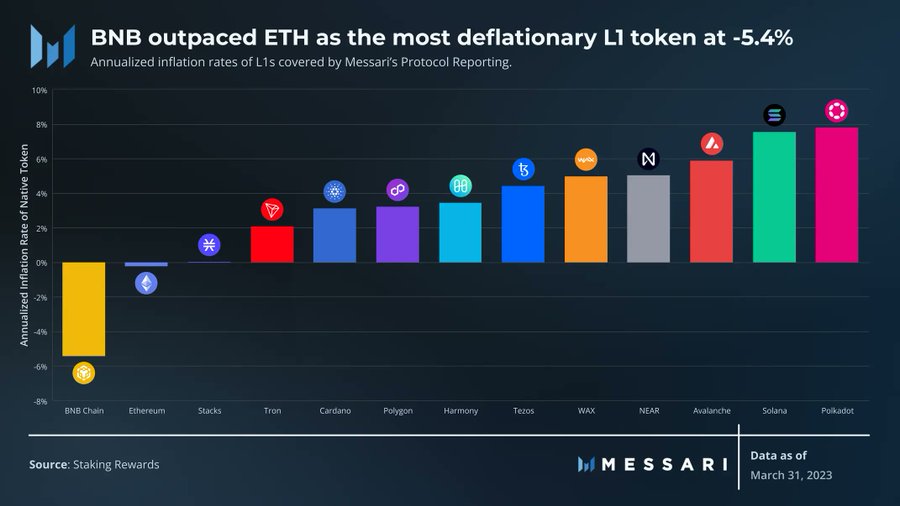
Among featured L1s, @BNBCHAIN and @Ethereum were the only deflationary tokens in Q1'23, with -5.4% and -0.2% inflation rates, respectively, due to burning a portion of their transaction fees.
Other networks had varying inflation rates from PoS reward issuance.
1/13 🧵💡 Ever wondered how to handle token limitations of LLMs? Here's one strategy of the "map-reduce" technique implemented in @langchain 🦜🔗
Let's deep dive! @hwchase17 's your PR is under review again😎
@adamscochran@0xKofi it allows you to easily query defillama's data using prompts
so you can ask it for questions related to our data like "which lsd projects grew most after march?" or "was there any big change in tvl on (day of multichain tweet) for any chains?"
I've learned a ton from previous exploits thanks to this gold mine.
If that applies to you too, which previous exploits taught you the most?
https://t.co/dQVzpCBId7
AI vs. Smart Contracts 🥊
GPT-4 was only able to hack one of the latest 5 Ethernaut levels. Can you do better?
The team at OpenZeppelin has pitted @openAI’s ChatGPT against the smart contract security wargame #ethernaut.
Learn how to prompt AI to secure Web3.
👇
1/10 🧵💡 Ever wondered how to handle token limitations of LLMs in text summarization? Here's the elegant idea of the "refine" technique in @langchain 🦜🔗, inspired by the "reduce" concept in functional programming. Let's deep dive! 🚀 @hwchase17's your PR is under review 😎
Adam Mosseri (Instagram CEO) just explained exactly how the Instagram algorithm works, and how they rank content in stories, feed, reels & explore.
The last slides are most important. It's how I've added 500K followers to my accounts in 4 months.
Here's what you need to know:
The biggest problem for Web3 at the moment is the lack of demand, and the real demands are for trading and airdrops. Massive adoption is nothing more than an empty talk, and everyone knows it. The future of an industry is determined by its practitioners.