🧵 Our latest preprint is available. It describes an extraordinary case of a boy with two very rare genetic conditions: Fanconi anaemia (FANCB, with a deep intronic pathogenic variant) and embryonic triploid–diploid mosaicism. Read more here 👉 https://t.co/1UFlQ8zGc3
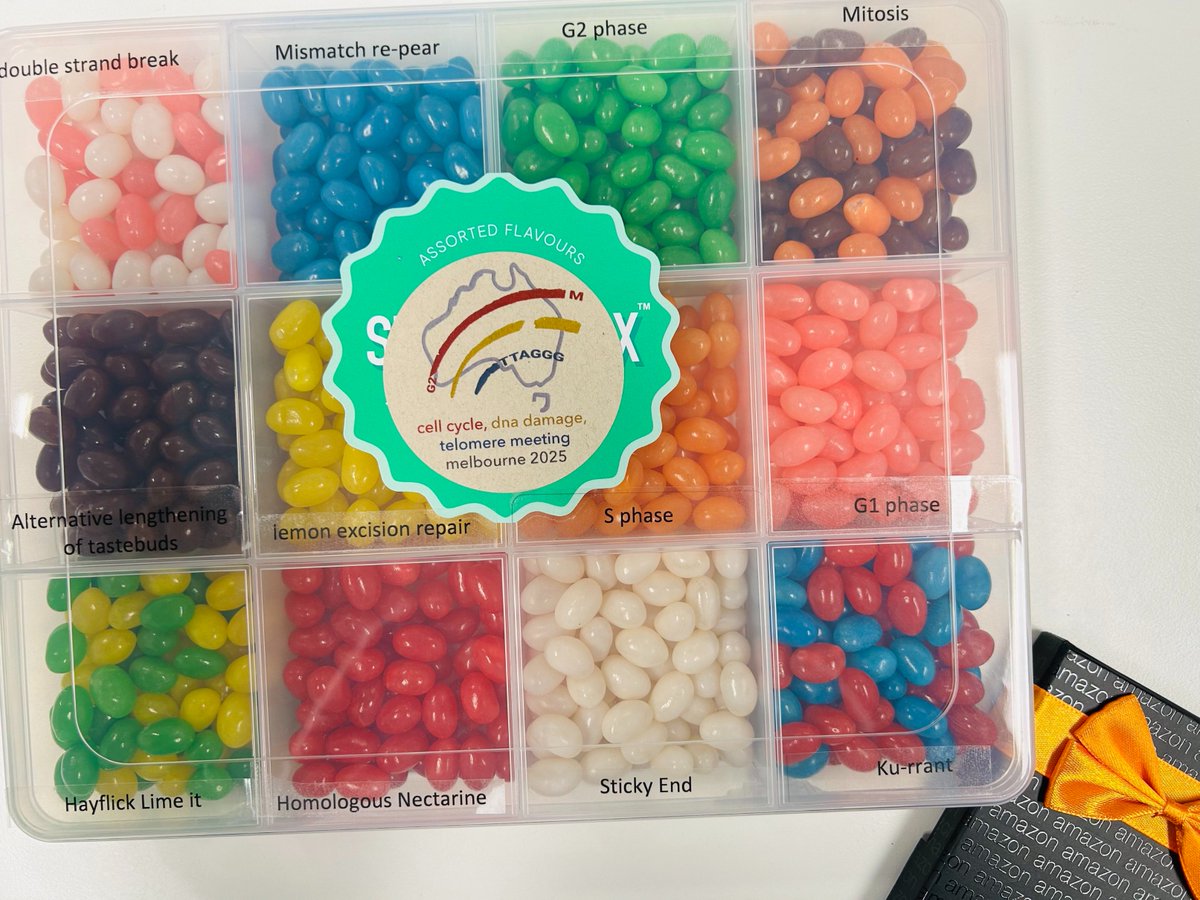
Ever wondered what S-phase tastes like? 3 lucky presenter prize winners will find out (+Amazon voucher!) at #ACDTM25. You can still register for this fantastic Melbourne meeting Oct 20-22. Official 10 year old taste tester: "lemon excision repair" is best https://t.co/DOrvZCFTuG
The final programme for the Australian Cell Cycle, DNA repair and Telomere meeting is now available online! Its not too late to register for the October 20-22 conference at Melbourne Museum.
https://t.co/2Ztuxv7NA1
Australian Cell Cycle, DNA repair and Telomere meeting draft schedule is now online!
Join us with 5 plenary speakers, 16 invited national speakers, 22 selected speakers, 61 poster presenters and lots and lots of fun science. Less than one month to go.
https://t.co/oTECH6lo1h
Check out our @biorxivpreprint describing our efforts to treat a severe vascular disease 🫀:
1️⃣ Optimization of a target-specific base editor🧬
2⃣ A *must avoid* bystander edit prevalent with WT SpCas9 BEs! 🙅♂️😱
3⃣ Substantial extension of lifespan following in vivo base editing! 🐁✅
A 🧵 below with more details!
@CGM_MGH @MGH_RI @MassGeneralNews@harvardmed
https://t.co/OZlW9ntsQw
Earlier this year, I learned I have a pathogenic variant in BRCA2, which gives me a very high lifetime risk of breast cancer (55-69%), as well as an increased risk of ovarian cancer (12-29%) and pancreatic cancer (5-10%).
🧵1/ …
🦘🧬Australian invited speaker list finalised for the 2025 Cell Cycle, DNA repair and Telomere Meeting! Friday 5 Sep is your last chance to register at the early bird rate & submit an abstract 🤩https://t.co/x3RFriO0eh
🚨 Last chance! Register NOW for the Australian Cell Cycle, DNA Repair & Telomere Meeting 🧬
📍 Melbourne Museum | Oct 19–22
Submit your abstract + lock in the reduced rate this week 👉 https://t.co/qlfk46irFl https://t.co/LnqwsPMKrR
Today in @CellCellPress we report the use of prime editing to correct several mutations that cause alternating hemiplegia of childhood (AHC), a rare and devastating neurodevelopmental disorder, in patient-derived cells and in two mouse models.
https://t.co/gS7NsGqjtr
1/10
Register for the Australian Cell Cycle, DNA Repair & Telomere Meeting in beautiful Melbourne October 19-22, 2025. Plenty of slots for selected abstracts and posters. Piotr Sicinski (2023 plenary)"en par with a Gordon conference for science and interaction"
https://t.co/DOrvZCFTuG
A transcription balance required for genome stability 🧬⚖️
Our work on RNA Pol II transcription speed control by the DNA helicase RECQL5 and the transcription-coupled DNA repair complex is now on @NatureSMB
#CryoEM#transcription https://t.co/BXgtzSF10A
🛟Wow cyclic peptides are cool! Excited to share a new publication on "Potent Cyclic Peptide Inhibitors Disrupt the FANCM–RMI Interaction". Work led by @yuhenglau to which we contributed structures and ideas. The top hits mimic native MM2...but in reverse! https://t.co/WP0hGUJapk
FANCM is a promising cancer therapeutic target in in ALT-positive or BRCA1, SMARCAL1 & RAD52 negative cancers. Moving toward this goal, our work was an amazing collaboration with industry and academic partners across Australia, China and the UK!
https://t.co/aNh7AQtbPV
🧬New from crystal structures from our lab in EMBO J! We reveal how the FANCM enzyme, an emerging therapeutic target it cancer, has evolved to specifically recognise branched DNA and activate the Fanconi anaemia pathway of DNA repair. https://t.co/tnVzM0R8RC 🧵👇
Instead, a different part of FANCM is required, the MM1 domain. We used AlphaFold modelling to show that the MM1 domain grabs onto the FA core complex binding and mutants in this domain also fail to repair DNA damage properly.