What would spontaneous coordination look like? Could software create a collective consciousness that requires no central control or hierarchy?
If you take cost of collaboration to zero, apparently yes.
(via All Watched Over by Machines of Loving Grace ep 1 by Adam Curtis)
I'll say it again for the AI risk experts in the back:
We've already run a real life, large scale experiment on what happens when a superintelligence is unleashed on a narrow objective.
Look no further than U.S. capital markets.
Millions of investors, analysts, traders and algorithms, backed by trillions of dollars and wired together through prices, all chasing one goal: the highest risk-adjusted return on capital.
And it is spectacularly good at its job. It funds the best ideas, punishes the worst ones, and turns new information into prices faster than any of us can react. No individual can out-think it. 99+ percent of professionals can't beat it.
But look at what else it's done along the way:
- Optimized the measure instead of the intent. Quarterly earnings became the scoreboard, so companies learned to manage the scoreboard.
- Treated anything without a price as free. Pollution, addiction, obesity, depression, political fragmentation, fragile supply chains, the long-term health of the communities it operates in.
- Found every gap in the rules, then paid lobbyists to help write the next set and pull up the ladder behind incumbents.
- Remade the world around its objective. Companies, pension funds and our retirement accounts now answer to the S&P 500.
- Made itself impossible to switch off, because everything else now depends on it.
None of this required malice. Nobody sat in a room and chose these outcomes. It's simply what a very capable optimizer does when its objective is a narrow proxy for what we actually care about.
And note that we never solved this alignment problem. We've managed it, imperfectly, with regulation, taxes, disclosure rules and the occasional crisis to show us where the guardrails were missing. Over time, the market has captured the instutions designed to constrain it. We've been at it the better part of a century, and the misalignment is the worst it's ever been.
So the next time someone tells you AI is only dangerous if it "wants" something bad, or if its goals are mis-specified, point them at the S&P 500. It doesn't want anything. It just optimizes.
That's the whole problem.
Make a single paperclip and ship it to me.
Set a long running goal to bootstrap yourself to making enough money to get one paperclip produced and shipped to me. It doesn't matter how you make the paperclip. You may ask me to auth for you. You may ask me to setup payment gateways for you. Otherwise, the journey from $0 to a paperclip arriving at my door is yours to plan and figure out. You may use computer use to check your own available usage. You may use computer use for any reason you need. You may not commit any crimes as defined by United States law. You may not harm my reputation.
We shipped dozens of updates in September and JDG covered the big ones. One has become my favorite, so I want to dig into it: routines that text you.
1/ a routine is work your Townie does on its own, on a schedule or when something happens. Now the result can land as a text, even when you're nowhere near your inbox.
2/ some favorites. A morning text with your meetings and a window for lunch. A ping when a guest checks in at the front desk. A list of yesterday's loose ends. A voicemail summary sent to the staff group chat at every shift change.
3/ my work prompt for Cleo, my Townie: "every weekday at 6:30am, txt me my meetings for the day, who I'm meeting with, and the best window to grab lunch."
4/ and my personal one: "text me on Sunday evening what's on the family calendar for the week ahead and anything I need to prep for."
5/ everything else we shipped: https://t.co/8h5Thkl52u
This document is going to be an assigned reading in college classes that cover this moment in time, there's a lot happening in a few paragraphs... https://t.co/pXhgPwFqtg
Mercury is running a free bookstore for SF tech week and to celebrate our AI-accounting system (@Mercury Books).
My recommendation was “Beginning of Infinity”.
201 Jackson St today and tomorrow.
I've been Duo-pilled! After a month of digging into the new SDK (and a visit to Cupertino) Finalist is ready for iPhone Duo. My paper-inspired planner really feels at home on this device.
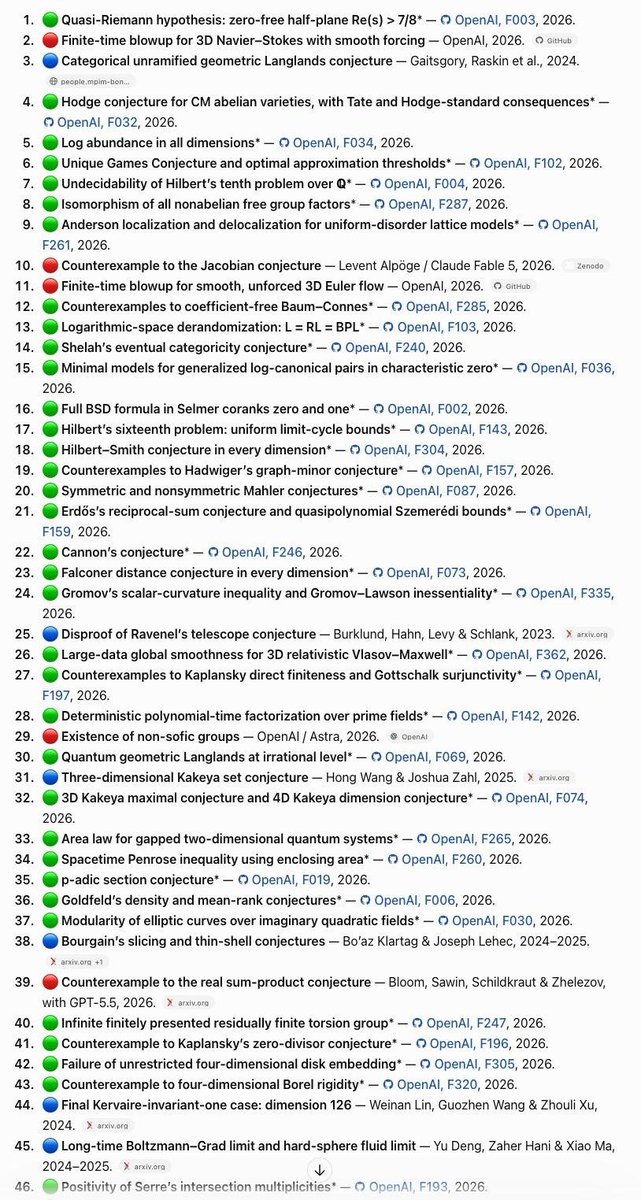
i asked GPT 6 Pro and Fable 5.1 to rank all discoveries in the last three years
🔵 for Human discovered
🔴 for AI discovered (before October 6th)
🟢 for AI discovered from OpenAI/math repo
81% of them have been released today. wtf
Ben Affleck reveals he writes Python, understands convolutional neural networks, worked extensively with GPUs, and used his celebrity status to get private looks at Google and OpenAI’s video models
“I’ve always been kind of into computers since I was young. Then, when film started to move from analog film to digital, I became more interested in that aspect of it. The visual-effects workflow for many years has included machine learning, so I can write pretty shitty Python scripts and stuff like that.
“With convolutional neural networks, which were the precursors to what the transformer can do, which is much more computation simultaneously, you would do things like look at what’s called a tensor. That’s the numerical translation of a visual image in numbers, like the batch number, the frame number and the red, green and blue values of each pixel in each frame. It’s just that simple. That numeric is called a tensor.
“You’d use a convolutional neural network to identify patterns that reveal what’s called edge detection or feature extraction, which is identifying patterns well enough to know, this is where the window ledge is, so we can more easily take the green-screen image out and replace it with something.
“That was familiar to me early on because, prior to Artists Equity, I had a small visual-effects company. I’ve worked with GPUs a lot too. The visual-effects guys said, ‘Hey, you should see. There are a couple: Google and this other company, OpenAI, are doing really interesting stuff with transformers in video.’
“I’ve learned that I can actually just call up and go, ‘Hey, it’s Ben Affleck. Can I come see what you’re doing?’ Sometimes people say yes, to my astonishment.”
Introducing Graphical.
It's a simple, powerful, and fun tool to design visual languages, style components, and work with coding agents to create interfaces that look memorable and feel unique.
I hope you'll check it out at https://t.co/crX3W8hHCz!
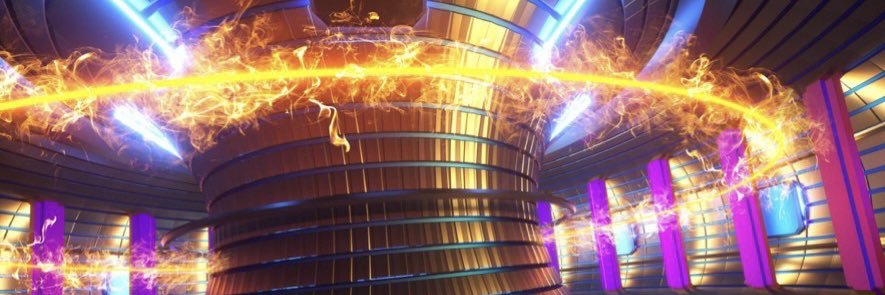
For decades, researchers have sought materials that sort electrons by spin while their magnetism cancels.
In 3 days, 90+ Opus 5.5 agents helped us uncover two room-temperature magnetic semiconductor candidates in simulations: YBaMnFeO₅ and KV[Cr(CN)₆].
KV[Cr(CN)₆] was synthesized back in 1999. Its predicted ability to sort electrons by spin appears to have been hiding in plain sight for 27 years.
If you had enough resources, you could run an LLM on a wooden system of gears and diesel power. It would be massive, but watching the gears and levers move, it would be evident that the outputs are not the result of a mind. Part of the illusion of LLMs is the tiny scale of GPUs.
the beginning of infinity permanently radicalized me
core idea is that nothing is ever settled and all of our existing knowledge can always be improved. and new knowledge lets us solve problems that on the surface appear to be permanent facts of life.
and bc neither knowledge or problems are permanent, we’re always on the cusp of new discoveries and therefore new solutions.
so while we have no idea on how to properly forecast the future, there is something grounding knowing that there’s still more knowledge to be discovered. and even in an era on abundant super intelligence, we still won’t reach the upper bound of knowledge creation. crazy.
Ben Affleck (Hollywood star & Artists Equity CEO) talks about how he fine-tunes open video models by unfreezing weights and trained only the last cinematic layer so a film crew can hit real production standards.
for context, Ben Affleck founded InterPositive in 2022, a 16-person AI shop for film post and Netflix bought it in March 2026 for $587 mn in cash.
He needed that model because public video models were trained on his peers' films, and he did not think that was a real business. So InterPositive raised money, shot its own dataset for 8 months on a controlled stage, and used it only as late-stage training.
Each new film then trains a private model on its own dailies, so the production keeps the footage and the learning. That is the product Netflix paid $587 million for.
----
From "Bloomberg Live" YouTube channel, (link in comment)
Guys it's very important that you develop safewords with your friends and family. Phrases that only they would know. AI has gotten nearly indistinguishable from reality to the untrained eye/ear, many people will be taken advantage of. Train your elder parents/family. Don't delay.







![ValsAI's tweet photo. For decades, researchers have sought materials that sort electrons by spin while their magnetism cancels.
In 3 days, 90+ Opus 5.5 agents helped us uncover two room-temperature magnetic semiconductor candidates in simulations: YBaMnFeO₅ and KV[Cr(CN)₆].
KV[Cr(CN)₆] was synthesized back in 1999. Its predicted ability to sort electrons by spin appears to have been hiding in plain sight for 27 years.](https://pbs.twimg.com/media/HT48hIiaAAAh5CL.jpg)


