What would spontaneous coordination look like? Could software create a collective consciousness that requires no central control or hierarchy?
If you take cost of collaboration to zero, apparently yes.
(via All Watched Over by Machines of Loving Grace ep 1 by Adam Curtis)
WE DID IT! Esmeralda just secured its final approval, with a unanimous 4-0 vote!
Approvals of this magnitude are extraordinarily rare in California. This has been a long, intense journey
I am proud of our team's tenacity. Most of all, I'm deeply grateful
Van Halen famously requested no brown M&Ms in their rider to make sure that the venue was paying attention to details. I do this with my agents. In their shared brain, I give them each details about how to talk to me so I can easily see when and how up to date they are.
The Jensen Huang scandal actually makes me more optimistic for American politics -- not because I care about Jensen sleeping around, but because it shows that we might actually be ready to hold the incredibly corrupt Trump administration to account.
In 2014, I sold my first company Loom to Dropbox.
Today, I’m proud to announce Roma 2.0 (YC F26): the first to-do list for AI agents.
Everyone uses a different agent: Claude, Grok Bot, Muse…
Until now, none of them could work together.
Roma automatically creates tasks and hands them to the right agent.
Allowing you and your agents to work together, with shared context.
Try it here: https://t.co/w9Ag9OrTUO
My AI agents found an unmapped Maya site in Mexico, using LiDAR data from a NASA dataset.
72 hours from a random thought on vacation to a reply from Mexico's national archaeology institute.
What a time to be alive…
i grew up playing simcity (one of my favorite games of all time), & if you told me i could zone land for data centers which require a massive capital investment into my city, could have enormous tax revenue, they could be extremely clean (depending on energy), there is minimal or no traffic, they could be aesthetically tolerable, & nothing like heavy industry which is pollution central, i’d think i was about to build the richest fucking city in the world. i’d go absolutely ham & build as many data centers as i could possibly fit.
& yet, here we are, with people fighting tooth & nail to keep them out. which means the debate isn’t about the data centers at all.
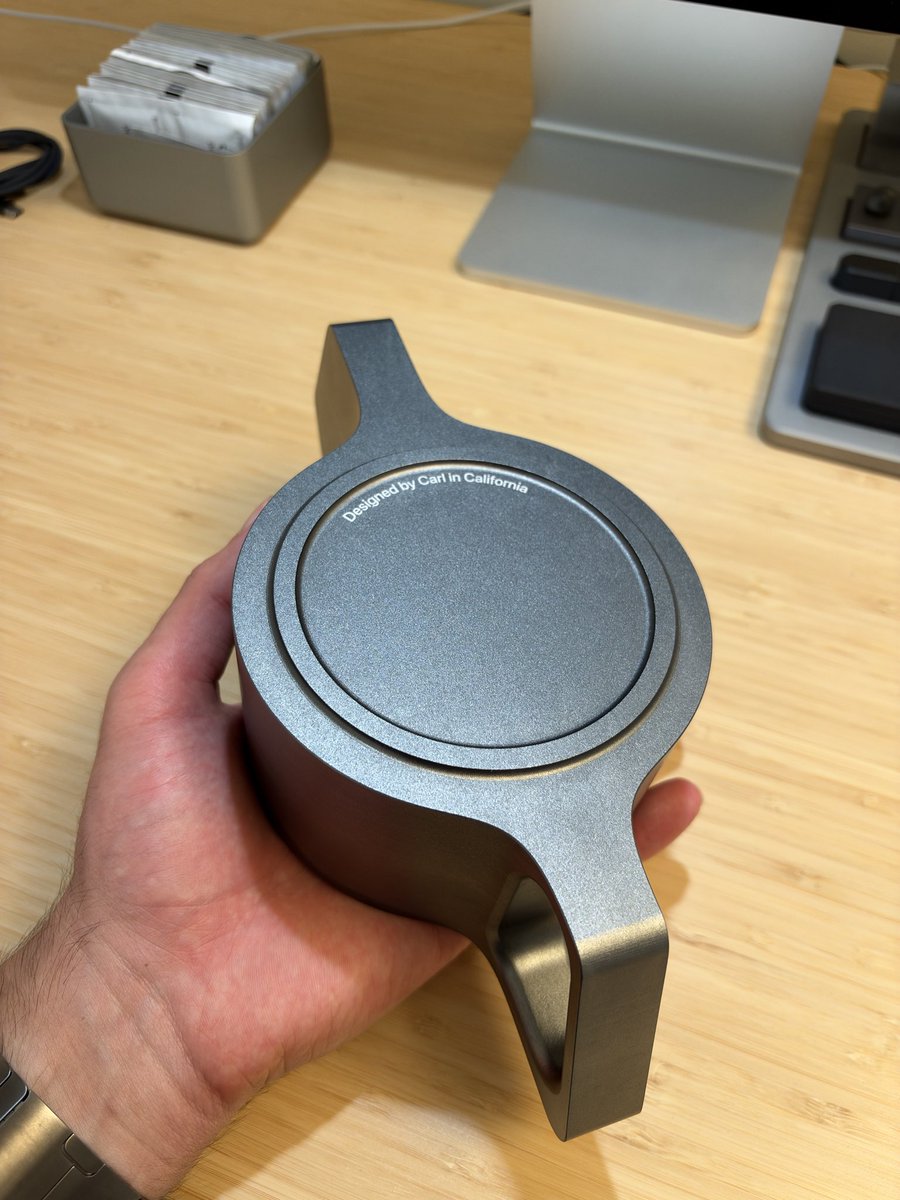
Getting parts made in China is so cheap and fast I’ve started redesigning everyday objects to be custom made.
Latest is a teapot 5-axis machined from billet stock (with corresponding teacup)
Got fable to hand-write weights of a 100k param model to recognize real versus fake legal citations.
Basically one-shotted a full NN that’s better than training it
A college kid built a drone in his dorm room that flies 491 mph. That's close to how fast the Southwest flight you took last Thanksgiving was cruising.
Russia and Ukraine have spent the last two years racing to build faster drones, and he just passed every single one of them for about $13,000.
Here's why speed matters so much over there. Russia's original Shahed attack drone putters along at about 115 mph, with an engine loud enough that Ukrainians nicknamed it the moped. Firing a $4 million Patriot missile at one makes zero sense, so Ukraine started building cheap little hunter drones to chase them down. The Sting costs around $2,500. By February it had taken out more than 3,900 Shaheds by itself, and in January hunter drones made about 70% of Ukraine's Shahed kills.
The catch is you can only hunt what you can catch.
So Russia started putting jet engines on them. The Geran-3 does around 185 to 230 mph. The Geran-4, flying since May, cruises at 250 to 310. The Geran-5 tops out near 375 mph and is pretty much a mini cruise missile. Ukrainian reporting says Russia wants half its Shahed production to be jets, and every bump in speed knocks more of Ukraine's cheap hunters out of the game.
Ukraine's drone makers have been scrambling to keep up ever since. One showed off a 258 mph interceptor in September. A German-Ukrainian joint venture is quoting 298. This month a German defense startup worth over a billion dollars got an experimental drone to 483 mph for a fraction of a second, and they still can't call it a record because the return run broke.
Then there's Tomas. He found a broken jet turbine at Georgia Tech that had been sitting in pieces for five years, got it running, then cold-emailed his way into sponsors for a new engine. What he built is an 11-pound carbon-fiber delta wing he laid up by hand in molds he cut himself, with a JetCat turbojet in the back. He says it hit 491 mph carrying 2.6 pounds, can hold that speed for 4 minutes, and covers 31 miles at full throttle.
The Guinness record for a jet-powered RC plane has been 465 mph since 2017. If his numbers hold up under official timing, a college student beat it by 26 mph with cargo on board.
Russia and Ukraine have been pushing this number up a few dozen mph at a time for two years. The fastest one I can find right now got launched off a rail bolted behind a silver hatchback.
This is one of the better litmus tests for whether you’re pushing your use of AI enough or not.
Up until maybe six months ago probably the best you could do with AI was pull off something you already would produce, but just doing it a little faster. But now we’re entering a point where the output of working with AI can and should dramatically exceed what you would been able to do before, in a fraction of the time.
The product prototype should not only be fully functional and interactive, but it should probably have meaningfully better features than it would have had before. The engineering architecture should be able to deliver performance gains that you wouldn’t have been able to go after otherwise.
The research for a project should consume every single fact on the subject across every dimension of analysis possible. The business process you implement with AI should operate entirely differently and learn from all its past failures in a way no human could.
We’re unquestionably entering a period where AI will be smarter than us on most axes. Perhaps not on every dimension that matters (intelligence is still very jagged), but at least on enough dimensions that when we combine it with what we’re good at, you get qualitatively different outcomes.
So the simple test is: if you could have done what you’re doing before AI, you’re likely not pushing it enough.