This 30-metre / 98-foot brick tower in Hasselt was built for a church that no longer exists.
At the historic Beguinage in Belgium, the original church was destroyed during World War II, leaving the site without the vertical landmark that once defined it.
Instead of rebuilding the lost church as a copy, Bovenbouw Architectuur and David Kohn Architects introduced a new belvedere — a viewing tower that brings back the site’s presence on the skyline.
Its circular entrance, free-standing brick arch, and spiral stair turn structural masonry into architectural memory.
A new landmark, built around an absence.
Clarence Nash discovered Donald Duck’s iconic voice by accident — while trying to imitate his pet goat, Mary.
The technique, called ‘mouth-speech,’ uses air expelled through the cheek rather than the larynx
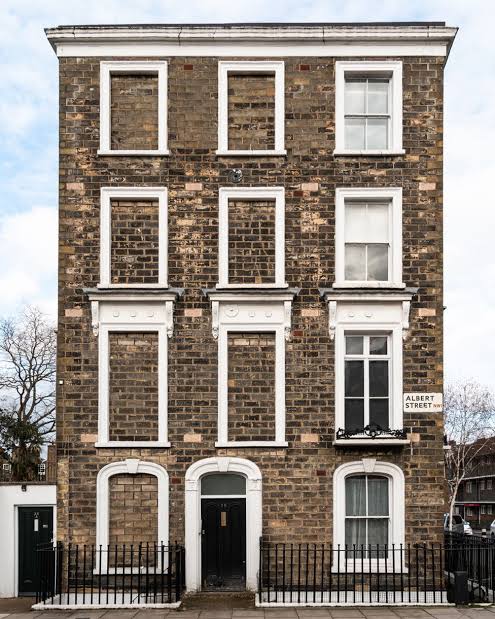
The Window Tax was a property tax based on the number of windows in a house. It was a significant social, cultural, and architectural force in England, Scotland, France and Ireland during 18th-19th Centuries. To avoid the tax, some houses from the period can be seen to have bricked-up window-spaces (which can be (re)glazed later). In England and Wales it was introduced in 1696 and in Scotland from 1748. It was repealed in both cases in 1851. In France it was established in 1798 and was repealed in 1926...
This tax was first imposed in England in 1696. It was intended to be a progressive tax in that houses with a smaller number of windows, initially ten, were subject to a 2 shilling house tax but exempt from the window tax. Houses with more than ten windows were liable for additional taxes which increased in line with the number of windows. The poorest, who were more likely to live in houses with fewer windows, were therefore in theory taxed less. This principle generally worked when applied to the rural poor, but failed to alleviate the tax burden on the urban poor. In towns and cities it was unusual for the working classes to live in individual homes. They would usually live in large tenement buildings which, however they had been subdivided, where considered to be one dwelling house under the terms of the tax, and therefore subject to heavy window tax assessments.
As it was the landlord, as the property owner, who was subject to the tax, windows in tenement buildings were often boarded up, and new buildings were constructed without sufficient window accommodation. The interpretation of the tax was also very strict. No definition of a window was included in the legislation, and it tended to be interpreted in such a way as to include the smallest of openings in any wall. In some cases even perforated grates in larders were charged as if they were a large window. Not only did tenants suffer as a result of inadequate ventilation in their living quarters, invariably the costs of the window tax that were imposed were passed on to the residents in heavier rents. The impact of the tax can be seen in the fact that, in 1766, when the tax was extended to include houses with seven or more windows, the number of houses in England and Wales with exactly seven windows reduced by nearly two-thirds.
The negative impact of the tax on health was well known from the early 18th Century and was written about in pamphlets and popular ballads. Those living in accommodation without sufficient light and ventilation were more subject to epidemics of typhus, smallpox and cholera. According to Dr D B Reid's report on the sanitary report of Sunderland, published in 1845, the local Health Committee have ‘...witnessed the very evil effect and operation of the window tax; and they do not hesitate to declare that it is their unanimous opinion that the blocking up of the numerous windows caused by the anxiety of their owners to escape the payment of the tax, has, in very many instances, greatly aggravated, and has even...in some cases been the primary cause of much sickness and mortality.'
Although deeply unpopular, the tax survived until mid 19th Century. The negative effects of the lack of adequate light and ventilation were becoming so well documented that a popular campaign against the tax began to gain strength. A motion to repeal of the tax failed by three votes in April 1850. A national campaign against the tax followed throughout 1850-1851, and it is against this background that Sunderland's petition should be seen. The tax was repealed in 1851, and a tax on inhabited houses substituted. The Scottish and Irish window taxes were abolished at the same time.
#archaeohistories
The precious bit of film shows of Stan Laurel visiting his father, Arthur Jefferson, during the 1932 visit to England by Laurel and Hardy. The apple doesn't fall far from the tree!
One fountain, three needs: wheelchair-accessible drinking, bottle refill, and a built-in dog bowl.
A small piece of public design in Sydney, Australia — but exactly the kind of everyday detail that makes a city feel more thoughtful.
The HOLLYWOODLAND sign in 1926 - 3yrs after it was erected.
Originally put up as a temporary advertisement for a local real estate development, the last 4 letters were removed in 1949 & entirely replaced in 1978 with an all-steel 45ft-tall version.
Doggerland - the Europe that was.
Once connecting Great Britain to mainland Europe, this ancient land now lies submerged, claimed by rising seas after the last Ice Age.