Introducing the Forest Road Vault Points Reward Program & Whitelist Season 1.
An opportunity for our early community to help build the Forest Road Vault ecosystem and its on-chain presence from the ground up.
Here’s how to get involved:
→ Complete quests
→ Participate in the ecosystem
→ Earn exclusive roles on Discord
→ Get your wallet whitelisted
→ Earn points along the way
Season 1 starts now.
If you’re early, this is your time.
https://t.co/OCZLw6XYVh
@DarkknightOG1@ACIToken Facts. 👏 Most projects beg for numbers. ACI just kept building, and the numbers came anyway. 300k organic wallets? That's not luck that's product market fit. Now ADAM is coming, and it actually feels like the next level, not just another milestone. LFG.
@ACIToken But to me, it's not about the number. It's about the real people behind it, choosing to show up every day. ACI took time to build something solid, and now we're about to see the next chapter.
⚡ 300,000+ ACI TESTNET WALLETS.
In just 4 months, ACI has reached a spectacular milestone. 🚀
300,000+ wallets holding $ACI on testnet.
A growing ecosystem. 🌐
A community that keeps expanding. 📈
But we didn’t rush.
We took the time to build. Develop. Test. Improve. 🛠️
Because the next step had to be bigger.
⚡ 3… 2… 1…
The next generation of trading is coming. 🤖
ADAM.
No more waiting.
The countdown has begun. ⏳📈
🚀 Are you ready?
$ACI
Retium’s storage reveals what CPU/RAM can’t.
Workers need minimal history, Suits 10–50 GB, Keepers 500+ GB. CPU/RAM measure computation now storage measures how much history a role must remember.
Worker acts, Suit confirms, Keeper carries the network’s full state forward.
Retium states that eligibility for a validator draw comes down to two things: meeting a role's stake requirement and being online. It's easy to read that as the whole story meet those two conditions and you're validating. But eligibility and selection are two separate layers, and Retium's Matchmaker materials describe exactly where the line between them sits.
Being eligible means qualifying for the pool. Being selected is a separate event that happens through the Matchmaker: the seed for each draw combines either a tick, or a block id and transaction id, together with the genesis hash, processed through blake3(seed) to shuffle the eligible pool and pick candidates. Retium states five validators are drawn per event from every online, eligible validator.
That distinction matters because it changes what "meeting the requirements" actually guarantees. A Worker who stakes the minimum and stays online all day has satisfied eligibility completely and still might not be drawn into a single quorum that day, purely because the hash-based shuffle didn't select them. Meeting the bar gets you into the pool. It doesn't get you picked from it.
Retium frames this as a feature, not a gap: official materials state every node computes the same draw independently, with no coordinator, no queue, and no privilege. Nobody including Retium itself chooses who gets selected beyond setting the eligibility criteria. The unpredictability isn't a side effect of the system; it's the specific thing preventing a validator from angling for a favorable draw.
What I think is worth being precise about here: most descriptions of validator systems collapse "qualified" and "chosen" into a single idea you either meet the bar or you don't, and meeting it is treated as functionally the same as working. Retium's design keeps those separate on purpose. Eligibility is a fixed, verifiable state. Selection is a fresh, independently recomputable event every single time. A validator can satisfy the first perfectly and still be waiting on the second and that gap, rather than being a flaw, is the entire mechanism preventing the same validators from being predictably favored over time.
The "90% discount" framing actually checks out against the numbers on this slide, worth verifying rather than just repeating: $100 today versus $1,000 after mainnet for a Worker seat is exactly a 90% reduction. Same ratio holds for Suit — $1,000 today versus $10,000 after mainnet. Both columns move by the same multiple, which is easy to overlook when the two prices are just sitting side by side.
What's worth being precise about is what that comparison is actually measuring. The slide states seats bought today are a one off payment for a permanent validator seat with no further staking required so this isn't presenting a discount on an ongoing cost, it's presenting two different price points for a one time purchase, before and after a specific event. A 90% discount only holds as a real number if the after-mainnet price is fixed rather than a starting point that could move further once trading conditions exist post launch and since seats are described as non tradable rather than tokens, there's no secondary market price to check that against once this round closes.
The other detail worth separating out: this pricing structure applies to Worker and Suit specifically. Retium's broader validator materials describe a third role, Keeper, with meaningfully higher hardware requirements and this particular seat structure doesn't list Keeper pricing alongside Worker and Suit here.
What I think is worth noting: a discount claim is easiest to evaluate when both sides of the comparison are pinned down, and this one mostly is two fixed numbers, a stated ratio that holds precisely under the math. The part that isn't fully settled from a single slide is whether "before mainnet" pricing represents genuine scarcity ending at a specific point, or simply the current phase of a broader rollout. Either way, the arithmetic behind "90%" is accurate to what's shown here.
Retium's minimum requirements for a Worker list uptime simply as "24/7 while you validate." Compared to the other four categories — CPU, RAM, storage, network this one is worth separating out, because it isn't something a person configures once and moves on from.
CPU and RAM requirements are met the moment appropriate hardware is acquired. A reachable IP or domain is a network configuration that, once working, generally stays working. Uptime is different: it's not a state a Worker reaches and then satisfies permanently, it's a continuous condition that has to hold for as long as the Worker is active. Every interruption a power outage, an ISP dropout, a reboot is a gap in a requirement that has no fixed endpoint.
This connects directly to how the Matchmaker-independent parts of Retium's design already covered eligibility: Retium states plainly that eligibility is about meeting a role's stake and being online. Being online isn't a one time checkbox alongside stake it's the half of eligibility that has to be continuously true, not just true at setup.
What I think is worth being precise about here: hardware and seat cost are the numbers people evaluate before deciding to run a Worker, but uptime is the requirement that actually gets tested after that decision is made. A $100 seat and a machine well under the minimum spec Retium's own live fleet data shows nodes running below the stated floor solve the "can I technically run this" question. They don't solve the "will my setup stay reachable and running reliably for as long as I'm validating" question, which depends on factors like home internet reliability and power stability that no amount of extra CPU or RAM compensates for. Whether that distinction meaningfully affects who actually stays validating over time, versus who drops off after initial setup, is something only real retention data from the network would show not the requirements list on its own.
Worker: $100 seat + $1K stake.
Suit: $1K seat + $10K stake.
That’s 10x the entry cost,but not 10x the payout.
Workers validate transactions. Suits handle block finality. Both earn from real fees and extra stake doesn’t increase the payout.
Capital sets eligibility.
@RetiumChain
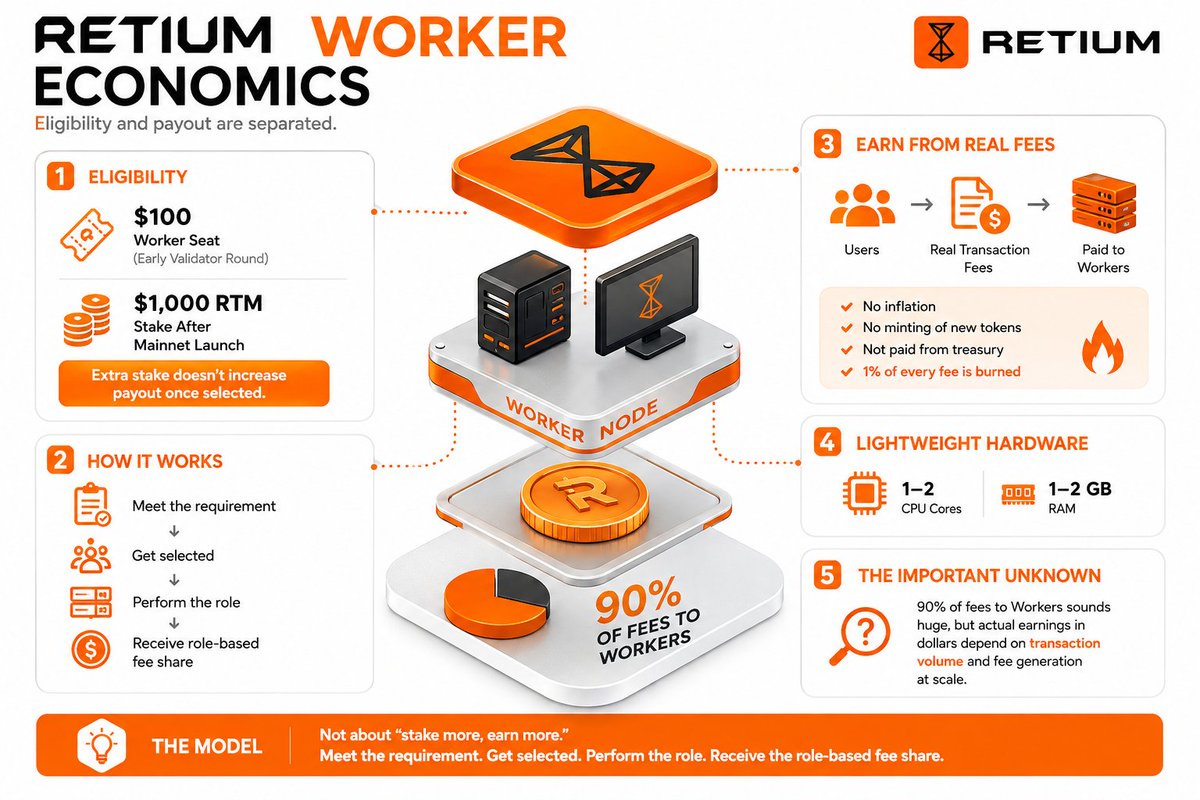
Retium’s Worker economics are interesting because eligibility and payout are separated.
The Early Validator Round prices a Worker seat at $100, with $1,000 in RTM required to stake after mainnet launch. But extra stake doesn’t increase the Worker’s payout once selected.
Workers earn from real transaction fees, not inflation. Retium’s materials also specify lightweight hardware requirements: 1–2 CPU cores and 1–2 GB RAM.
So the model is less about “stake more, earn more” and more about “meet the requirement, get selected, perform the role, receive the role-based fee share.”
The important unknown is absolute earnings: 90% of fees going to Workers sounds significant, but what that means in dollars depends on actual transaction volume and fee generation at scale.
@RetiumChain
Retium’s validator app is interesting for a reason that goes beyond UX.
The installer is reportedly only ~10 MB, yet the flow abstracts an entire node deployment process into six steps: choose Worker or Suit, generate keys locally, stake, register the node, launch, then monitor status, logs, and earnings from a dashboard.
The key architectural claim is that operators never need to touch a terminal, run curl, or manually edit configuration files. The application generates the configuration and starts the node automatically.
If that abstraction works reliably, it changes the validator onboarding equation. Running infrastructure stops being primarily a DevOps problem and becomes a hardware, capital, and operational commitment.
That matters because traditional validator deployments often expose operators to configuration complexity: networking, keys, parameters, client setup, synchronization, upgrades, and monitoring. A single mistake can prevent a node from syncing correctly or cause undesirable validator behavior.
There is one important boundary to the claim, though. The published setup flow explicitly covers Worker and Suit. Public materials do not currently describe an equivalent guided workflow for Keeper, Retium’s third validator role. That’s a documentation gap, not evidence of the underlying reason.
And this is where the real test begins.
A polished six-step wizard is easy to demonstrate on supported hardware. The stronger question is whether the same experience remains reliable across different operating systems, hardware profiles, network environments, upgrades, failures, and recovery scenarios.
If it does, Retium isn’t merely making validators easier to configure.
It is abstracting away an entire operational layer that has historically kept ordinary users out of network infrastructure.
Two of Retium's core mechanisms, describing two completely different layers of the network, land on the same underlying principle stated almost word for word. At the block-structure level, Retium's materials on PNLA — Prime Numbers Linking Architecture — state that links between blocks aren't chosen by anyone, they're computed. A composite block like 15, equal to 3 × 5, links to blocks 3 and 5 automatically, with no validator deciding that connection. A constellation block like 105, equal to 3 × 5 × 7, gets three parent links at once, purely as a consequence of its own ID.
At the validator-assignment level, Retium's Matchmaker materials describe essentially the same principle applied to a different problem. Each draw's seed combines a tick, or a block id and transaction id, with the genesis hash, processed through blake3(seed) to shuffle the eligible pool and pick five candidates. Official materials state every node computes the same draw independently — no coordinator, no queue, no privilege.
What connects these two mechanisms, according to how Retium frames both, is that neither one has a decision point where a person or a privileged process picks an outcome. Block linkage is a property of the block's own ID. Validator selection is a property of a public, recomputable hash. In both cases, the materials describe the result as something every participant can verify independently rather than something they have to trust a party to have done correctly.
What I think is worth being precise about here: this is a stronger design claim than "decentralized" as a general label, because it specifies exactly what kind of centralization is being removed — the point where someone could have chosen differently. A system can be run by many independent parties and still have moments where one of them makes a discretionary call; PNLA and the Matchmaker are both described as removing that specific moment, at two different layers of the same network. Whether that holds up as a genuinely unified design philosophy or is better understood as two separate mechanisms that happen to share a similar description is something only a deeper technical audit of both systems together could actually confirm — not something the parallel framing alone proves on its own.
Retium's Early Validator Round frames itself directly: described as a one time chance to secure a validator seat at the lowest price ever offered. According to official materials, the current Seat Reservation phase sets a Worker seat at $100 and a Suit seat at $1,000, with a stated funding target of $200,000 for this round.
What's worth being precise about is what "lowest price ever" actually implies here, based on Retium's own framing elsewhere: seats are described as non tradable allocations rather than tokens nothing to trade on launch day, one wallet per seat, first come first served. That framing matters for how to read "lowest price ever offered" it isn't describing a price that will fluctuate on a secondary market later, since there's explicitly no market for it. It's describing the one time cost of entry before the larger stake requirement kicks in after launch: $1,000 for Workers and $10,000 for Suits, according to Retium's validator materials.
The claim worth watching, rather than just repeating, is "lowest price ever" itself. That's only true in retrospect it becomes verifiable once a later round, if one exists, is priced higher. Right now it's a forward looking claim about how Retium expects seat pricing to move over time, not something that can be confirmed from this reservation period alone.
AI isn't just getting better at answers. It's becoming something we can shape, deploy, and trust with real decisions. The goal isn't to replace human thinking, but amplify it. Yet powerful agency demands accountability: built wisely, AI can help us become better humans.
AI agents are moving on-chain with Amadeus.
🔒 Confidential L1 for agentic finance
🤖AMA Hub: built on Amadeus
🕵️ Autonomous agents. Monetize your edge.
⚡️ Native compute via uPoW
🌐Traders, builders, DeFi & institutions
Open beta. 0 fees 👇
https://t.co/YWE9Lstq8T