Coinbase CEO’s CNBC Bombshell
Live on CNBC, Brian Armstrong: $100T in global capital/credit markets can be rebuilt on crypto. The same round table with @Ripple’s brad Garlinghouse.
“We’re updating the financial system,”
Meet the Gemini Credit Card, XRP edition.
Designed for enthusiasts, this limited edition metal card gives up to 4% back in XRP instantly. No waiting, just stacking.
Available now 👀
A new record for XRP futures! 📈
They hit an all-time high in open interest with 6K+ contracts on August 18, right as their anniversary approaches.
It's a clear sign of growing conviction in the market. ➡️ https://t.co/8nheY8T9FP
Singapore is taking tokenisation from pilots to real-world adoption, advancing regulated finance with greater access, efficiency, and market maturity: https://t.co/3Bakt4zRCh
Fiona Murray, VP & Managing Director, APAC at @Ripple, shares insights with @readtheedge_sg on how progressive regulation and blockchain innovation on XRPL are driving this shift.
We’ve been seeing more and more players in the payments and stablecoins space launch their own blockchains. To me, that���s a clear sign the market sees blockchain as core financial infrastructure — something we’ve believed in and have been building toward on the XRP Ledger for over 13 years.
Launching a blockchain is hard. Building an ecosystem with developers, liquidity, trust, and real-world usage is even harder. The XRPL has real traction and institutional adoption because it’s been battle-tested, updated, and improved upon for well over a decade.
Some blockchains are built with permissioned validator sets controlled by one entity or a small group. This can provide control and compliance for specific, closed-network scenarios, but it limits reach, resilience, and the ability for anyone to contribute to securing and growing the network. Decentralization vs. centralization is constantly debated and there’s not a single answer that fits every use case for crypto and the concepts themselves have changed in definition over the years.
As many of you know, the XRPL is public and permissionless at its core, with optional permissioned features for regulated use cases. This open foundation makes it adaptable, interoperable, and well-positioned to serve as critical infrastructure for the world’s financial system — connecting assets, markets, and participants seamlessly across borders.
The XRPL was built so fees stay low and predictable, just fractions of a cent, without a separate gas token. You can pay directly in XRP for any issued asset, avoiding the friction and hidden costs of buying another token just to transact. XRP is counterparty-free, accessible by all, and used as a bridge asset with real utility for payments, settlement, and liquidity. (Every transaction on the XRPL uses/burns XRP.)
It’s encouraging to see some newer chains adopt design choices that have long been part of the XRPL’s architecture, like deterministic finality and Proof of Authority-based consensus mechanisms. It shows there’s growing alignment in the industry on the importance of predictable, reliable settlement for financial applications without expensive validation.
Looking forward to the next phase of XRPL innovations, bringing more programmability, compliance-grade capabilities, and deeper liquidity for institutional use.
And to those just getting started… Welcome to the party! The crypto tent is only getting bigger.
CALLING XRP ARMY 🗣️
Gemini is giving away 305 XRP ($1,000) to one person on X to celebrate the future of finance
The winner will be selected and notified on August 8
Like this post and follow to enter ✅
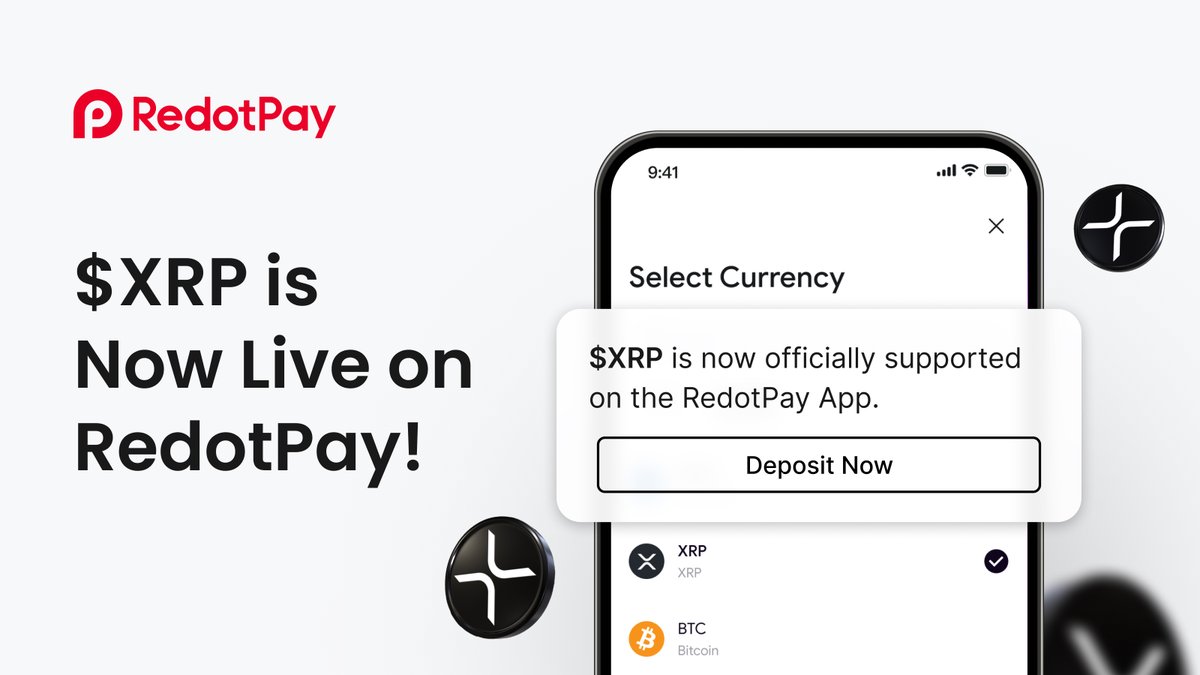
XRP is Now Available on RedotPay!
Great news! We’re excited to share that XRP is now officially supported on the RedotPay App.
Users can now deposit and spend XRP through RedotPay, unlocking greater flexibility and convenience when interacting with digital assets globally.
🗓️ Launch Schedule (UTC+8):
✅ Deposit: Jul 31, 4:00 PM
✅ Spend: Jul 31, 4:00 PM
⏳ Withdraw: Available from Aug 7, 4:00 PM
Try it on RedotPay today!
Tired: Paying high transaction fees for international payments.
Wired: Reducing costs up to 90% by offering pay with crypto for payments.
✅ Reduce international transaction fees by up to 90%
✅ Offer 100+ cryptocurrencies and eligible wallets at checkout
✅ Get immediate access to funds
We’re making all of this, and more, easily accessible and available through Pay with Crypto, a new payment method that allows merchants to reach more than 650 million crypto users and allow them to pay using any of hundreds of eligible wallets and cryptocurrencies: https://t.co/vmQChL3PfN
🚨NEW: The “big three” banking regulators — @USOCC, @federalreserve & @FDICgov — just issued joint guidance on how banks should approach custodying crypto assets. 🏦
The guidance doesn’t create new rules, but reaffirms that banks must apply existing risk management, legal, and compliance frameworks when holding crypto on behalf of customers.
TLDR:
1. Banks can hold crypto for customers in fiduciary or non-fiduciary roles, but must follow existing laws & risk-management principles.
2. Key risks for banks to consider:
•Cybersecurity
•Cryptographic key control
•Volatile markets
•AML/CFT/OFAC compliance
•Third-party oversight
3. If a bank holds the keys, it holds the liability. Full control = full responsibility.
An interesting nugget in this section: The guidance says that banks must ensure that only they — not even the customer — can access the keys, which they call the standard for true control.
4. Third-party custody vendors are allowed, but banks remain on the hook for their actions and must do due diligence on them.
Bottom line: The banking regulators will allow institutions to custody crypto, but it will be a highly scrutinized, high-liability practice.