Porfesor CE Asia y África, Colmex, Medio Oriente - editor: Siria en el torbellino: insurrección, guerras y geopolítica - RT/follow ≠ apoyo/endorsement.
🇵🇸 The anonymous collective Israel Exposed has launched a searchable online archive of Gaza genocide documentation. They said it contains over 64,500 videos, 17,900 photos, geolocation data, a live map, a victim database, and a source index spanning more than 300 journalists. The group says more material will be added over time. Link to access is below ⬇️
Esta carta de intención lleva al desmantelamiento del cerco militar que EU tiene alrededor de Irán, detalló @GilbertoConde.
“Por un lado, promete el fin del régimen de sanciones, la liberación de 100 mil millones de dólares de fondos iraníes que Estados Unidos tenía congelados.”
Key points to keep in mind:
1) Iran can't unilaterally open the SoH: only the maritime insurance industry can. And it won't as long as a nuclear deal remains unnegotiated, as the threat of renewed military strikes remain.
2) In other words, best case it will still take months for the SoH to get back to pre-February 28 levels.
3) The US negotiating position has to shift from all stick to some stick/some carrot, because we've tried the stick alone and it wasn't enough to coerce strategic capitulation. And that carrot for Iran is $$$, either from unblocked assets or an easing of sanctions.
4) An Iranian commitment to 'never have a nuclear weapon' is about as dependable as a USG commitment not to attack Iran again. Any worthwhile nuclear deal needs IAEA w/Additional Protocol as a starting point.
5) Israel isn't going to stop in Southern Lebanon.
6) Iran is not going to let the US participate in digging out the HEU.
According to my sources, the draft proposal that’s supposed to be finalised include:
-End of war on all fronts including Lebanon
-Freeing several billion dollars of Iran's blocked funds
-Lifting the U.S. naval blockade and opening the strait of Hormuz
-Withdrawal of American forces from the immediate vicinity of Iran
After this, the parties will have 30 days to agree on the nuclear issue.
These 30 days can be extended by mutual agreement.
During these thirty days, passage will be facilitated through the strait.
According to Iran, management of the Strait of Hormuz will be an Iranian-Omani issue, and is being negotiated with Muscat.
This is an extraordinary document written by the research arm of China's spy agency (the powerful MSS, basically the CIA and the FBI all wrapped in one) that absolutely zero media has picked up on.
As far as I can see, I'm the first person to write about it even though it was published (in Chinese) on May 13th on https://t.co/6uFjJ6ObmL, a website of China's Ministry of Foreign Affairs.
The document contains perhaps the most authoritative description of where China thinks its relationship with the U.S. stands, and where it’s headed.
The title of the report is “The Great Global Transformation and the Path to U.S.–China Coexistence” and I provide a full translation of it in my article, the link of which is at the bottom of this post.
To summarize briefly the most important - and, perhaps, surprising - aspect of the document: China's spy agency - the one institution whose entire job is to worry about the U.S. threat - has largely stopped worrying.
That's really what transpires from the document. They use a strategic framework borrowed from Mao's "protracted war" theory and, according to this framework, America's offensive phase is finished and China weathered the storm intact.
The question is no longer "how do we survive America?" but "how do we manage America?" - and they're proposing a six-step relationship recovery program.
I'll let you read the full document as well as my analysis of it here: https://t.co/vDvWFZJlrQ
The International Criminal Court has issued 5 secret arrest warrants for three Israeli politicians and two military officials, according to @lizarozovsky@haaretzcom
This (https://t.co/vsbyqxllFG) is, by any measure, an extraordinary article: Prince Turki Al-Faisal is a son of King Faisal and ran Saudi intelligence (the GID) for over two decades.
He is writing that the plan of "the US-Israeli war on Iran" was "to ignite war between us [Saudi Arabia] and Iran," so that Israel could "impose its will on the region and remained the only actor in our surroundings."
This further confirms that, contrary to what many have asserted, the notion that the Saudis were quietly backing the war on Iran was a myth (alongside the recent fact the Saudis denied the U.S. access to its bases and airspace: https://t.co/Q5xiUT7rCA).
From the horse's mouth they're literally saying it was as much a war on them as it was on Iran!
Pretty crazy when you think about it: this is Saudi Arabia saying that their real enemy in this war was the U.S. and Israel. Hard to overstate how significant a rupture this represents.
Now of course they could be saying so because, seeing how the war turned out, they're trying to retroactively position themselves on the winning side (at least strategically, by saying they didn't take the bait), or trying to justify domestically why they absorbed hits from Iran without retaliating.
And, of course, it's not like they're presenting Iran as some sort of ally here: Prince Turki explicitly calls them a "neighbor" that caused "pains."
But still, the end result remains: the Saudi establishment is now committing, on the record and in plain language, to a framing in which, while Iran is a "painful neighbor", the U.S. and Israel represent the deeper strategic threat, having tried to engineer their destruction.
If you had any lingering doubt that this war accelerated the collapse of U.S. influence in the region, this should settle it.
Iran’s Response to the U.S. Proposal: Deal or Renewed Conflict?
🔹According to multiple reports – including WSJ, Al-Mayadeen, and Tasnim – Tehran’s response to the U.S. proposal includes immediate end to the war; guarantees against renewed attacks; sanctions relief; lifting OFAC restrictions on oil exports; release of frozen assets; end of maritime pressure/blockade on Iran.
🔹Iran also reportedly links any agreement to de-escalation on other regional fronts, especially Lebanon. That suggests Tehran is treating the conflict as part of a broader regional security arrangement, and not just a bilateral issue.
🔹On Hormuz, Tehran has reportedly proposed phased reopening/stabilization of the strait in exchange for U.S. steps on sanctions, removing shipping restrictions, and de-escalation. In other words, Hormuz is treated as part of an eventual deal, and not a concession to make upfront.
🔹But the biggest challenge appears to be the nuclear file. Iran has reportedly rejected dismantling its nuclear infrastructure – as expected. Instead, it is willing to discuss limits, sequencing, monitoring, and addressing the concerns of its highly enriched uranium
🔹Reports also suggest Iran wants nuclear negotiations to continue during a 30-day follow-on phase AFTER an initial ceasefire/political understanding. That sequencing is probably one reason Trump reacted so negatively.
🔹From Tehran’s perspective, making irreversible concessions first would repeat the vulnerabilities exposed after the collapse of the JCPOA. That is why guarantees also reportedly became a major part of the Iranian response.
🔹Trump has called Iran’s response “inappropriate” and “unacceptable.” That sounds less like tactical dissatisfaction and more like rejection of the overall framework Tehran proposed.
🔹The timing also matters. Trump spoke with Netanyahu after receiving the Iranian response. The call highlights how closely the diplomatic and military tracks remain intertwined with Israeli calculations.
🔹At the same time, both Trump and Netanyahu made comments today that may indicate preparation for renewed escalation.
🔹Trump said the war is not necessarily over, only around “70%” of objectives were achieved, and indicating that more military moves may still be needed.
🔹Netanyahu also suggested that the job is not done because Iran still has its nuclear program, still supports proxies, and still has ballistic missiles.
🔹That framing is important because those objectives go well beyond what Iran appears willing to negotiate away.
🔹Tehran’s apparent position is to preserve strategic infrastructure while negotiating de-escalation. But Israeli strategic objectives increasingly appear aimed at long-term rollback of Iran’s capabilities.
🔹That mismatch is becoming more dangerous. The atmosphere now increasingly resembles coercive diplomacy backed by preparation for renewed conflict. Both sides still seem to believe additional pressure could improve their position.
🔹Iranian military signaling today may reflect the same assessment. Warnings from IRGC naval and aerospace commanders, issued around the time Tehran submitted its response, may have been intended as deterrent messaging ahead of a possible new escalation cycle.
🔹Overall, the trajectory is clearly becoming more unstable because the two sides appear to be negotiating toward fundamentally different end states.
Very good insight, and I would add,
Netanyahu’s strategy may have been intentional in this erosion of ambiguity, to trigger a nuclear race and forever war https://t.co/g9J5nE1hLJ
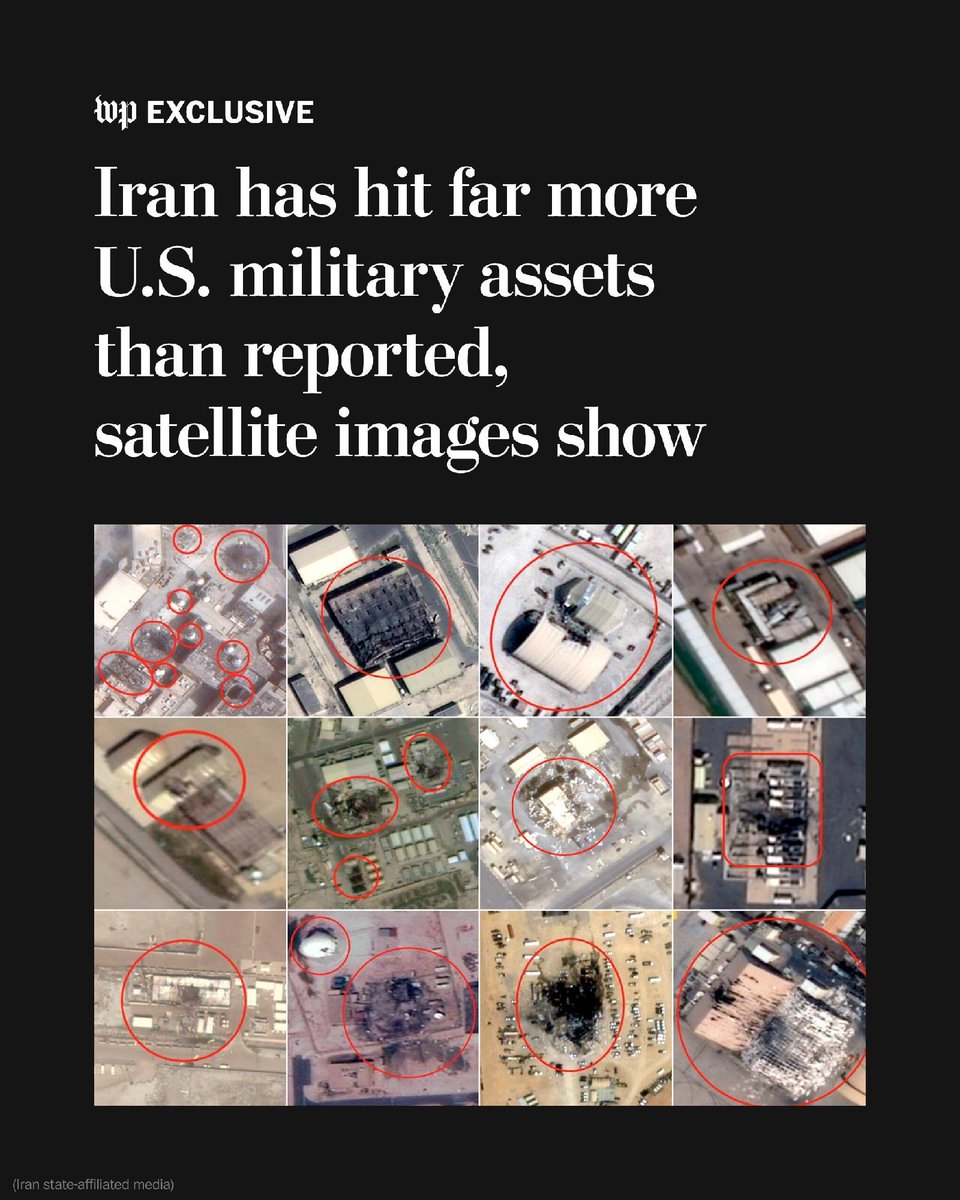
Exclusive: Iranian strikes have hit at least 228 structures or pieces of equipment at U.S. military sites since the war began, a Post analysis of satellite imagery reveals.
The destruction is far greater than what was previously reported or acknowledged by the U.S. government. https://t.co/WFVA8owMVT
Gulf governments are now “rejecting an assumption, held by the United States and Israel, that Gulf states could be incorporated into a regional security architecture premised on Israeli dominance,” writes @hahellyer.
https://t.co/PHkVKIcHx0
On the geostrategic position of Cuba and Mexico:
Cuba is also about the control of the Gulf of Mexico, the Caribbean, and Panama-related sea lanes. A regime changed Cuba would mean that the Gulf-Caribbean would become a completely U.S.-managed inner sea with all that this implies.
Cuba is the key to the Gulf of Mexico.
On another note, it also would weaken Mexico. If Cuba survives as it does now, this means that Mexico's eastern and southeastern "flank" is not inside a U.S.-controlled maritime perimeter. But with regime-change....
This is important and connects back to the China-argument, too. Mexico has several ports that a CSIS study has alsready classified has high-risk ports, that could be "dual-use" infrastructure used by China (which cannot be, the U.S., of course, wants to "deny" those ports.)
The Gulf of Mexico and the Caribbean are seen as a kind of U.S. American Mediterranean by the US, or at least they wished it was that. It's part of their naval strategy.
Mexico has a long Gulf and Caribbean-facing flank with offshore energy infrastructure, ports, and links to Central America. All of that would be in danger without a sovereign Cuba.
For Mexico this means, only with Cuba resisting, can it carve itself out some room to manuever diplomatically and regionally (which is actually also important for Latin America).
Of course, Cuba is also a regional symbol...
Saudi Arabia has come to view Israel and its actions as a threat to regional security and sees the UAE’s alignment with Israel in a poor light.
Read @NeilQuilliam1's latest analysis for Chatham House⤵️
https://t.co/1BbrnzUO7v
EXCLUSIVE: Trump's abrupt U-turn on a plan to reopen the Strait of Hormuz came after Saudi Arabia suspended U.S. access to its bases and airspace. https://t.co/ugxw2ilzpD
Mr. Trump, para "no violar" la ley de EEUU (requiere autorización del Congreso para una operación armada tras 60 días de iniciada), acaba de rebautizar la guerra contra Irán. O sea, ¿ya no requerirá fin al programa nuclear iraní? ¿O es sólo una cruel payasada más?
At this point, it is irrefutable that the blockade has failed. Not from failed enforcement (although that certainly has happened), but due to it being built on a fundamentally flawed premise.
This is something that can clearly be drawn from Trump’s own “3 days until Iran’s oil infrastructure explodes”. CLEARLY, he was operating on a very specific piece of data that indicated this would take place.
It did not.
Eight days later, a full 21 days into the U.S. blockade, Trump is now stating it will be “two weeks”…
35 days in total.
Here’s the problem: He’s wrong.
Data published by Bloomberg via Kpler indicates that Iran had 12-22 days of onshore storage available, that was 8 days ago. 4-14 days. Other experts are putting that number ~13 days.
So 13 days of onshore oil still remains, but there are other factors we need to consider.
Within the perimeter of the U.S. blockade line, Iran has enough vessels to hold ~35M barrels. This will extend the timeline by approximately 28-42 days.
Then, Iran is unmothballing old tankers, old storage, trucking into neighboring countries, utilizing rail. None of these things taken along are substantial, but each of them add to the timeline. Plus 7 days.
But Iran can also manipulate output from their oil wells. They don’t need to be ripping at 100% day after day. The output can be lowered. And this is where it becomes catastrophic. When we factor this in, we go from an aforementioned timeline ~69-83 days, to something that could run well into the triple digits.
How the Secretary of Treasury, who is spearheading “Operation Economic Fury”, and the PRESIDENT of the United States is unable to put this together, or even come to the same conclusion between one another, is beyond me.
What I DO know, is that this blockade has horrendously failed, and for the sake of the global economy, I sure as hell hope Washington still has the cards they say they do.
MUST WATCH: Majority of US military sites in Middle East damaged by Iran, CNN investigation reveals. Many of them are "virtually unusuable."
Day by day, we will find out more and more about what actually happened in this war...
https://t.co/BdCLtuzgAZ