The real issue with Ha-Joon Chang’s FT op-ed last week isn’t his economics—it’s the cartoonish caricature of Catholic theology in the Middle Ages, straight out of an outdated high school textbook or a bad History Channel doc.
The 12th and 13th centuries were among the most creative and intellectually rich in Western thought, including philosophy and theology.
Just to name a few great Catholic theologians of the time: Anselm of Canterbury, Bernard of Clairvaux, Hildegard of Bingen, Albertus Magnus, Anthony of Padua, Bonaventure, Thomas Aquinas, William of Ockham, and Duns Scotus.
These thinkers have shaped the Western perspective on reason, language, metaphysics, epistemology, ethics, the mind, mysticism, and politics to this day.
Reading Aquinas—by far the deepest and most influential of them all—is breathtaking. His Latin wasn’t elegant, but his mind was. If he were alive today, he’d publish two Econometricas a year.
And yes, his theology triumphed because it was better argued, despite strong resistance from entrenched interests at the University of Paris.
Dismissing all this as “backward” is just absolute ignorance, pure and simple.
A gentle but very well-written introduction to all this is The Bright Ages: A New History of Medieval Europe by Matthew Gabriele and David M. Perry.
Read also, for a fantastic, easy narrative, Medieval Philosophy: A History of Philosophy without Any Gaps, Volume 4, by Peter Adamson.
La riforma dei #taxi è necessaria perché in tutta Italia, paese da 60 milioni di abitanti, il numero di licenze è simile a quello di una parte della regione di Parigi.
Solo che in quella parte di regione di Parigi da 8,2 milioni di abitanti, ci sono anche 40 mila NCC!
La situazione italiana è inaccettabile come dico a #muschioselvaggio con @matteohallissey
@trad_west_ You are writing about Saint Anthony the Abbot on the day the Church celebrates Saint Anthony of Padua. That may be confusing for your readers.
🚨Hiring news! 🚨 I’m looking to hire five really important new roles in UKRI.
Each will lead a major new innovation programme to tackle one of five major national challenges.
The U.S. is building a MASSIVE embassy in tiny Lebanon—the second largest embassy in the world.
Why?
To run secret prisons, spy on Lebanon and the region, and use it as a hub for flights to Cyprus.
This is not an embassy.
It’s a fortified CIA base.
Nauseating news this morning.
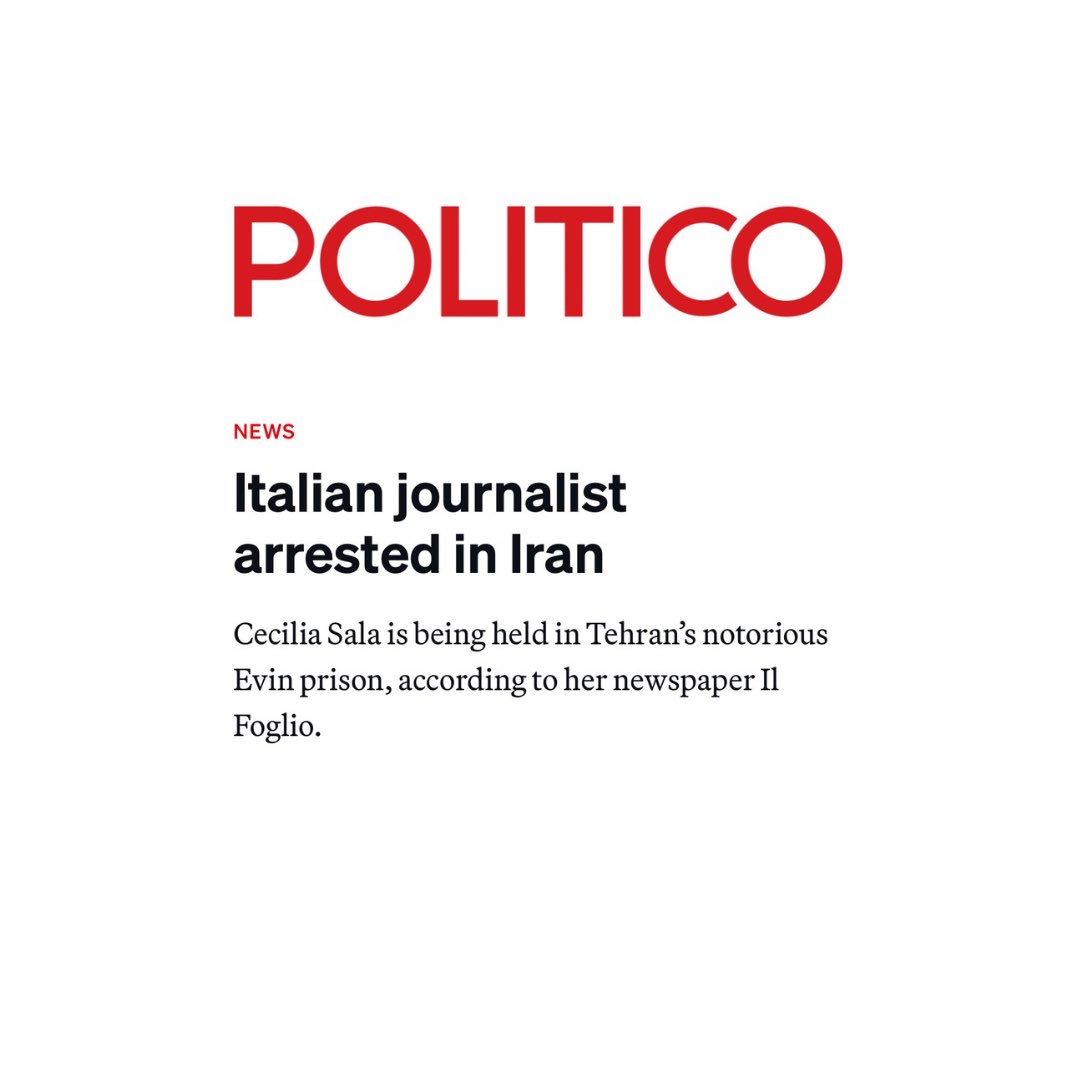
Italian journalist @CeciliaSala has been kidnapped and thrown in Iran's Evin prison, notorious for human rights abuse.
I spoke with her just a few weeks ago when she was covering the US election — a truly kind and gracious person.
FREE CECILIA!
Since Trump is raising the possibility of a "G2" where, in his words, China and the U.S. could "together solve all the problems in the world", it's worth noting that this isn't the first time an American leader has proposed such an arrangement - and that China has consistently said no to U.S. proposals to jointly rule the world.
It's an idea that's actually been around for 16 years, first proposed by economist Fred Bergsten (at the time the founding director of the Peterson Institute for International Economics) in an article entitled "A Partnership of Equals" (https://t.co/8ceTrrQVdR) in which he argued that the US should develop a true partnership with Beijing to provide joint leadership of the global economic system. A "G2" approach, Bergsten argued, was the only way to properly acknowledge China's new role as a global economic superpower.
The idea gained significant traction within the Obama administration. Hillary Clinton - Secretary of State at the time - spoke of the US and China being "in the same boat" during her visits to Beijing. Former National Security Advisor Zbigniew Brzezinski, who served as an advisor to Obama during his campaign, actively promoted the concept, and even Henry Kissinger joined in, suggesting the US and China should build a "community of destiny" similar to post-WWII transatlantic relations.
However, China consistently and firmly rejected these proposals for joint global leadership. The pushback became so necessary that Premier Wen Jiabao had to address it explicitly during a May 2009 EU-China summit in Prague, calling the G2 concept "baseless and wrong" because "China will never seek hegemony" and "one or two countries, or a group of major powers cannot solve global problems." (https://t.co/5BTGxXc01L)
He also directly told Obama in November 2009 that China wouldn't go for a G2, explaining to him that "the main reasons [China] doesn't agree with the concept of a 'G2' are": "First, China is a developing country with a large population, and we remain clear-headed about the long road ahead to build a modernized nation; Second, China pursues an independent and autonomous peaceful foreign policy and does not ally with any country or group of countries; Third, China maintains that world affairs should be decided jointly by all countries, not dictated by one or two countries." (https://t.co/PXCQtEkPrR)
This rejection stems from China's fundamentally different vision of international relations. Since the 1950s, China has promoted an alternative to great power politics through its "Five Principles of Peaceful Coexistence": mutual respect for sovereignty and territorial integrity, mutual non-aggression, non-interference in internal affairs, equality and mutual benefit, and peaceful coexistence. These principles, born from China's own experience with imperialism, envision a world where all nations - regardless of size or power - interact as equals. From this perspective, a G2 arrangement wouldn't just be strategically unwise - it would contradict China's core vision of how international relations should work.
Even Deng Xiaoping, when addressing the UN, explicitly warned against China ever becoming the kind of superpower that would dominate others. He declared that "if one day China should change her color and turn into a superpower, she too should play the tyrant and everywhere subject others to her bullying, aggression and exploitation, the people of the world should identify her as social-imperialism, expose it, oppose it and work together with the Chinese people to overthrow it." (https://t.co/Hy4dI19Yco). He defined a "superpower" precisely as what China didn't want to be: "an imperialist country which everywhere subjects other countries to its aggression, interference, control, subversion or plunder and strives for world hegemony".
Plus, from a purely down-to-earth strategic perspective, it would make very little sense for China to establish a G2 with the U.S. as it would isolate China from other nations, particularly the developing world where China has cultivated relationships for decades. And I don't think any Chinese thinker truly believes the U.S. would ever offer a genuine "equal partnership" to China, especially looking at how the U.S. treats its other "equal partners" like Europe...
So what WOULD China want when it comes to its relations with the U.S.? In response to these recurring proposals, Xi Jinping developed his own framework for US-China relations when he became leader in 2012. He called it alternatively "major country relations" (大国关系) or a "new type of great power relations" (新型大国关系), built on three core principles:
1) No conflict and no confrontation (不冲突、不对抗)
2) Mutual respect (相互尊重)
3) Win-win cooperation (合作共赢)
In practice, this means China seeks:
- Recognition as an equal partner but NOT joint leadership of the global order
- Issue-specific cooperation rather than comprehensive alignment
- Clear respect for its "red lines" and core interests
- Cooperation primarily through multilateral institutions rather than bilateral arrangements
- The ability to maintain its policy independence and non-aligned status
- Economic engagement without political conditions
This vision has become increasingly specific over time. In his meeting last month with Biden in Lima, Xi was extremely direct, laying out "7 lessons of the past 4 years that need to be remembered" (https://t.co/S1iFIcvv94), among which:
- He said that "there must be correct strategic understanding. The 'Thucydides Trap' is not historical destiny, a 'new Cold War' cannot and should not be fought, containment of China is unwise, undesirable, and will not succeed."
- He called out U.S. duplicity, warning that "words must be trustworthy and actions must be fruitful. A person cannot stand without credibility. China always follows through on its words, but if the U.S. side always says one thing and does another, it is very detrimental to America's image and damages mutual trust."
- He reiterated that both countries need to "treat each other as equals. In exchanges between two major countries like China and the United States, neither side can reshape the other according to their own wishes, nor can they suppress the other based on so-called 'position of strength,' let alone deprive the other of legitimate development rights to maintain their own leading position."
- He warned that "red lines and bottom lines cannot be challenged. As two major countries, China and the United States inevitably have some contradictions and differences, but they cannot harm each other's core interests, let alone engage in conflict and confrontation. The One China principle and the three China-US joint communiqués are the political foundation of bilateral relations and must be strictly observed. Taiwan issue, democracy and human rights, development path, and development rights are China's four red lines, which cannot be challenged. [Note: Bold text in the original] These are the most important guardrails and safety nets for China-US relations."
- He said that "there should be more dialogue and cooperation. Under current circumstances, the common interests between China and the United States have not decreased but increased."
- Specifically on global leadership he said that both countries need to "demonstrate great power responsibility. China and the United States should always consider the future and destiny of humanity, take responsibility for world peace, provide public goods for the world, and play a positive role in world unity, including engaging in positive interaction, avoiding mutual consumption, and not coercing other countries to take sides."
So, to conclude, while we don't know exactly what Trump meant when he said that China and the US could "together solve all the problems in the world", I think it would be mistaken to expect China to agree to a joint US-China global leadership. From Deng's explicit rejection of superpower politics to Wen Jiabao's firm "no" to Obama, to Xi's recent articulation of China's red lines - China has maintained a clear position: they seek a stable relationship of equals with clear boundaries, not a "let's rule the world together" type of arrangement which is antithetical to China's principles.