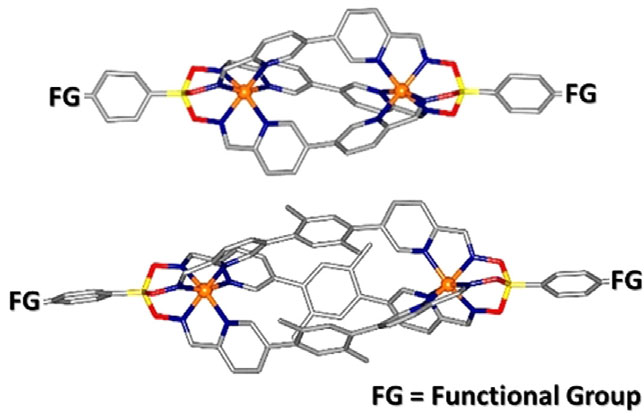
Merging dynamic covalent chemistry with supramolecular coordination chemistry. This @InorgChem Featured Article by @GiraldiErica, @kay_severin et al @EPFL_en describes boronate ester-based molecular cages stabilized by transition metal ions. Check it out: https://t.co/FYXwkQEO5l
@annajmcconnell @ismsc2020 @ChemEurJ Thank you @annajmcconnell. Both width and length could be tuned by ligand design (e.g. longer or bulky ligands). Of course, limitations may arise from solubility issues and synthetic complexity.
Check out my poster for @ISMSC2020 conference #ISMSCPoster#metallosupra6 on our work with Kay Severin: Boronate Ester-Capped Helicates.
Read more @ChemEurJ: https://t.co/ctSPOiZsNx.
Check out my poster for @ISMSC2020 conference #ISMSCPoster#metallosupra6 on our work with Kay Severin: Boronate Ester-Capped Helicates.
Read more @ChemEurJ: https://t.co/ctSPOiHRoX.
Building molecular nanostructures from synthetic helicates? The utilization of helicates with 'sticky ends' might be an option. Read the publication by @GiraldiErica, which was just published in @ChemEurJ : https://t.co/GQWQxgBJeq
While Italy is on quarantine, the Italian Air Force flies a single jet, representing the virus, to meet other jets that stream the colors of the Italian flag while Pavoratti's Nessun Dorma that has the lyrics "we shall overcome" plays.
Breathtaking. 🇮🇹❤️
What is the most basic site in triazenes? The answer to this old question is revealed below, and details are given in the study of @irisrlandman and @Abdusalom in @DaltonTrans : https://t.co/6Rbggifyk5
Iron cage complexes with pyridyl groups are highly versatile ligands in metallosupramolecular chemistry (see: https://t.co/yxI4Ccpq1t ), but incorporation in #MOFs turned out to be tricky. We now found a simple solution, which is described here: https://t.co/tonqghPIE1