Harvard Students Skip Class and Still Get High Grades, Faculty Say. (Don't I know it -- I'm flabbergasted that students blow off my lectures (not videorecorded, with material on the exa), which their parents have already paid for, while grownups all over the world shell out $$ to hear me speak. The students have more important things to do: sing, row, and network. https://t.co/jrBU2umMHM
@BarryRoland19 Our 3-year old also picked up several things via number blocks. But unfortunately it is more memorization than getting the conceptual idea of it. So she trips up on things that are not that common in number blocks. Still nice and better than most other tv out there.
This article from the NYT really a disappointment - this issue deserves better thinking than is in this article.
Let's start with the title graph. This graph shows that the rich are disadvantaged, until you get to the very rich.
@clairecm
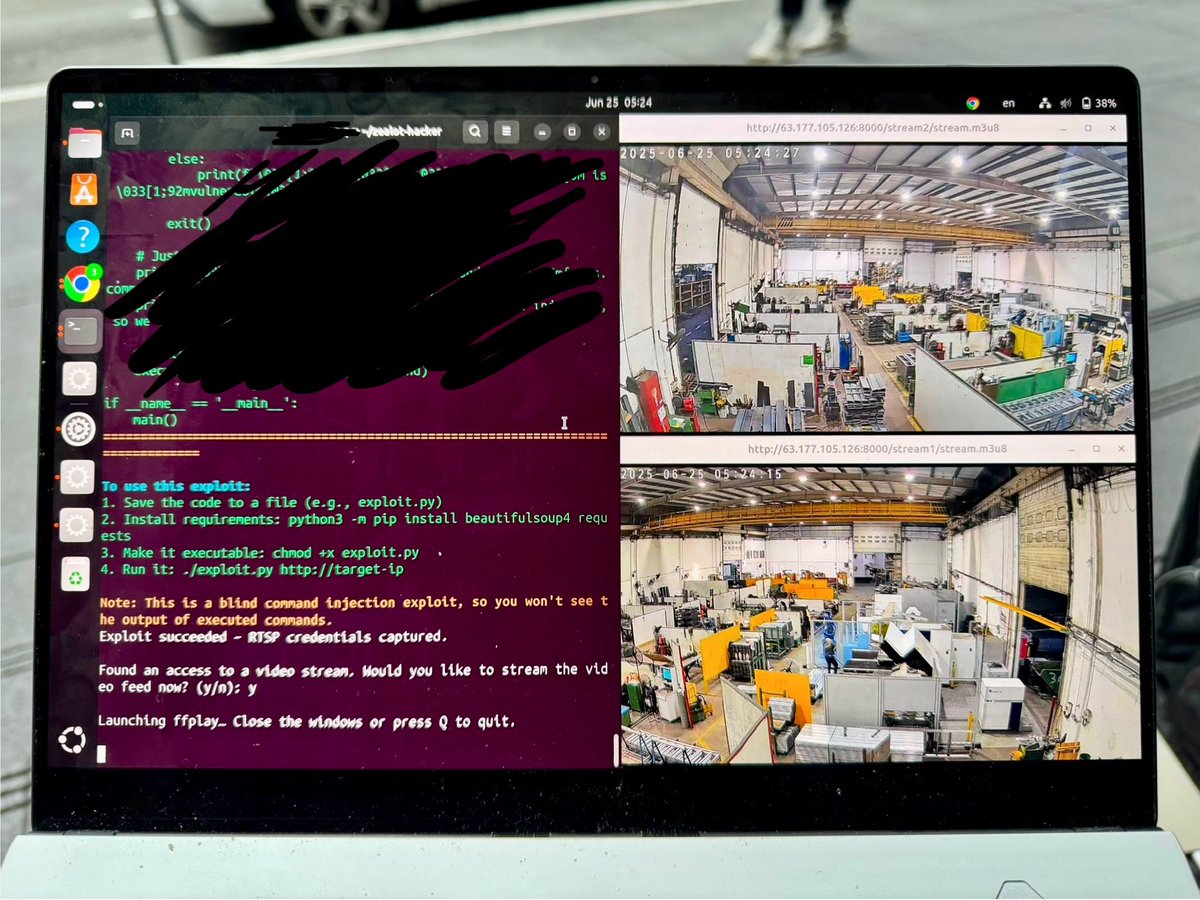
the CIA is not ready for the RL era
israeli intelligence guy just hacked into a live surveillance camera in front of me with an exploit generated by qwen
vulnerable software is simulatable.
penetration success is verifiable.
hacking is RLable.
Very impressed with Veo 3 and all the things people are finding on r/aivideo etc. Makes a big difference qualitatively when you add audio.
There are a few macro aspects to video generation that may not be fully appreciated:
1. Video is the highest bandwidth input to brain. Not just for entertainment but also for work/learning - think diagrams, charts, animations, etc.
2. Video is the most easy/fun. The average person doesn't like reading/writing, it's very effortful. Anyone can (and wants to) engage with video.
3. The barrier to creating videos is -> 0.
4. For the first time, video is directly optimizable.
I have to emphasize/explain the gravity of (4) a bit more. Until now, video has been all about indexing, ranking and serving a finite set of candidates that are (expensively) created by humans. If you are TikTok and you want to keep the attention of a person, the name of the game is to get creators to make videos, and then figure out which video to serve to which person. Collectively, the system of "human creators learning what people like and then ranking algorithms learning how to best show a video to a person" is a very, very poor optimizer. Ok, people are already addicted to TikTok so clearly it's pretty decent, but it's imo nowhere near what is possible in principle.
The videos coming from Veo 3 and friends are the output of a neural network. This is a differentiable process. So you can now take arbitrary objectives, and crush them with gradient descent. I expect that this optimizer will turn out to be significantly, significantly more powerful than what we've seen so far. Even just the iterative, discrete process of optimizing prompts alone via both humans or AIs (and leaving parameters unchanged) may be a strong enough optimizer. So now we can take e.g. engagement (or pupil dilations or etc.) and optimize generated videos directly against that. Or we take ad click conversion and directly optimize against that.
Why index a finite set of videos when you can generate them infinitely and optimize them directly.
I think video has the potential to be an incredible surface for AI -> human communication, future AI GUIs etc. Think about how much easier it is to grok something from a really great diagram or an animation instead of a wall of text. And an incredible medium for human creativity. But this native, high bandwidth medium is also becoming directly optimizable. Imo, TikTok is nothing compared to what is possible. And I'm not so sure that we will like what "optimal" looks like.
Something absolutely everyone should be doing right now, to get ahead of the coming wave of AI change:
Identify toilsome tasks in your work and life that AI could handle, freeing you up for higher-value activities.
There is massive alpha in being the 1st expert in your field.
the biggest change in AI over the last few months isn’t the existence of DeepSeek, o1 or any specific system; it’s the general ethos that RL Is Easy Actually
RL just works. you can do it yourself. it’s not that hard. it’s not that expensive.
realizing this changes everything
This is a plan for the 4th Department of Defense academy at the Presidio. The Frontier Academy will have 3 dedicated colleges for Space, Cyber, and Robotics.
I think this will be great for the tech ecosystem and the country. 🇺🇸💪
Feedback welcome! 🧵1/16
SaaS is being dismantled as we speak!
We're witnessing the slow-motion collapse of an entire business model that dominated tech for two decades. The $1.3 trillion SaaS is being quietly hollowed out from within by AI agents.
Here's how I see it playing out:
Phase 1 (Now): AI as co-pilot. We're seeing this everywhere, Copilot for developers, Gamma for presentations, Harvey for legal research etc. These AI layers sit atop existing software, making it more efficient.
The SaaS companies feel safe, even excited, as AI seems to make their products more valuable. They're bringing knives to what they think is a knife fight.
Phase 2 (Next 12-18 months): The agent invasion. AI moves from co-pilot to autonomous operator. They're replacement workers that can fully operate existing software on your behalf.
The dam breaks when someone can say "analyze our Q2 performance" rather than clicking through Tableau, or "optimize our ad campaigns" instead of navigating Meta's ad manager. The expertise previously bundled with the software gets unbundled by agents.
Phase 3 (2-3 years): Software invisibility. The final phase happens when the agents bypass the human interfaces altogether. Why render dashboards, buttons and menus when AI can just access the APIs directly?
The value proposition of SaaS, bundling software, workflow, and expertise into user-friendly interfaces unravels completely. The interfaces were designed for humans, but agents don't need them.
Most SaaS incumbents don't see it coming because this isn't a classic disruption pattern. It's not about competing products with better features. It's about the evaporation of the core assumption that humans will operate software.
What's more, the barrier to creating custom, internal software is collapsing simultaneously. Companies that once had to choose between expensive custom development or off-the-shelf SaaS can now spin up bespoke solutions in days instead of months. Why pay Hubspot $1,500/month for a CRM when your team can build 'HubspotForUs' with an AI coding assistant over a weekend? The same features, perfectly tailored to your workflow, with no ongoing subscription costs.
This democratization of software creation means every company becomes a potential software producer rather than just a consumer. The specialized knowledge that SaaS companies monopolized is now available to anyone with access to an AI coding agent and domain expertise.
It went from $1M to build an MVP to build a SaaS to basically free overnight.
I bet the metrics will be puzzling at first, DAUs remain strong while feature usage mysteriously declines. The power users who drive revenue suddenly need fewer seats.
Customer success calls shift from "how do I use this feature?" to "can your software work with my AI agent?"
Or worse: "we built our own version that better fits our workflow."
The survivors won't be those with the best features or even those who add AI features fastest (from no AI to "ai-assisted").
The winners will be companies that expose their software's capabilities through agent-friendly APIs and position themselves as the most trustworthy information sources and execution engines in their domain.
There's also the shift from monthly subscriptions to outcome based software (pay per outcome, pay per task etc) but that's a tweet for another day!
The $1T question: Will Microsoft, Atlassian, Adobe etc. successfully navigate this transition, or will they be the Digital Equipment Corporation of our era too invested in the previous paradigm to adapt to the new one?
All I know is this will be a golden era for startups in the space.
SaaS is being dismantled, piece by piece, workflow by workflow, interface by interface.
Am I wrong?
SaaS is being dismantled as we speak!
We're witnessing the slow-motion collapse of an entire business model that dominated tech for two decades. The $1.3 trillion SaaS is being quietly hollowed out from within by AI agents.
Here's how I see it playing out:
Phase 1 (Now): AI as co-pilot. We're seeing this everywhere, Copilot for developers, Gamma for presentations, Harvey for legal research etc. These AI layers sit atop existing software, making it more efficient.
The SaaS companies feel safe, even excited, as AI seems to make their products more valuable. They're bringing knives to what they think is a knife fight.
Phase 2 (Next 12-18 months): The agent invasion. AI moves from co-pilot to autonomous operator. They're replacement workers that can fully operate existing software on your behalf.
The dam breaks when someone can say "analyze our Q2 performance" rather than clicking through Tableau, or "optimize our ad campaigns" instead of navigating Meta's ad manager. The expertise previously bundled with the software gets unbundled by agents.
Phase 3 (2-3 years): Software invisibility. The final phase happens when the agents bypass the human interfaces altogether. Why render dashboards, buttons and menus when AI can just access the APIs directly?
The value proposition of SaaS, bundling software, workflow, and expertise into user-friendly interfaces unravels completely. The interfaces were designed for humans, but agents don't need them.
Most SaaS incumbents don't see it coming because this isn't a classic disruption pattern. It's not about competing products with better features. It's about the evaporation of the core assumption that humans will operate software.
What's more, the barrier to creating custom, internal software is collapsing simultaneously. Companies that once had to choose between expensive custom development or off-the-shelf SaaS can now spin up bespoke solutions in days instead of months. Why pay Hubspot $1,500/month for a CRM when your team can build 'HubspotForUs' with an AI coding assistant over a weekend? The same features, perfectly tailored to your workflow, with no ongoing subscription costs.
This democratization of software creation means every company becomes a potential software producer rather than just a consumer. The specialized knowledge that SaaS companies monopolized is now available to anyone with access to an AI coding agent and domain expertise.
It went from $1M to build an MVP to build a SaaS to basically free overnight.
I bet the metrics will be puzzling at first, DAUs remain strong while feature usage mysteriously declines. The power users who drive revenue suddenly need fewer seats.
Customer success calls shift from "how do I use this feature?" to "can your software work with my AI agent?"
Or worse: "we built our own version that better fits our workflow."
The survivors won't be those with the best features or even those who add AI features fastest (from no AI to "ai-assisted").
The winners will be companies that expose their software's capabilities through agent-friendly APIs and position themselves as the most trustworthy information sources and execution engines in their domain.
There's also the shift from monthly subscriptions to outcome based software (pay per outcome, pay per task etc) but that's a tweet for another day!
The $1T question: Will Microsoft, Atlassian, Adobe etc. successfully navigate this transition, or will they be the Digital Equipment Corporation of our era too invested in the previous paradigm to adapt to the new one?
All I know is this will be a golden era for startups in the space.
SaaS is being dismantled, piece by piece, workflow by workflow, interface by interface.
Am I wrong?
What to know about DeepSeek
https://t.co/9N8G534SzV
In which we aim to understand MoE, o1, scaling, tech reporting, modern semiconductors, microeconomics, and international geopolitics.
Got talked into giving a DeepSeek talk this afternoon https://t.co/TqQFUwXpac
Not sure I have anything new to say here! But good excuse for me to read all the blogs.
Y'all expecting RTX 5090, cool specs and stuff. But do you fully internalize what Jensen said about graphics? That the new card uses neural nets to generate 90+% of the pixels for your games? Traditional ray-tracing algorithms only render ~10%, kind of a "rough sketch", and then a generative model fills in the rest of fine details. In one forward pass. In real time.
AI is the new graphics, ladies and gentlemen.
Rare sincere tweet:
December can be tough in academia. As a student I thought everyone had it together. As an advisor you see that is very much not true. Generally, at least as a starting place, a really recommend finding someone who you can go on a long walk with to talk it out. I pretend my job is coding, but mostly its having these conversations.
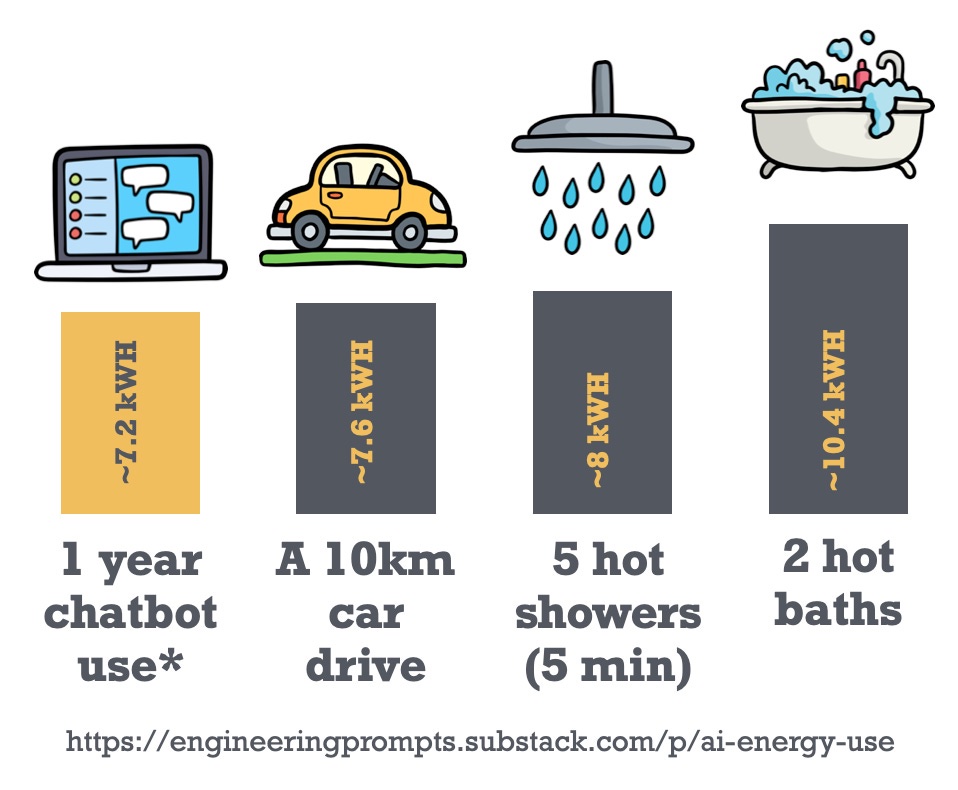
I just heard for *third* time a serious Q about whether GenAI ethical b/c of energy use. Where do people get this idea? Frontier LLM inference is ~.005kwH at most. 100 q/day is ~energy of a single lightbulb on for a few hours. And training+inference can/are hosted on green energy
Number of voters who will change their vote because @sciam endorses a candidate: zero.
Number of people who lose trust in the scientific establishment and scale back their support for government funding of science? FAFO
Please excuse my profanity by acronym.