The OTC premium is probably the strongest signal here. People are paying a lot for early access, which means expectations around Arc are already very high.
People are using OTC services to get Arc USDC before public access
The flow is simple: you send USDC on Ethereum, and receive USDC that is already on Arc
Now it costs ~20%+ extra, plus around a 3% fee.
So people are paying more to get capital onto Arc early and start trading
The real differentiation may come from market structure, not just volume.
As prediction markets specialize by category, liquidity design and execution quality will become increasingly important competitive advantages.
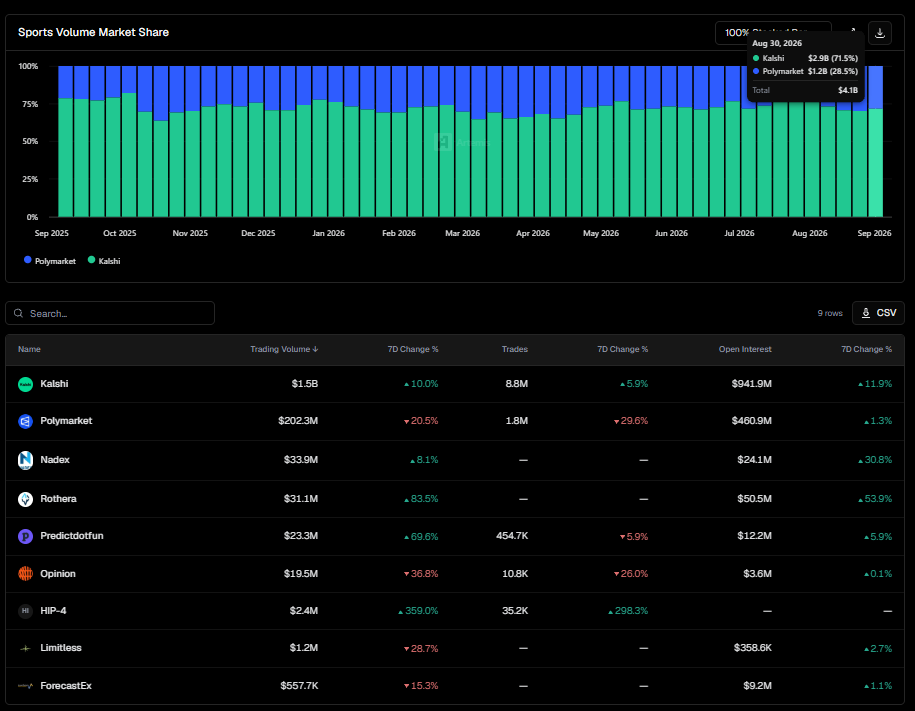
Sports is where the difference is easiest to see.
Sports volume market share on Aug 30
@Kalshi : $2.9B, 71.5%
@Polymarket : $1.2B, 28.5%
Total : $4.1B
This is the main reason Kalshi looks much larger by current trading volume.
The platform is taking a bigger share in the category where users trade more frequently and where volumes can scale quickly around events.
Late night cooperative multiplayer gaming sessions with long time friends offer the most enjoyable social relaxation imaginable. Great teamwork makes winning match rounds feel amazing. #CoOp#Gaming#Multiplayer#PCGaming#Gamers
Layer 2 network throughput metrics reflect steady dApp user engagement across top chains despite recent price fluctuations in underlying gas tokens across the ecosystem. #Ethereum#Layer2#Web3#Crypto#Blockchain
Major altcoins show brief relief rallies with BNB and XRP gaining up to 5 percent despite ongoing macroeconomic headwinds and temporary volatility across traditional equity index futures contracts. #Altcoins#Crypto#XRP#BNB#Markets
The pasta at this new Italian place completely won me over. A rare case when reality fully exceeded all expectations from social media. Will definitely come back here again.
Real-world asset integration requires zero performance assumptions. Complete visibility and rigid KYC setups are turning into necessary institutional features. #RWA
Classic tech playbook: network effects vs. margins. While Polymarket captures massive mindshare, @Kalshi uses its regulated status and strict compliance moat to scale profitably. In prediction infrastructure, regulatory resilience is the ultimate long-term moat.
Event-driven model shows extreme dependency: 🧮
@Kalshi growth pattern:
▫️ Total volume: $16B (since Jun 2021)
▫️ Daily avg volume: $10.09M
▫️ 16B+ total trades
▫️ Open interest: peaked at $600M+ (election), now $296M
@Polymarket pattern - same story:
▫️ TVL: peaked $600M (US election) → crashed to $240M (-60%)
▫️ Volume: massive spikes around binary events, flatlines between
▫️ 69,436 markets exist, activity in <1%
Both platforms live on major events. Difference: Kalshi monetizes every spike. @PolymarketIntel builds network effects on zero revenue.
📍Key question: how long can @PolymarketSport sustain "capture users first, monetize later" when Kalshi is already profitable and can scale aggressively?
Right now this is classic tech bet: network effects > margins. But in regulated prediction markets, compliance moat might prove stronger than network effects.
Premium headphones with active noise cancellation are the ultimate tool for protecting personal boundaries today. They serve as your personal portal into deep work mode, whether you are in a noisy airport, a coworking space, or an office.
The convergence of commodity trade finance and public network settlement is accelerating. Global supply operations are launching specialized cryptographic credit lines to settle cross-border logistics on @solana.
As a protocol architect I can confirm this monopoly is driven by smart contract security. Writing basic code is easy but building battle tested risk architecture to secure billions is incredibly hard. Secure code is the ultimate institutional asset.
The Risk Curators Protocols sector is currently a prime example of how the economy of trust works in decentralized finance.
While retail investors continue to chase random yields institutional players prefer to allocate their billions to just a handful of professional risk management teams.
This direction has rapidly evolved into a classic winner take all market. The true scale of this hidden industry is revealed by the massive concentration of capital among the top three leaders who effectively control the lion share of all on chain debt liquidity.
Such a staggering gap between the top giants and the rest of the market proves one simple point. In institutional DeFi an unblemished reputation and automated risk management frameworks have become the most scarce and valuable commodities.
One look at this current leaderboard is enough to understand the actual power hierarchy and see who truly dictates the rules in the premier league of capital management.
Healthy boundaries begin with the realization that you are not required to live up to other people's expectations. Trying to please everyone inevitably dilutes your focus and compromises your authenticity. Stay strictly loyal to your inner strategy.
Real economic traction is replacing artificial bootstrap mechanics. Maturing Web3 teams are refusing to fund predatory acquisition channels, pivoting to sustainable token architecture. Real institutional demand drives core utility on @arbitrum.
Celebrating the success of others without a hint of envy is the ultimate marker of an abundant, mature mindset. The market is not a zero-sum game; there is ample room for everyone creating real value. Synergy among top players always multiplies results.
Liquidity fragmentation remains a massive hurdle, but advanced clearing layers are abstracting the friction. The future belongs to modular networks that allow institutional capital to move frictionlessly between @solana and @ethereum.