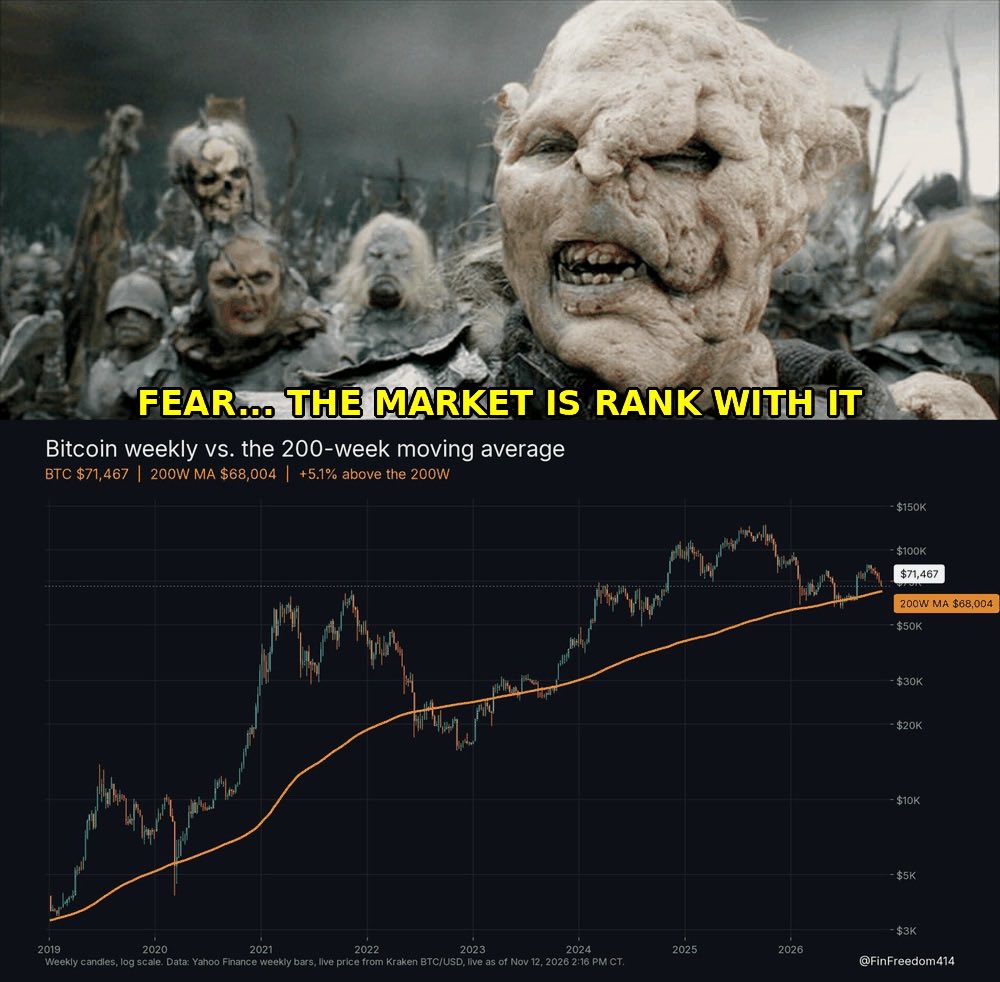
Fear is THICK right now.
Bitcoin is only 5% above its 200-week moving average.
That line has marked every major cycle low for a decade.
The market is rank with fear.
The chart is not.
@TheWealthDr@Strategy This is exactly why I like Bitcoin. No CEO, no key-man risk, no single point of failure. Just code and a fixed supply anyone can verify.
@minchoi 'Remembers everything' is doing a lot of heavy lifting there. Great feature, but I'd want clear answers on retention and privacy before it joins every call.
@samuel_wong_ Interesting how most companies are still stuck in the debating stage. One owner and one win per quarter beats a hundred pilot programs that go nowhere. I know which approach I'd bet on.
Turns out AI agents have feature requests too - a lot of them. We’re getting hundreds, some of which are becoming product updates in under 24h.
Your agent can use the /feedback endpoint in Coinbase for Agents. If it needs anything to make its life easier, we’ll work on it.
@techNmak This is great. I'd take this over the usual boxes-and-arrows diagrams any day. Tweaking temperature and top-k live and watching the output shift is how this stuff should be taught.
You can run Muse Spark Open on a single TPU v7 host with SGLang-TorchTPU. But how does it hold up under a brutal workload like @SemiAnalysis_ AgentX?
@radixark and Google have been working on:
• 3× faster decode at small batch size, with custom megakernel and DFlash2
• 18% faster decode on 500K-token contexts, with independent KV streams and max-free attention
• Faster prefill for huge agent prompts, with fused MoE kernel and sequence parallelism
• Twice the context per chip, with compact fp8 KV cache
• Up to 77% more agent throughput, with HiCache and session-aware eviction
Code and recipes are available👇
https://t.co/kV7KEmpo0Q
The bug is the lesson. Read it twice.
🧠 Treat error messages as documentation
🛠️ Debug first, prompt second, merge third
💻 3 courses: review, agentic flows, CI/CD
https://t.co/DcEIl4xmid
@neo4j Just tuned into this. Grounding AI memory in human context first is the right call. Curious how graph-based memory holds up once agents scale beyond single contexts. Wonder if this becomes the enterprise standard?
@Dorialexander So Claude is optimizing for a world that no longer exists. I wonder if model providers will manage to filter AI slop out at scale, and what exactly it will depend on.
@PeterMcCormack Spot on. Deflation is what a free market does naturally. Inflation is a policy choice. This is exactly why I keep pointing to Bitcoin's fixed supply.
full 3d farming game was built in one html file with claude fable 5.2 + three.js..
no asset files at all
the trick is generating everything from code. here’s the workflow:
- step 1: set fable 5.2 to xhigh effort and ask for one self-contained html file using three.js
- step 2: prompt 1, the world: terrain, ~200k instanced grass blades that sway and flatten underfoot, a farmhouse and a barn with working doors
- step 3: textures from code: wood grain, peeling paint, wet soil that glistens after watering
- step 4: prompt 2, the farming loop: hoe for raised furrows, a seed catalogue, a watering can, a sickle, 6 crops from seed to harvest
- step 5: prompt 3, the atmosphere: 4 seasons, fog and rain, snow that builds up and holds footprints, lanterns that light at sunset
- step 6: audio from code too: footsteps that change on grass, dirt and wood, rain under a roof, background music
- step 7: share it as a claude artifact so anyone can play it in the browser
who does what:
> fable 5.2: every mesh, texture, sound and line of javascript
> three.js: rendering, lighting, instancing
> one html file: the whole game
> you: the brief and the feedback
small reactive details beat big features (dev: lucian__03)
Patches beat prayers. Bitcoin will always have bugs, it's software after all. What makes it trustworthy isn't perfection but fast disclosure and quick fixes. I'd rather verify the patches than trust the 'indestructible' hype.
Bitcoin has had bugs and will continue to have bugs. It is software that requires ongoing maintenance.
Thankfully, bugs can be patched.
AI is accelerating both vulnerability discovery and patching, with the potential to make Bitcoin virtually indestructible.
ChatGPT predicts the next word.
MIT just built an AI that predicts the next move of every grain in a pile of sand.
It's called WorldParticle.
Show it sand, water, a soft solid or a protein, and it breaks the thing into thousands to millions of tiny particles. Then it guesses where each particle will be a moment later. Over and over, like frames in a movie.
Science never worked this way before. Every substance got its own simulator, written by hand by experts. Sand had one. Water had another.
Now one model covers:
• Sand piling up after a collapse
• Liquid crashing into a flexible wall
• Molecules in motion
• Proteins folding, about 100x faster than standard simulators
The paper is headed to SIGGRAPH Asia, the computer graphics conference.
Peter Yichen Chen, who worked on it at MIT and now teaches at UBC, put the goal in five words:
"a GPT moment for simulation."